Technical Assessment Tools
Explore a variety of blog posts on our site.


Explore a variety of blog posts on our site.

18 Sep, 2026
4 Min Read
A recruiter opens a blank document every single time a new role needs a skills test, spending an hour writing questions from scratch before candidates can even start applying. Multiply that across dozens of open roles a year, and it becomes hours of repeated, avoidable work. Assessment question banks exist to remove exactly that bottleneck. […]

Two candidates apply for the same role. One breezes through a friendly, free-flowing interview and gets hired on gut feeling. The other completes a structured evaluation and a hands-on skills test.
Six months later, only one of them is actually thriving in the role. This is the real-world stakes behind the Structured Interviews vs Technical Assessments debate.
Both methods exist to answer the same basic question: will this person actually succeed in the job? But they go about it in very different ways, and recruiters often assume one is simply better than the other. The honest answer is more nuanced than that.
This blog breaks down the Structured Interviews vs Technical Assessments question in detail, covering what each method actually measures, what the research says about their accuracy, and when combining them beats picking just one.
Understanding this side of the Structured Interviews vs Technical Assessments comparison starts with what a structured interview actually looks like in practice.
A structured interview asks every candidate the same set of job-relevant questions, scored against a consistent rubric, instead of letting the conversation wander wherever the interviewer feels like taking it.
This is the other half of the Structured Interviews vs Technical Assessments equation, and it works very differently from a conversation-based evaluation.
A technical assessment gives candidates a real task, like writing code, solving a case study, or completing a role-specific exercise, and scores the actual output.
| Factor | Structured Interviews | Technical Assessments |
|---|---|---|
| What it measures | Judgment, communication, past behavior | Hands-on, job-specific ability |
| Scalability | Limited by interviewer time | Easy to run at high volume |
| Bias reduction | Strong, if scored consistently | Strong, especially with automated scoring |
| Candidate experience | Feels personal, but can feel inconsistent | Feels objective, if clearly job-relevant |
| Best used for | Roles needing judgment, communication, leadership | Roles needing demonstrable technical skill |
This comparison is really the core of the Structured Interviews vs Technical Assessments question. Each method is strong in areas the other one is weaker in, which is exactly why picking a permanent winner misses the point.
Multiple large-scale studies place both methods among the strongest predictors of on-the-job performance, far ahead of unstructured, free-flowing interviews. Some research even shows unstructured interviews carry less than half the predictive power of a properly run structured interview.
Technical, job-specific assessments tend to land in a similar range, sometimes edging slightly ahead depending on the study and the role being measured.
The real takeaway from the Structured Interviews vs Technical Assessments research is not that one method dominates, but that both dramatically outperform casual, unscored conversations.
A few data points help put the Structured Interviews vs Technical Assessments comparison in perspective.
The pattern across the research is clear. The real gap is not between structured interviews and technical assessments, it is between structured, evidence-based methods and casual, unscored ones.
Rather than treating Structured Interviews vs Technical Assessments as a competition, the strongest hiring processes rarely pick just one method. They layer both together, using each one where it naturally fits.
Platforms like HyreNet are built around exactly this layered approach, combining skills testing with structured evaluation tools so recruiters are not forced to choose one method over the other.
Recruiters navigating the Structured Interviews vs Technical Assessments decision tend to fall into a few predictable traps.
For more on how modern platforms are solving these exact hiring gaps, do check out HyreNet's breakdown of common recruitment challenges.
The Structured Interviews vs Technical Assessments debate does not really have a single winner, because both methods measure different, equally important things. Structured interviews reveal judgment and communication. Technical assessments reveal real, hands-on ability.
The strongest hiring processes stop treating this as an either-or choice and instead use both, each in the place it naturally fits. That combination is what consistently outperforms relying on just one method alone.

You hire someone who interviews beautifully. Three months in, they are struggling, the team is frustrated, and you are quietly wondering if you made the wrong call.
This is the exact problem quality of hire was built to catch, and skills assessments are one of the most reliable ways to fix it.
Quality of hire is a metric that tells you how well a new employee actually performs after joining, not just how they looked on paper or in the interview.
It pulls together things like job performance, retention, and manager satisfaction into one score you can track over time.
This blog explains what quality of hire actually means, how it is calculated and compares to other hiring metrics, the warning signs that it is slipping, and how adding skills assessments to your process can genuinely move that number in the right direction.
Quality of hire is not a single number pulled from one source. It is a composite score built from several post-hire indicators that, together, show whether a new employee is actually working out.
The most common formula looks like this:
| Indicator | What It Captures | Typical Weight |
|---|---|---|
| Job performance | Formal review score or manager rating | 30 to 40 percent |
| Retention | Still employed after 12 months | 20 percent |
| Time to productivity | Speed of reaching full output | 20 percent |
| Hiring manager satisfaction | Manager's rating of fit and contribution | 20 percent |
Each indicator gets scored on a consistent scale, usually 0 to 100, and the scores are averaged or weighted to produce one final quality of hire number.
Say a new hire scores 85 on their first performance review, stays with the company past 12 months, and their manager rates satisfaction at 90 out of 100.
If time to productivity also comes in strong at 88, averaging those four numbers gives a quality of hire score in the high 80s.
That single number does not tell the whole story on its own, but tracked across many hires, it starts to reveal real patterns.
You might notice that hires from a certain source, or hires who scored well on a specific pre-hire assessment, consistently land higher quality of hire scores than others.
It is easy to confuse quality of hire with other common recruiting numbers, but each one answers a different question.
| Metric | What It Measures | What It Misses |
|---|---|---|
| Quality of hire | How well a new employee performs after joining | Says nothing about hiring speed or cost |
| Time to hire | How many days it takes to fill a role | A fast hire can still be a poor fit |
| Cost per hire | How much money is spent to fill a role | A cheap hire can still underperform |
| Offer acceptance rate | How often candidates accept your offers | Tells you nothing about post-hire success |
None of these metrics replace quality of hire. A company can hire fast and cheap while still filling roles with people who do not work out, which is exactly why this metric deserves its own focus instead of being folded into the others.
Quality of hire sounds simple, but tracking it consistently is genuinely hard, and most companies still are not doing it well, even though HR leaders agree it matters.
The problem is not that companies do not care. It is that the data needed to calculate quality of hire, like performance reviews and manager feedback, is scattered across different systems and often collected inconsistently.
Without that data, the metric stays a good idea instead of a real practice.
This is exactly where skills assessments start to help, since they generate clean, structured data from the very first stage of hiring.
A few current data points help explain why this metric is getting more attention heading into 2026.
These numbers point to the same conclusion: quality of hire is becoming a bigger priority, but most companies still lack the structured process needed to actually improve it.
Adding an assessment alone does not automatically fix quality of hire. It needs to be part of a thoughtful process.
Platforms like HyreNet are built around this exact idea, combining skills testing, AI-powered proctoring, and detailed candidate reports so recruiters get consistent, comparable data from day one instead of piecing it together later.
Sometimes the metric itself lags behind reality. These early signals often show up before the numbers catch up.
Catching these signs early, before they show up in a formal quarterly report, gives you time to fix the process instead of just reacting to it.
For a closer look at how these mistakes play out in real hiring teams, do check out HyreNet's breakdown of common recruitment challenges and how modern platforms solve them.
Gathering consistent post-hire data is often the hardest part of this whole process, so a few small habits make a real difference.
Quality of hire is one of the few hiring metrics that actually tells you whether your process is working, not just whether it is fast or cheap. Skills assessments give you the real, structured data that metric depends on.
Start by picking one or two indicators you can track consistently, add a relevant skills assessment early in your process, and compare the results against actual performance over time.
That feedback loop is what slowly turns quality of hire from a buzzword into a genuinely useful number.

A strong resume does not always mean a strong candidate. Applicants can have similar qualifications on paper yet perform very differently once they start working. Recruiters therefore need a reliable way to identify candidates who genuinely match the role.
Candidate screening helps hiring teams narrow a large applicant pool into a smaller group of qualified candidates. The process can include resume screening, skills assessments, screening calls, and structured evaluation methods.
Effective screening also saves time later in the hiring process. Recruiters can focus interviews on candidates who have already demonstrated relevant skills or experience.
This guide explains how candidate screening works and explores the best methods for identifying top talent:
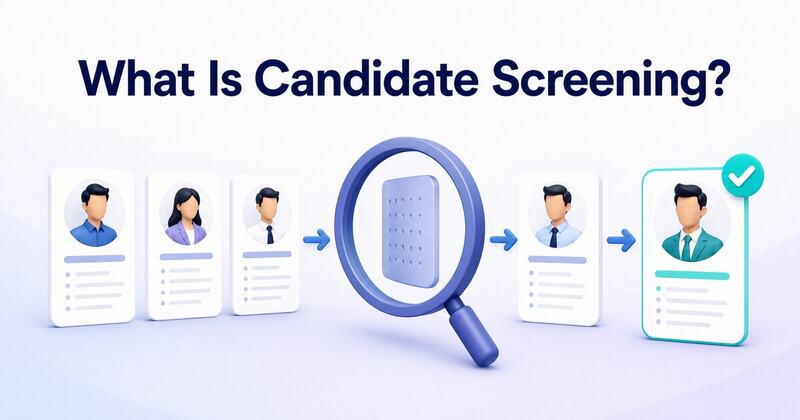
Candidate screening is the process of evaluating job applicants to determine who should move forward in the hiring process. It usually happens after applications are received and before detailed interviews begin.
Recruiters compare candidates against predefined job requirements. These requirements may include technical skills, relevant experience, qualifications or other role-specific competencies.
The goal is not simply to remove applicants. Effective screening identifies candidates who have meaningful evidence of their ability to perform the job.
A typical candidate screening process may involve:
Each stage should answer a specific question about the candidate’s suitability.
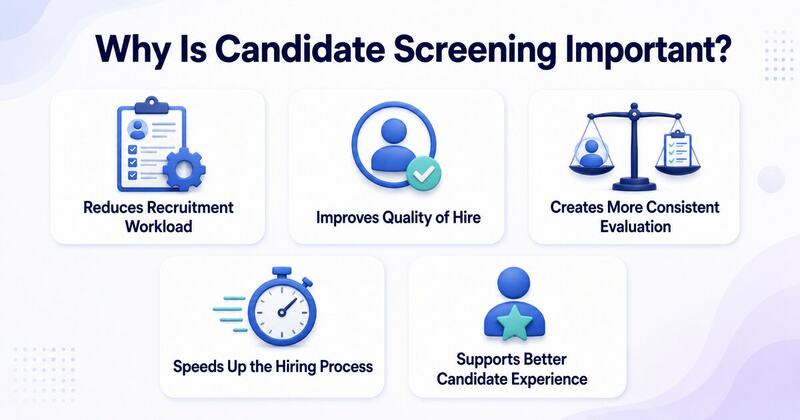
Screening helps recruiters identify unsuitable applications before investing time in detailed interviews.
This becomes particularly important during high-volume recruitment. Hiring teams can prioritize candidates who meet the essential requirements instead of reviewing every application with the same level of detail.
A candidate may have an impressive resume without possessing the practical skills required for the position.
Adding skills assessments, technical assessments and job-related screening methods gives recruiters more evidence before making interview decisions.
Unstructured screening can vary significantly between recruiters.
One recruiter may prioritize education while another focuses on previous employers. Clear screening criteria give hiring teams a common framework for evaluating candidates.
Poor screening can fill interview calendars with candidates who do not match the position.
Effective candidate screening narrows the applicant pool earlier. Recruiters can spend their interview time on candidates with stronger potential.
Long hiring processes can frustrate applicants.
Clear screening stages help candidates understand what comes next. Timely updates also prevent applicants from waiting unnecessarily for a decision.
Make candidate screening smarter and more accurate with HyreNet’s data-backed hiring platform. Screen applicants faster, identify top talent with structured assessments, reduce manual review, improve hiring efficiency, and build a reliable recruitment workflow that supports better hiring decisions.
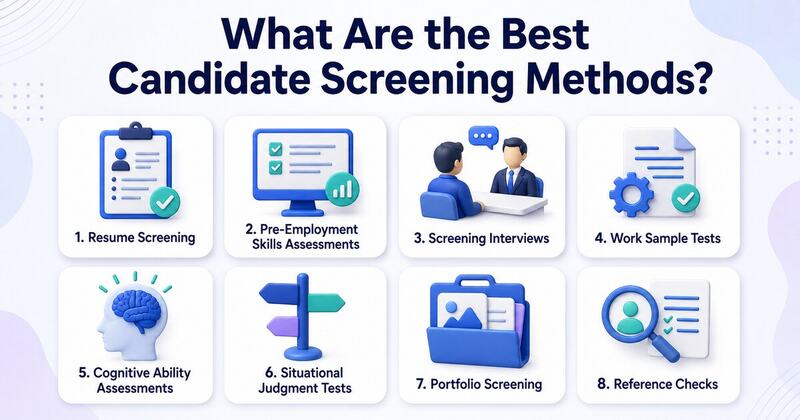
There is no single candidate assessment method that works for every job. The right approach depends on the skills and responsibilities associated with the position.
The following candidate assessment methods can provide recruiters with different types of evidence.
Resume screening is usually the first step.
Recruiters review applications for essential qualifications, relevant experience and job-related skills. Applicant tracking systems can also help organize resumes or filter applications using predefined requirements.
However, resumes should not become the only screening method.
A resume tells recruiters what candidates say they have done. It does not always demonstrate how well they can perform a task.
Recruiters should therefore use resume screening as an initial filter rather than a complete evaluation.
Skills assessments evaluate whether candidates can perform tasks related to the actual position.
A software developer might complete a coding assessment. A content writer could complete an editing exercise. A data analyst may need to interpret a dataset and explain the findings.
Assessments can measure:
The assessment should closely reflect the responsibilities candidates would handle after joining.
A short screening interview helps recruiters verify information before arranging a detailed interview.
These conversations can cover availability, relevant experience, role expectations and basic job requirements.
Recruiters should use a consistent set of core questions across candidates applying for the same position. This makes responses easier to compare.
Work samples ask candidates to complete a realistic task similar to something they would perform on the job.
A designer may create a small visual concept. A salesperson might prepare a mock sales pitch. A customer support candidate could respond to a sample customer complaint.
This method moves screening beyond claims on a resume.
Recruiters can see how candidates approach realistic work and evaluate the final output using predefined criteria.
The task should remain reasonable in scope. Screening exercises should not become unpaid project work.
Some positions require strong numerical reasoning, logical thinking or problem-solving ability.
Cognitive assessments can help measure these abilities through standardized questions.
These tests should only be used when the abilities being measured have a clear connection to job performance. Employers should avoid adding assessments simply because they are available.
Situational judgment tests present candidates with realistic workplace scenarios.
Candidates choose or describe how they would respond to each situation.
For example, a customer service candidate might receive a scenario involving an unhappy customer. The response can show how the applicant prioritizes communication and problem resolution.
These assessments can be useful for roles where workplace decisions form an important part of everyday responsibilities.
Portfolios provide direct evidence of previous work.
They are particularly valuable for writers, designers, developers and other professionals whose output can be demonstrated through completed projects.
Recruiters should evaluate portfolios against consistent criteria rather than relying entirely on personal preferences.
Reference checks usually happen later in candidate screening.
They can help verify employment details and provide additional context about previous responsibilities.
Reference checks work best as supporting evidence. They should not replace skills assessments or structured interviews.
Different screening methods answer different hiring questions.
| Screening Method | What It Evaluates | Best Used For |
| Resume screening | Experience and qualifications | Initial filtering |
| Skills assessment | Practical ability | Technical and skill-based roles |
| Screening interview | Basic suitability and expectations | Early candidate verification |
| Work sample | Realistic job performance | Practical and creative roles |
| Cognitive assessment | Reasoning and problem solving | Roles requiring analytical thinking |
| Situational judgment test | Workplace decision making | Customer-facing and operational roles |
| Portfolio review | Previous work quality | Creative and technical positions |
| Reference check | Previous employment information | Later-stage verification |
Automated candidate screening uses recruitment technology to support repetitive parts of the screening process.
An applicant tracking system may organize candidates based on predefined requirements. Assessment platforms can automatically send tests after applicants reach a certain stage. Scheduling tools can then invite shortlisted candidates to screening interviews.
Automation can be particularly useful when application volumes are high.
However, automated screening should not mean automatic decision-making.
Recruiters should understand the criteria being used and regularly review screening outcomes. Human oversight remains important when technology influences who progresses through the recruitment process.
Good candidate screening begins before the first resume arrives.
Start by identifying what successful performance actually requires.
Separate essential requirements from skills that can be learned after hiring. This prevents recruiters from rejecting promising candidates based on unnecessary criteria.
Decide how candidates will be evaluated before reviewing applications.
For example, a technical position may include minimum technical knowledge followed by a coding assessment and structured interview.
Using the same core criteria improves consistency.
Every assessment should have a purpose.
Do not give candidates a lengthy numerical reasoning test when numerical reasoning has little relevance to the role.
Job-related assessments produce more useful screening information and create a more reasonable candidate experience.
Define how responses or assessments will be scored before evaluation begins.
A work sample might be rated on accuracy, task completion and role-specific skills.
Structured scoring makes candidate comparisons clearer and reduces reliance on general impressions.
More screening does not automatically mean better screening.
Too many assessments or interview stages can increase candidate drop-off. Use only the steps needed to gather meaningful hiring evidence.
One screening method rarely provides a complete picture.
A resume may demonstrate experience while an assessment demonstrates practical ability. A structured interview can then provide additional context.
Combining relevant evidence can support a more informed decision.
Track what happens to candidates after they pass screening.
Recruiters can compare screening scores with interview performance and eventual hiring outcomes. This can reveal whether current screening methods are identifying suitable candidates.
| AI tool | How it supports candidate screening |
| AI resume parser | Extracts skills, education, experience and contact details from resumes in a structured format. |
| AI resume screening tool | Matches candidate profiles with job requirements and helps recruiters shortlist relevant applicants faster. |
| Applicant tracking system | Centralizes applications and tracks each candidate through the hiring pipeline. |
| Skills assessment platform | Sends role-based tests and compares candidate performance through standardized scores. |
| AI chatbot | Answers basic candidate questions and collects initial screening details before recruiter review. |
| Interview scheduling tool | Lets shortlisted candidates choose available slots and reduces back-and-forth emails. |
| Video interview analysis tool | Helps review recorded interviews with structured evaluation support. Recruiters should use it carefully with human oversight. |
| Recruitment analytics dashboard | Tracks screening metrics such as pass rates, drop-off points, time to screen and assessment completion. |
Even a structured process can become ineffective when screening criteria are poorly designed.
Technology can improve candidate screening through an AI-powered recruitment automation platform. It can parse resumes, match candidate profiles with job descriptions and rank applicants based on role-specific requirements.
A modern candidate assessment platform can also deliver coding tests, aptitude tests, communication tasks, domain-based quizzes and situational judgment tests. These assessments give recruiters measurable proof of skills instead of depending only on resumes.
Automation also helps with one common recruitment challenge. It reduces manual follow-ups by sending test links, reminders and status updates automatically. Recruiters can then track completion rates, scores and shortlisted profiles from one dashboard.
This makes screening faster and more structured. Recruiters still review the final context before making hiring decisions.
Candidate screening helps recruiters turn a large applicant pool into a focused shortlist of qualified candidates.
Resume screening can identify basic eligibility while skills assessments and work samples provide evidence of practical ability. Structured screening interviews and situational assessments can add further context.
The best approach combines relevant screening methods with clear evaluation criteria. It also keeps the process short enough to maintain candidate engagement.
Effective candidate screening is not about finding the most impressive resume. It is about identifying candidates who can demonstrate the skills and capabilities needed to succeed in the role.

Nearly 79% of HR professionals believe skills assessment scores are as important as or more important than traditional hiring criteria. Yet many employers still rely heavily on resumes and interviews that may not reveal a candidate’s actual abilities.
A pre-employment assessment helps employers evaluate job-related skills, knowledge and workplace behaviour before making an offer. It supports faster screening and gives candidates a fair opportunity to demonstrate their abilities.
However, the assessment must reflect the actual role to deliver meaningful results. This guide explores the major types of pre-employment assessments along with their benefits and best practices.
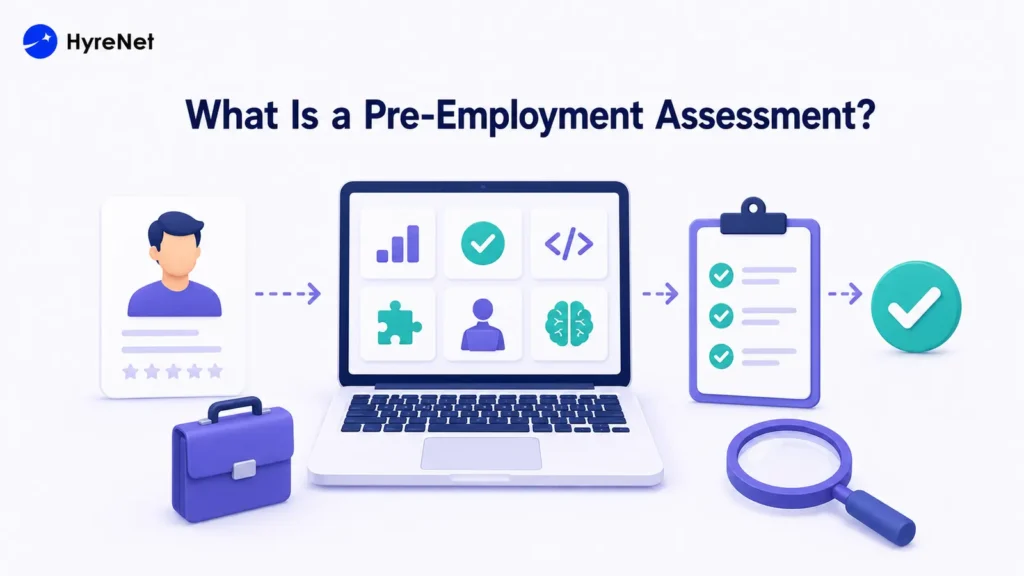
A pre-employment assessment is a structured test used to evaluate candidates before hiring. It measures job-related skills, knowledge, cognitive ability, communication or workplace judgment.
The assessment should reflect the role’s actual responsibilities. Employers should use it alongside resume screening, structured interviews and reference checks rather than as the only hiring method.
Resumes and interviews can be influenced by personal impressions. Different interviewers may also apply different standards.
A structured assessment gives candidates comparable tasks and uses predefined scoring criteria. This helps recruiters evaluate proven abilities and determine:
Assessment results help recruiters prioritize qualified candidates. Final decisions should also consider interviews, experience and other relevant evidence.
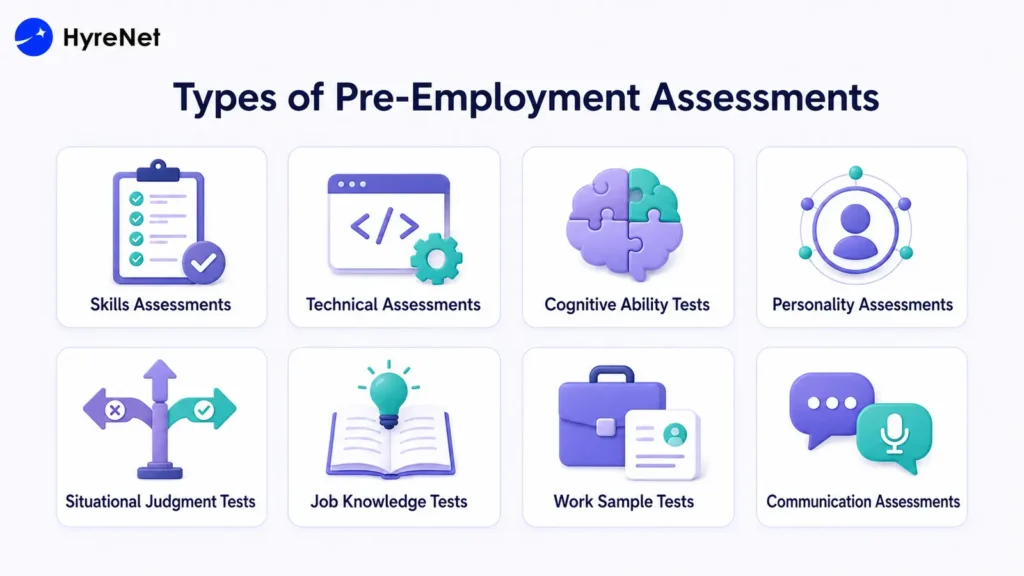
The right hiring assessment depends on the position. A developer may complete a coding test, while a customer service applicant may respond to support scenarios.
Skills assessments measure a candidate’s ability to complete practical job tasks.
Common examples include:
These assessments show whether candidates can apply their knowledge in realistic situations.
Technical assessments evaluate specialized knowledge required for roles in software development, engineering, cybersecurity, data science and IT.
They may include multiple-choice questions, coding challenges, debugging exercises or case studies. The difficulty should match the position’s seniority level.
Cognitive ability tests measure logical reasoning, numerical ability, verbal comprehension and problem-solving skills.
These tests can indicate how quickly candidates process information and learn new concepts. Questions should remain relevant to the role and avoid unnecessary complexity.
Personality assessments examine workplace preferences and behavioral tendencies such as dependability, adaptability and collaboration.
Employers should use these results as supporting evidence. Personality scores should not independently determine whether a candidate receives an offer.
Situational judgment tests present realistic workplace scenarios and ask candidates to select the most appropriate response.
They help measure decision-making, communication and conflict resolution. They also give applicants a clearer view of situations they may face in the role.
Job knowledge tests measure a candidate’s understanding of industry terms, regulations, procedures or professional practices.
They are most useful for positions that require candidates to possess essential knowledge before joining.
Work sample tests require candidates to complete a task similar to the actual job.
A marketer may create a campaign outline. A developer may build a small feature. An accountant may review a financial statement.
These tests provide direct evidence of job performance. Employers should keep assignments reasonable and avoid using unpaid candidate work commercially.
Communication assessments evaluate written or verbal communication for customer service, sales, marketing, leadership and remote roles.
Candidates may write an email, deliver a presentation or handle a simulated customer call. A scoring rubric should measure clarity, accuracy, tone and organization.
Build a smarter pre-employment assessment process with HyreNet’s data-backed hiring platform. Evaluate candidates with structured skill tests, improve hiring efficiency, reduce mis-hires, increase quality of hire, and create a more reliable recruitment workflow for better talent decisions.
Here are the most common types of pre-employment assessments employers use to evaluate candidates.
A pre-employment assessment gives employers clear evidence of a candidate’s job-related skills and knowledge. The assessment should match the role and use consistent scoring. It should also remain accessible and fair.
HyreNet helps businesses assess candidates at scale and identify qualified applicants faster. Combined with structured interviews and recruiter judgement, it supports more confident hiring decisions.

Candidate drop-off during online assessments is one of the most common recruitment challenges companies face today. A candidate may apply with interest, open the test link, and still leave the process before submission.
This does not always mean the candidate was uninterested. Many drop-offs happen because the assessment feels too long, unclear, difficult to access, or disconnected from the actual role.
Online assessments are useful for measuring skills at scale, but they must be designed carefully. A poor assessment experience can make strong candidates leave before recruiters ever get to evaluate them.
Reducing candidate drop-off starts with one simple shift. Companies need to treat online assessments as part of the candidate experience, not only as a screening tool.
Candidate drop-off during online assessments refers to the percentage of applicants who start or receive an assessment but do not complete it.
This can happen at different stages. Some candidates never open the test link. Some abandon the test midway. Others complete the test but do not continue with the next hiring step.
A high candidate drop-off rate usually signals a problem in the hiring process. The issue may be test length, poor instructions, weak communication, technical barriers, or lack of motivation.
Long assessments are one of the biggest reasons candidates abandon the process. Applicants are more likely to complete tests that feel focused, relevant, and reasonable.
A two-hour test for an early-stage role can feel excessive. Candidates may also question whether the company respects their time. This creates one of the most common recruitment challenges, where qualified applicants leave before recruiters can properly evaluate them.
The best approach is to test only what matters for the role. Every question should have a clear hiring purpose.
Candidates drop off when they do not understand what to do, how much time the test will take, or what will happen after submission.
Unclear instructions create anxiety. They also make the company look unorganized.
Clear communication should explain the test format, time limit, deadline, tools required, evaluation criteria, and next steps.
Candidates lose interest when assessments do not match the job. A content writer should not receive a generic aptitude-heavy test if the role mainly requires writing ability.
A developer should not face theoretical questions that do not reflect real coding work.
Role relevance improves completion because candidates can see the purpose behind the assessment.
Login errors, broken links, poor mobile compatibility, browser restrictions, and platform glitches can quickly increase drop-off.
Many candidates complete assessments after work, during travel, or on shared devices. A platform that is difficult to access can discourage even serious applicants.
The assessment platform should be simple, stable, and easy to use.
Candidates are more likely to complete an assessment when they understand why it matters.
A short explanation can help. Tell candidates that the assessment helps evaluate skills fairly, reduce hiring bias, and move qualified applicants faster.
People are more willing to invest time when the process feels transparent and worthwhile.
Shorter assessments usually lead to better completion rates. A good online assessment should measure the most important skills without overwhelming the candidate.
The ideal length depends on the role, but early-stage assessments should be concise. Companies can use longer evaluations only after candidates have already shown strong interest.
A focused test also improves hiring accuracy. Recruiters get cleaner signals because candidates are not exhausted by unnecessary questions.
Role-based assessments reduce drop-off because candidates can connect the test to the actual job.
A sales role may need communication judgment, objection handling, and situation-based questions. A coding role may need practical problem-solving. A content role may need editing, research, and writing judgment.
Relevant assessments feel fair. They also help candidates understand what the company values.
Candidates should never feel lost before starting an assessment.
The invitation email should clearly mention:
This reduces confusion and builds trust. Clear instructions also reduce support queries for recruiters.
Many candidates open assessment links on mobile first. Some may not have immediate access to a laptop.
A mobile-friendly assessment experience can reduce early drop-off, especially for entry-level, high-volume, and remote hiring roles.
Mobile compatibility does not mean every test should be completed on a phone. It means the candidate should be able to open instructions, check deadlines, access support, and understand requirements easily.
Very strict time limits can make candidates anxious. Very long timelines can make them delay the test and forget about it.
A realistic deadline works better. Give candidates enough time to plan, especially if they are working professionals.
For urgent hiring, mention the reason clearly. Candidates respond better when deadlines feel practical and transparent.
Reduce candidate drop-off during online assessments with HyreNet’s smarter recruitment assessment workflows. Create shorter, clearer, and more candidate-friendly evaluations that improve completion rates, protect candidate experience, and help hiring teams keep qualified applicants engaged until the final decision.
Many candidates do not drop off intentionally. They simply forget the deadline or miss the email.
Reminder emails can improve completion rates without adding pressure. Send one reminder midway and another before the deadline.
The tone should be helpful, not robotic. A reminder should include the assessment link, deadline, estimated time, and support contact.
A complicated login process can hurt completion before the assessment even begins.
Candidates should not have to create multiple accounts, verify too many details, or download unfamiliar tools unless necessary.
A smooth entry experience improves participation. It also creates a better first impression of the company.
Candidates are more likely to complete a test when they understand how results will be used.
Explain whether the assessment is used for shortlisting, skill mapping, interview preparation, or final decision-making.
This transparency helps candidates feel the process is fair. It also reduces uncertainty around automated hiring tools.
Technical support can reduce preventable drop-offs. Candidates should know whom to contact if the link fails, the page freezes, or they face upload issues.
Support does not need to be complex. A clear email address, help page, or chatbot can make the experience smoother.
Fast support also protects the company from losing good candidates due to avoidable problems.
Many hiring teams add too many assessment rounds because they want more confidence. This can create fatigue and increase drop-off.
A candidate may complete one test, but leave when asked to complete another similar task.
Assessments should be mapped to hiring stages. Early rounds should screen essential skills. Later rounds can evaluate deeper role-specific ability.
Silence after an assessment damages candidate trust. Even a short update can improve the experience.
Companies should tell candidates when they can expect results. Automated status updates are better than no communication.
Feedback also helps employer branding. Candidates may accept rejection better when the process feels respectful.
Recruiters should measure where candidates leave the assessment process because drop-off data helps companies cut hiring costs smartly and improve hiring efficiency.
Track these metrics:
This data helps companies identify the exact problem. A high start rate but low completion rate may mean the test is too long. A low start rate may mean the email, deadline, or communication needs improvement. Tracking these patterns helps recruiters fix weak points early, reduce repeated screening efforts, and cut hiring costs without lowering candidate quality.
Reducing candidate drop-off during online assessments starts with better hiring design. Candidates are more likely to complete assessments that are short, clear, relevant, accessible, and respectful of their time.
Companies should not treat drop-off as a candidate problem. It is usually a process problem.
A strong online assessment experience improves completion rates, hiring accuracy, and employer branding. It also helps companies solve major recruitment challenges by keeping qualified candidates engaged until the final hiring decision.
Choosing the right assessment platform shapes your entire hiring process. Pick the wrong one and you end up with a tool that creates more work than it saves. Pick the right one and your team moves faster, makes better decisions, and spends far less time on tasks that should not require human attention. It comes down to the features every modern assessment platform should have, and whether the platform you are considering actually delivers on all of them consistently.
Not all assessment platforms are built equally. Some handle basic test delivery and little else. Others are built to support the full hiring cycle, from screening to final decision, without adding complexity for your team. Here is what you should be looking for before committing to any platform.
1. Customisable Assessments
No two roles are the same and your tool should reflect that. The features every modern assessment platform should have start with the ability to build role-specific tests from templates or from scratch, without being locked into a rigid question bank.
2. AI-Generated Questions
Manually building question sets for every new role is slow and repetitive. A good platform uses AI to generate relevant questions based on role, skill level, and domain. This is one of the core features every modern assessment platform should have in 2026.
3. A Rich Question Library
Beyond AI generation, a pre-built library of vetted questions across technical domains, aptitude areas, and soft skills saves enormous time. HyreNet gives recruiters access to the HCL GUVI question library, covering programming languages, logical reasoning, and domain-specific topics.
4. Multiple Assessment Types
Skills tests, aptitude tests, personality assessments, coding challenges, video responses: a modern platform should support all of them in one place. Switching between tools for different types adds unnecessary complexity.
5. AI Video Proctoring
Remote testing only works if results are trustworthy. AI proctoring monitors candidates through webcam feeds, screen activity, and tab switching detection throughout every session. This is a non-negotiable entry in the features every modern assessment platform should have for remote hiring.
6. Automated Candidate Reminders
Candidates get busy and test invites get buried. A good platform sends automated follow-up reminders to candidates who have not yet completed their assessment, keeping the pipeline moving without manual chasing.
7. Detailed Candidate Reports
A raw score tells you very little. The features every modern assessment platform should have include comprehensive reports covering performance breakdowns, personality indicators, and comparative data against others in the pipeline.
8. Built-in Analytics and Reporting
Among the features every modern assessment platform should have, built-in analytics often get underestimated. Recruiters need visibility into how long candidates take, where people drop off, and which assessments produce the strongest hires. A platform that cannot answer these questions leaves valuable data untouched.
9. Centralised Data Storage
All assessment results, candidate videos, scores, and reports should live in one place. Jumping between spreadsheets and email threads to track candidate data is a clear sign a company has outgrown its hiring tools.
10. Scalable Pricing
Scalable pricing is firmly in the features every modern assessment platform should have. Whether you are hiring for two roles or running a large campaign, you should only pay for what the situation demands.
11. Easy Integration
The best platforms connect with the ATS and HR tools your team already uses. Forcing manual data transfers between systems adds friction and wastes time.
12. Candidate-Friendly Experience
A confusing assessment reflects badly on your company and increases drop-off rates. The features every modern assessment platform should have include a clean, intuitive interface that works on both desktop and mobile.
13. Question Shuffling and Anti-Cheat Controls
Strong platforms randomise question order and answer options to reduce the risk of candidates sharing answers. This is firmly in the features every modern assessment platform should have when assessments run at scale.
14. Role-Based Access for Teams
HR managers, hiring managers, and recruiters need different levels of access. A good platform lets you set permissions by role so the right people see the right information.
15. Fast, Reliable Support
When something goes wrong during a hiring cycle, you cannot wait days for help. Responsive support is one of the features every modern assessment platform should have that gets overlooked until it is urgently needed.
HyreNet is designed to deliver all of these out of the box. From AI-generated questions and automated proctoring to detailed reports and flexible pricing, it covers the features every modern assessment platform should have without requiring additional tools or multiple vendors.
Also read - 5 Reasons Why HyreNet’s Recruitment Platform Easily Stands Out in Talent Acquisition
Hiring technical talent sounds simple on paper. A candidate applies. The resume looks strong. The skills match the job description. The recruiter moves the profile ahead. Then the interview happens, and the hiring manager says, “This person is not technically strong enough.”
Recruiters know this situation well. A resume can show experience, but it cannot always show how someone writes code, solves problems, debugs errors, or handles real work pressure. That is why technical assessment tools have become an important part of modern recruitment. These tools help recruiters test real skills before sending candidates to technical interviews.
Want to hire better technical talent with more confidence? Read our complete blog on technical assessment tools and learn how recruiters can screen candidates faster, test real skills, and make smarter hiring decisions.
Technical assessment tools are platforms that help recruiters check a candidate’s job-related technical skills. They are mostly used during screening, interviews, campus hiring, remote hiring, and lateral recruitment.
These tools can test coding, debugging, data analysis, SQL, cloud skills, QA knowledge, DevOps basics, cybersecurity understanding, system design, and problem-solving ability.
Recruiters often use them for roles such as:
Coding assessment tools test how well a candidate can write code. Candidates usually solve programming questions, run test cases, and submit their answers through an online platform.
These tools are useful for software development roles. They usually support languages such as Python, Java, JavaScript, C++, C#, Go, PHP, and SQL.
Recruiters can use coding tests during early screening. Hiring managers can later review the candidate’s logic, code quality, and problem-solving style.
Every technical role needs a different skill set. A frontend developer does not need the same test as a DevOps engineer. A data analyst should not be judged only on generic coding questions.
Role-based assessment tools solve this problem. They test skills related to a specific job.
A DevOps assessment may include Linux, Docker, Kubernetes, CI/CD, and cloud questions. A data analyst assessment may include SQL, Excel, dashboards, and business problem-solving.
These tools help recruiters understand whether the candidate is ready for the actual role.
Work sample assessments feel closer to real work. Candidates may be asked to debug broken code, review a pull request, build a small feature, write SQL queries, test a user flow, or design a simple API.
These assessments give strong hiring signals because they show how candidates think in practical situations.
Recruiters can use work samples for mid-level and senior roles where real-world judgment matters more than textbook answers.
Live coding tools allow candidates and interviewers to work together in the same coding environment. The interviewer can watch how the candidate approaches the problem, asks questions, handles feedback, and explains their thinking.
This format is useful because technical hiring is not only about the final answer. The process also matters. A candidate who explains clearly and thinks logically may be a better fit than someone who only memorized solutions.
Take-home projects give candidates more time to complete a practical task. These are useful for roles where quality, structure, and real-world thinking matter.
Recruiters should keep these assignments short and fair. A long unpaid project can frustrate candidates and reduce completion rates. A good take-home task should test the role, not consume the candidate’s entire weekend.
Many technical assessment platforms now use AI. Some tools generate questions, check code quality, detect plagiarism, summarize performance, or support interview feedback.
AI can save time, but recruiters should use it carefully. Automated scoring should support hiring decisions, not make every decision alone. Recruiters should also understand how the tool uses candidate data, how scores are created, and whether candidates can request support or accommodations when needed.
A good technical assessment platform should test the skills needed for the actual role. Recruiters should look for question libraries covering coding, databases, cloud, DevOps, QA, cybersecurity, data science, and IT support.
The questions should match the job description. Random puzzles may look interesting, but they rarely help unless the role truly needs that thinking.
Every company hires differently. A startup may need a flexible developer, while a larger company may need someone with deeper backend or system design skills.
A good tool should let recruiters create custom tests with different question types, difficulty levels, time limits, and scoring rules. This makes the assessment more useful for the role.
Automated scoring saves time during high-volume hiring. It can check accuracy, test cases, logic, completion time, and other performance details.
Still, recruiters should involve hiring managers for important roles. A score gives direction, but it should not become the final decision.
Remote hiring has made test integrity more important. Many tools now offer plagiarism checks, copy-paste tracking, browser monitoring, question randomization, and proctoring.
These features are useful, but recruiters should use them carefully. A fair process should protect the company without making candidates uncomfortable.
Good candidates may drop off when a test feels confusing, too long, or poorly explained. A technical assessment tool should be simple to use. Candidates should know the format, duration, deadline, allowed tools, and evaluation method before starting.
Recruiters need reports that are easy to understand. A strong report should show the candidate’s score, strengths, weak areas, time taken, and test integrity signals. Hiring managers should quickly understand whether the candidate is ready for the next step.
ATS integration helps recruiters manage assessments inside the hiring workflow. It can send tests, update candidate stages, attach reports, and reduce manual follow-ups. This keeps the pipeline cleaner and saves recruiter time.
HyreNet is a good choice for recruiters who want a simple platform for coding tests, AI-proctored exams, and skill-based hiring. It supports programming assessments, aptitude questions, automated reports, and remote hiring workflows. This makes it useful for companies that want to screen candidates faster and reduce mis-hires with structured evaluation.
HackerRank is one of the most popular platforms for developer hiring. Recruiters can use it for coding assessments, technical interviews, and skill-based screening. It works well for companies hiring software developers at scale and helps hiring teams evaluate coding ability more objectively.
TestGorilla is useful for recruiters who want to test both technical and workplace skills. It offers skills assessments across programming, role-specific skills, cognitive ability, software skills, and other hiring areas. This makes it helpful for companies that want a broader view of candidate fit before interviews.
iMocha is a strong option for enterprises and teams hiring across many technical roles. Its assessment library covers coding, cloud, data, DevOps, cybersecurity, communication, and other skill areas. Recruiters can use it for job-role-based assessments, large-scale screening, and skills intelligence.
CoderPad is useful for live coding interviews and real-time technical evaluation. Recruiters and hiring managers can assess candidates in a shared coding environment and understand how they approach problems. It is especially helpful when the team wants to evaluate both coding ability and problem-solving communication.
| Area | Traditional Interview | Technical Assessment Tool |
| Main purpose | Understand experience and communication | Test practical skills |
| Evaluation style | Human-led | Structured and score-based |
| Best for | Motivation and team fit | Coding and job skills |
| Main risk | Subjective judgment | Poor test design |
| Best use | Later hiring stages | Screening and skill validation |
Technical assessment tools help recruiters hire with more confidence. They reduce resume guesswork, improve shortlisting, and make technical hiring more structured. The right tool should be practical, role-relevant, easy for candidates, and simple for hiring teams to use. It should also support fair evaluation and responsible automation.
Recruiters do not need another complicated hiring step. They need a tool that helps them understand real skills before moving candidates forward. A strong technical assessment process helps companies find people who can solve problems, do the work, and grow with the team.

In today’s competitive job market, finding the right talent quickly and efficiently can be challenging. That’s where HyreNet’s recruitment platform steps in. As a leading AI-powered solution, HyreNet empowers companies to streamline their hiring processes, ensuring they attract and identify top talent with ease. Trusted by over 50 companies, HyreNet offers a suite of features designed to simplify recruitment while maintaining the highest standards of candidate evaluation. Here are five reasons why HyreNet is the go-to choice for businesses looking to enhance their talent acquisition strategies.
HyreNet provides tools to create role-specific assessments effortlessly. You can customize templates by importing questions via CSV, setting the duration, and shuffling questions to match your needs. Whether hiring for junior positions or senior roles, you can create and reuse templates across multiple tests, ensuring consistency and efficiency. HyreNet also offers a unique shuffling feature, where the order of questions varies for each candidate, enhancing the assessment's integrity.
Additionally, HyreNet offers lifetime free customized question generation. Questions are tailored to your company's requirements, covering various formats like objective, programming, and video questions. The platform also includes real-world project problem statements that candidates can develop using frameworks like React, Vue.js, and AngularJS, offering a deeper evaluation of their practical skills.
Integrity is crucial in recruitment assessments, and HyreNet takes this seriously with its AI-powered proctoring. The platform continuously monitors candidates’ faces during the test, capturing video throughout to ensure focus and prevent cheating. If multiple faces are detected on the screen or if someone else attempts to take the test, the system will flag the incident.
Additionally, if a candidate's face is not visible during the assessment, it will be detected, ensuring the authenticity of the test-taking process. HyreNet also detects if a candidate switches to another tab during the test, taking screenshots and logging the event for review. If programming content is copied from another site, it will be detected, and the copied content can be viewed in the report by recruiters. This comprehensive monitoring system ensures that genuine candidates succeed, giving you confidence in your hiring decisions.
HyreNet provides detailed insights into candidate performance through its robust reporting features. Access reports that include leaderboards, skill assessments, and other critical metrics. The platform also records candidate videos and captures screenshots of any suspicious activities, all compiled into a thorough report. These insights help you identify top talent and make informed, data-driven decisions.
Moreover, recruiters can take advantage of role-based access controls, ensuring that team members have the appropriate level of access based on their role, which helps maintain security and organization within the hiring process.
Managing recruitment assessments is simple with HyreNet’s integrated calendar, accessible directly from the dashboard. The calendar displays upcoming and completed tests, giving you a clear overview of your recruitment schedule. The dashboard also shows recent tests, the number of candidates who attended, and those hired, making it easy to track your recruitment progress. This feature helps you stay organized and ensures that your hiring process runs smoothly. In addition, HyreNet supports 15+ programming languages for programming tests. Recruiters can choose to include all languages or limit the assessment to a select few, ensuring that the tests align with the specific needs of the role.
HyreNet’s user-friendly interface makes it easy to navigate and manage your recruitment assessments. You can quickly import questions in bulk using CSV, streamlining the setup process. Additionally, HyreNet offers 24/7 technical support, so any questions or issues are resolved promptly.
This allows you to focus on finding the right talent without worrying about technical challenges. Furthermore, HyreNet provides lifetime support for its customizable question generation service, ensuring your assessments remain relevant and aligned with your evolving hiring needs.
HyreNet is not just another recruitment platform; it’s a comprehensive solution designed to transform your hiring process. With its customizable assessments, advanced AI features, and user-friendly interface, HyreNet ensures you’re equipped to make the best hiring decisions, quickly and efficiently. Ready to experience the future of talent acquisition? Don’t miss out on the opportunity to elevate your hiring strategy—schedule a demo today and see how HyreNet can help you secure the top talent your company needs to succeed.

Recruitment are the frontline of building a successful organization, yet they come with numerous obstacles. From attracting the right talent to ensuring a smooth and efficient hiring process, recruiters must overcome various recruitment challenges to secure the best candidates. Fortunately, modern assessment platforms provide effective solutions, helping companies streamline their recruitment efforts. Here are the top 10 recruitment challenges and how they can be addressed.
One of the most common recruitment challenges is reaching the right candidates. With a vast pool of applicants, it can be difficult to identify those who truly meet the specific needs of the role. This issue worsens when job descriptions are vague or overly broad, leading to many unqualified applicants. Ensuring job postings are clear, precise, and targeted is essential for attracting the right talent.
Solution: Crafting a detailed, accurate job description that precisely outlines the role's requirements attracts qualified candidates, streamlining the recruitment process.
Lengthy hiring processes can be detrimental to both the company and the candidates involved. Delays in filling positions can lead to increased workload for current employees, decreased productivity, and potential loss of top candidates who may accept offers elsewhere. Reducing the time-to-hire is crucial for maintaining operational efficiency and securing the best talent.
Solution: Efficient use of remote hiring options and platforms such as HyreNet speeds up the recruitment process, reducing time-to-hire significantly.
A candidate's decision to accept a job offer is heavily influenced by their hiring experience. A cumbersome or disorganized recruitment process can create a negative impression of the company, leading candidates to decline offers or speak poorly of the organization. Ensuring a smooth, efficient, and respectful hiring process is vital for maintaining a positive employer reputation.
Solution: Tailoring interview rounds to job requirements and rapidly announcing results ensures a smooth and positive hiring experience for candidates.
An efficient recruitment process is crucial for companies to attract top talent and stay competitive. Inefficiencies, such as lengthy decision-making or poor communication, can result in lost opportunities and higher costs. Streamlining recruitment workflows, from candidate sourcing to final selection, is necessary to improve hiring outcomes and reduce unnecessary expenses.
Solution: Conducting tests online, ranking candidates based on skills, supported by data visualization and efficient data management through platforms like HyreNet, streamlines the recruitment process.
Recruiting for multiple roles at once can lead to confusion and inefficiencies, particularly if follow-up procedures are not well-managed. Without proper tracking, candidates may be overlooked or the process may stall, leading to delays in filling crucial positions. Effective management of multi-role recruitment is necessary to ensure that all candidates are properly evaluated and the hiring process remains on track.
Solution: Using customizable assessment platforms like HyreNet helps manage multiple roles simultaneously by tracking hiring stages, candidate data, and test reports efficiently.
Maintaining fairness in recruitment is essential for fostering diversity and inclusion within an organization. Biases in the hiring process, whether conscious or unconscious, can lead to the exclusion of qualified candidates and create a homogenous workforce. Ensuring that recruitment practices are transparent and based on merit is crucial for attracting and retaining diverse talent.
Solution: Implementing transparent, skill-based recruitment with talent assessments ensures that all candidates are evaluated fairly and without bias.
Skill shortages present a significant hurdle in recruitment, particularly in specialized industries. When there is a lack of candidates with the necessary expertise, it becomes challenging to fill positions effectively. This shortage can slow down the hiring process and force companies to compromise on the quality of hires, ultimately impacting business performance.
Solution: Implementing tests and interviews tailored to assess role-specific skills helps identify candidates who can effectively meet the job's demands.
The rapid pace of technological advancement can pose challenges for recruitment, particularly for companies that struggle to keep up with new tools and platforms. Failure to adapt can lead to outdated hiring practices that hinder the ability to attract and evaluate candidates effectively. Staying current with technological trends is essential for maintaining a competitive edge in recruitment.
Solution: Customizing talent assessments according to the latest technology and role-specific needs ensures the recruitment process stays up-to-date and effective.
Recruitment can be a costly endeavor, particularly if the process is prolonged or inefficient. High expenses related to advertising, interviewing, and onboarding can strain a company’s budget. Implementing cost-effective recruitment strategies is essential for balancing the need to attract top talent with the necessity of maintaining financial health.
Solution: Leveraging remote hiring platforms reduces recruitment costs by streamlining the hiring process and eliminating unnecessary expenses.
A strong employer brand is key to attracting top talent, but building and maintaining this brand requires consistent effort. Candidates are drawn to well-regarded companies, not just for their products or services, but also for their workplace culture and values. Negative perceptions or lack of engagement can significantly deter potential applicants.
Solution: Engaging with people by responding to queries —whether positive or negative—helps to build a strong employer brand that attracts quality candidates.

In today’s competitive job market, reducing hiring costs without compromising on the quality of hires is more important than ever. Companies are seeking innovative solutions that not only streamline recruitment processes but also help reduce inefficiencies. HyreNet, an AI-powered assessment platform, offers a comprehensive and cost-effective solution, helping businesses save time, money, and resources while ensuring they hire the right candidates. Here's how HyreNet can help your company cut hiring costs by up to 40%.
The traditional hiring process is often expensive and time-consuming, requiring multiple rounds of interviews, travel expenses, and administrative costs. HyreNet's online assessments allow candidates to complete tests remotely, reducing these inefficiencies. Whether candidates are applying from the same city or a different continent, businesses can eliminate travel and logistics expenses by assessing candidates from anywhere. This drastically cuts down on the time and costs associated with manual interview scheduling, in-person assessments, and travel reimbursements. As a result, HyreNet helps companies reduce hiring costs and make faster, more informed decisions.
One of the main challenges in recruitment is filtering out unqualified applicants early in the process. HyreNet’s AI-driven assessments provide an efficient solution by automatically identifying candidates that meet specific criteria. This means recruiters can focus their time and resources on interviewing the most promising candidates, significantly reducing the time and money spent on screening unsuitable applicants. The platform’s AI technology also ensures that every candidate is evaluated fairly and objectively, resulting in better outcomes with lower hiring costs.
Managing and storing candidate data is a hidden expense that many companies fail to account for. The cost of organizing large volumes of candidate information and assessment results can add up, particularly for companies that handle a high volume of applicants. HyreNet simplifies this by offering centralized data storage and reporting, which ensures that all assessment results, candidate videos, and reports are stored in one easily accessible location. Not only does this eliminate the need for expensive third-party data storage solutions, but it also provides recruiters with actionable insights that help them make smarter hiring decisions. With built-in analytics and reporting, companies can easily track their hiring metrics and optimize their processes, further reducing costs.
For businesses of all sizes, managing recruitment costs effectively is crucial. Whether you’re hiring for one role or filling multiple positions across different departments, HyreNet offers flexible pricing options tailored to your specific needs. Companies only pay for what they use, making it a scalable solution for small, medium, and large enterprises alike. This flexibility ensures that businesses can maintain control over their hiring budget without sacrificing access to the powerful features HyreNet offers. As your company grows and hiring demands increase, the platform can scale with you, helping to reduce hiring costs while still providing top-tier assessment tools.
Building new assessments from scratch for every role can be both time-consuming and costly. HyreNet’s customizable templates allow recruiters to design assessments tailored to specific job roles and reuse them across different positions. This feature is especially valuable for companies that frequently hire for similar roles. By reducing the time and effort spent on creating and designing new assessments for each role, businesses can significantly lower the cost of recruitment. Moreover, the platform’s ability to shuffle questions, set durations, and adjust assessments on the fly enables recruiters to further optimize their hiring process, saving time and money at every stage.
Hiring the right candidate goes beyond assessing technical skills. Today, companies are looking for well-rounded individuals who also fit into the company culture. HyreNet’s comprehensive candidate reports offer detailed insights into a candidate’s skills, personality traits, and performance during assessments. This rich data allows recruiters to make more informed decisions, reducing the risk of a poor hire, which can be an expensive mistake. By providing all the necessary information upfront, HyreNet reduces the chances of needing to rehire for the same position, contributing to cost-effective recruitment.
One of the risks associated with remote assessments is the possibility of cheating. HyreNet’s AI-powered proctoring tools help ensure the integrity of every assessment, preventing candidates from gaining unfair advantages. This feature not only maintains the quality and reliability of test results but also saves costs by reducing the need for live proctors or in-person assessments. With AI proctoring, companies can confidently hire candidates who have passed a thorough and fair assessment, minimizing the risk of hiring underqualified individuals and the costs associated with mis-hiring.
Every day that a job remains vacant can cost a company money in lost productivity. HyreNet shortens time-to-hire by streamlining the entire recruitment process, from initial screening to final hiring decision. Faster hires mean companies can fill critical positions more quickly, reducing downtime and boosting productivity. In addition, by automating many aspects of the hiring process, HyreNet reduces the manual workload for HR teams, allowing them to process more candidates in less time, further cutting hiring costs.
With these features and capabilities, HyreNet helps businesses reduce hiring costs without compromising on quality, speed, or efficiency. Whether you're looking to save on travel expenses, reduce the time spent on interviews, or streamline data management, HyreNet provides a robust solution designed to meet the demands of modern recruitment.