

Choosing the right assessment platform shapes your entire hiring process. Pick the wrong one and you end up with a tool that creates more work than it saves. Pick the right one and your team moves faster, makes better decisions, and spends far less time on tasks that should not require human attention. It comes down to the features every modern assessment platform should have, and whether the platform you are considering actually delivers on all of them consistently.
TL;DR Summary
- The features every modern assessment platform should have go well beyond basic test delivery.
- AI-powered question generation, automated proctoring, and detailed analytics are now baseline expectations.
- Scalability, customisation, and candidate experience matter just as much as the assessment itself.
- HyreNet is built around the features every modern assessment platform should have for companies hiring at any scale.
- If a platform is missing more than one or two of these, it will create friction in your hiring process.
The 15 Features to Look For
Not all assessment platforms are built equally. Some handle basic test delivery and little else. Others are built to support the full hiring cycle, from screening to final decision, without adding complexity for your team. Here is what you should be looking for before committing to any platform.
1. Customisable Assessments
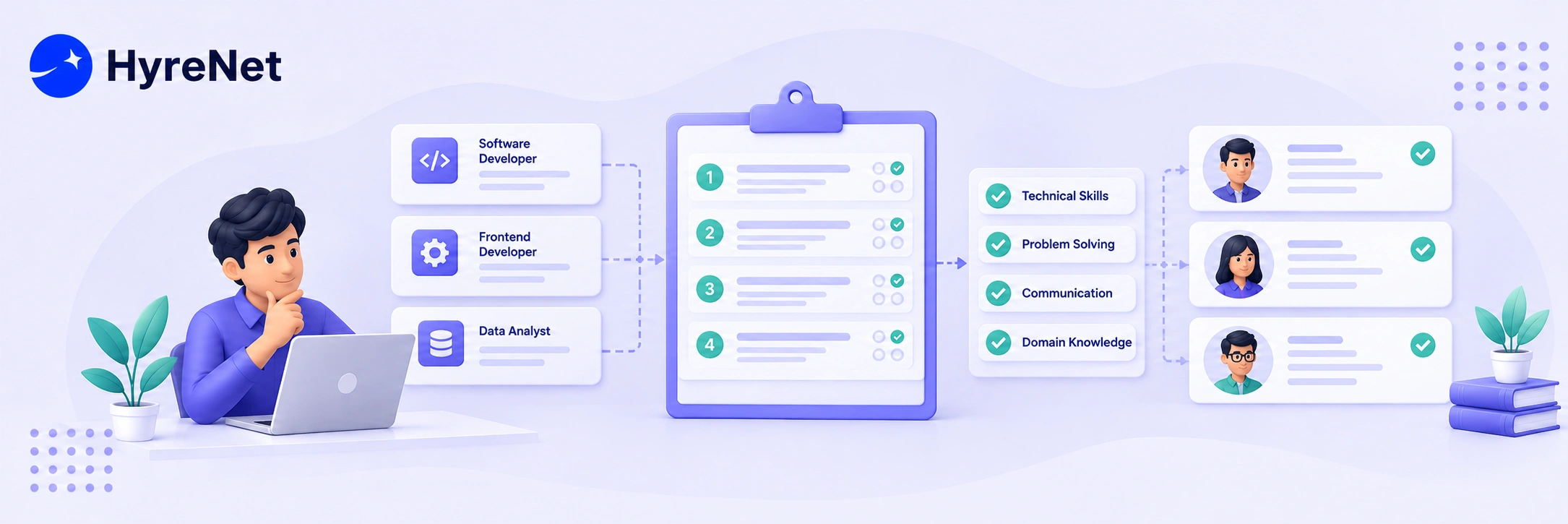
No two roles are the same and your tool should reflect that. The features every modern assessment platform should have start with the ability to build role-specific tests from templates or from scratch, without being locked into a rigid question bank.
2. AI-Generated Questions
Manually building question sets for every new role is slow and repetitive. A good platform uses AI to generate relevant questions based on role, skill level, and domain. This is one of the core features every modern assessment platform should have in 2026.
3. A Rich Question Library
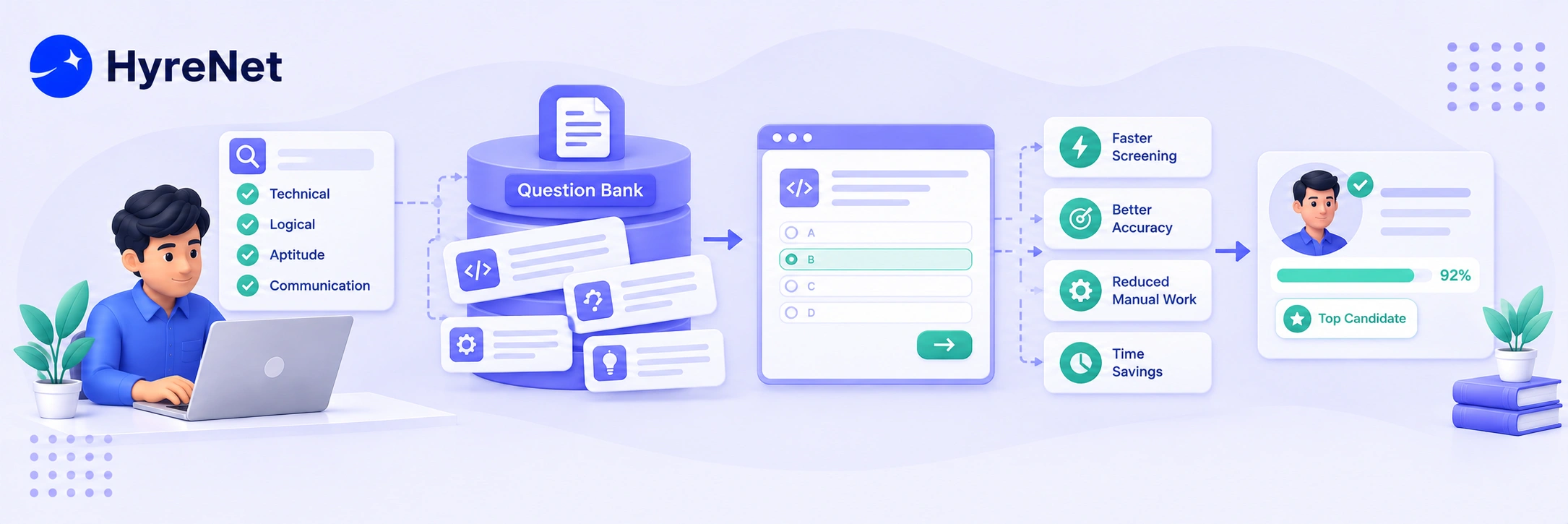
Beyond AI generation, a pre-built library of vetted questions across technical domains, aptitude areas, and soft skills saves enormous time. HyreNet gives recruiters access to the HCL GUVI question library, covering programming languages, logical reasoning, and domain-specific topics.
4. Multiple Assessment Types
Skills tests, aptitude tests, personality assessments, coding challenges, video responses: a modern platform should support all of them in one place. Switching between tools for different types adds unnecessary complexity.
5. AI Video Proctoring
Remote testing only works if results are trustworthy. AI proctoring monitors candidates through webcam feeds, screen activity, and tab switching detection throughout every session. This is a non-negotiable entry in the features every modern assessment platform should have for remote hiring.
6. Automated Candidate Reminders
Candidates get busy and test invites get buried. A good platform sends automated follow-up reminders to candidates who have not yet completed their assessment, keeping the pipeline moving without manual chasing.
7. Detailed Candidate Reports
A raw score tells you very little. The features every modern assessment platform should have include comprehensive reports covering performance breakdowns, personality indicators, and comparative data against others in the pipeline.
8. Built-in Analytics and Reporting
Among the features every modern assessment platform should have, built-in analytics often get underestimated. Recruiters need visibility into how long candidates take, where people drop off, and which assessments produce the strongest hires. A platform that cannot answer these questions leaves valuable data untouched.
9. Centralised Data Storage
All assessment results, candidate videos, scores, and reports should live in one place. Jumping between spreadsheets and email threads to track candidate data is a clear sign a company has outgrown its hiring tools.
10. Scalable Pricing
Scalable pricing is firmly in the features every modern assessment platform should have. Whether you are hiring for two roles or running a large campaign, you should only pay for what the situation demands.
11. Easy Integration
The best platforms connect with the ATS and HR tools your team already uses. Forcing manual data transfers between systems adds friction and wastes time.
12. Candidate-Friendly Experience
A confusing assessment reflects badly on your company and increases drop-off rates. The features every modern assessment platform should have include a clean, intuitive interface that works on both desktop and mobile.
13. Question Shuffling and Anti-Cheat Controls
Strong platforms randomise question order and answer options to reduce the risk of candidates sharing answers. This is firmly in the features every modern assessment platform should have when assessments run at scale.
14. Role-Based Access for Teams
HR managers, hiring managers, and recruiters need different levels of access. A good platform lets you set permissions by role so the right people see the right information.
15. Fast, Reliable Support
When something goes wrong during a hiring cycle, you cannot wait days for help. Responsive support is one of the features every modern assessment platform should have that gets overlooked until it is urgently needed.
HyreNet is designed to deliver all of these out of the box. From AI-generated questions and automated proctoring to detailed reports and flexible pricing, it covers the features every modern assessment platform should have without requiring additional tools or multiple vendors.
Also read – 5 Reasons Why HyreNet’s Recruitment Platform Easily Stands Out in Talent Acquisition
FAQs
1. What are the most important features every modern assessment platform should have?
The essentials include customisable assessments, AI proctoring, automated reminders, detailed candidate reports, and built-in analytics. Scalability and a good candidate experience matter just as much.
2. How does AI proctoring work in an assessment platform?
AI proctoring monitors candidates through webcam feeds, screen activity, and browser behaviour. Anything suspicious gets flagged automatically and included in the candidate report for recruiter review.
3. Do all assessment platforms support multiple question types?
Not all of them. Some are built only for technical assessments or personality tests. A modern platform should support skills tests, coding challenges, aptitude questions, and video responses in one place.
4. How important is candidate experience in an assessment platform?
Very important. A confusing assessment increases drop-off rates and damages your employer brand. Candidates who have a bad test experience are less likely to accept an offer even if they perform well.
5. Can small companies benefit from using an assessment platform?
Yes. Scalable pricing means smaller companies only pay for what they use. The time and cost savings from structured assessments are just as valuable for a small HR team as for a large enterprise.