

A candidate writes flawless code from scratch during an interview, then completely stalls when handed a broken function with a single subtle bug hiding in it. That moment reveals more about how someone will actually perform on the job than almost any other part of a technical interview. Debugging skills, not just the ability to write new code, are often what separate a strong hire from a rough one.
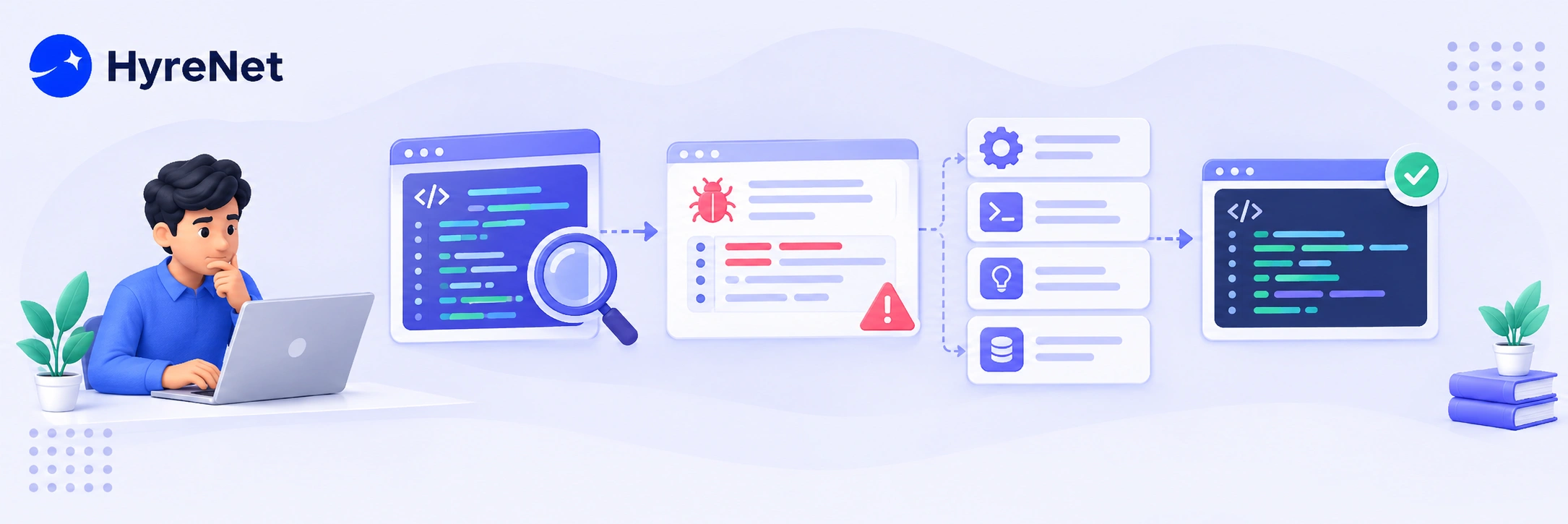
Debugging skills refer to a developer’s ability to locate, understand, and fix problems in existing code, often under time pressure and with incomplete information. Unlike writing code from a blank page, debugging requires reading someone else’s logic, forming hypotheses, and testing them systematically, which is exactly what most real engineering work actually looks like day to day.
This blog covers why debugging skills deserve more attention in your hiring process, practical ways to evaluate them, and a step-by-step method for building a debugging assessment that actually predicts job performance.
TL;DR Summary
- Debugging skills predict real job performance better than pure algorithm-writing ability
- Strong evaluation methods hand candidates broken code instead of asking them to write from scratch
- Watching how a candidate reasons through a problem matters as much as whether they fix it
- A mix of syntax, logic, and performance bugs gives a fuller picture of ability
- Communication during debugging reveals collaboration skills the code alone cannot show
- A structured rubric keeps scoring consistent across different interviewers
Why Debugging Skills Matter So Much in Hiring
Most day-to-day engineering work involves reading and fixing existing code, not writing brand new systems from a blank file, which is exactly where debugging skills come into play. Yet many technical interviews still focus almost entirely on writing fresh algorithms.
Debugging exercises flip that focus, testing whether a candidate can reason through someone else’s logic under realistic conditions. This maps far more closely to what the job actually demands than a classic whiteboard algorithm question.
Debugging also reveals traits that a clean coding exercise often hides, like patience, systematic thinking, and how someone handles the frustration of not immediately knowing the answer.
What Strong Debugging Skills Actually Look Like
Evaluating debugging skills well starts with knowing what good debugging behavior looks like in practice, not just whether the bug gets fixed.
- Reproducing the problem first: Strong candidates confirm they can trigger the bug before trying to fix it
- Forming and testing hypotheses: Rather than guessing randomly, they narrow down possible causes methodically
- Reading code carefully before changing it: Jumping straight to edits without understanding the logic often creates new bugs
- Explaining their thinking out loud: Clear reasoning during the process reveals how they will communicate on a real team
- Verifying the fix actually works: Confirming the original bug is resolved, and nothing else broke, before calling it done
Types of Debugging Exercises to Use
Testing different bug types gives you a fuller picture of a candidate’s debugging skills than relying on just one scenario.
| Bug Type | What It Tests | Example Scenario |
|---|---|---|
| Syntax and logic errors | Basic code reading and careful attention to detail | A function returning the wrong value due to an off-by-one error |
| Runtime errors | Ability to trace an error back to its actual cause | A null reference crash buried a few function calls deep |
| Performance issues | Understanding of efficiency and system behavior | A function that works but runs far slower than expected on large input |
| Intermittent or flaky bugs | Systematic thinking under uncertainty | A bug that only appears under specific, hard-to-reproduce conditions |
Do check out HyreNet’s guide to choosing the best online assessment platform for more on structuring technical assessments like this one.
How to Evaluate Debugging Skills Step by Step
These five steps cover a practical, repeatable process for evaluating this skill fairly.
1. Choose Realistic, Role-Relevant Bugs
Pull broken code from real, anonymized examples your team has actually encountered, rather than inventing artificial puzzles unrelated to your actual stack.
2. Mix Bug Types Across the Assessment
Include a syntax issue, a logic error, and at least one bug that requires tracing through multiple functions, so you see more than one dimension of ability.
3. Ask Candidates to Narrate Their Process
Request that candidates explain their reasoning as they work, since the thought process often matters more than whether they land on the fix quickly.
4. Score Against a Defined Rubric
Rate specific behaviors, like hypothesis testing and verification, not just whether the final answer was correct, so scoring stays consistent across interviewers.
5. Watch How They Handle Being Stuck
Give candidates a genuinely hard bug and observe what they do when their first few attempts fail. This often reveals more than an easy bug ever could.
Platforms like HyreNet support this kind of structured evaluation directly, since HyreNet’s remote assessment best practices emphasize realistic, role-specific tasks over generic algorithm puzzles.
A Simple Example of Debugging Skills in Action
Imagine handing two candidates the same broken function, one that is supposed to calculate a running total but returns the wrong number on the final item in a list.
Candidate A immediately starts changing lines of code at random, hoping something works, without first confirming where the calculation actually goes wrong.
Candidate B adds a few print statements, narrows the bug down to a loop boundary issue within two minutes, and only then makes a targeted, one-line fix.
Both candidates might eventually reach the same fix, but only one of them demonstrated the systematic debugging skills that translate reliably to real, more complex production issues.
Common Mistakes When Assessing This Skill
These mistakes quietly weaken how well an interview actually measures debugging skills.
- Only testing algorithm writing: Skipping debugging entirely misses a skill candidates will use constantly on the job
- Using bugs that are too obvious: A bug anyone can spot instantly does not differentiate skill levels effectively
- Focusing only on the final answer: Ignoring the reasoning process misses valuable signal about how someone actually thinks
- Inconsistent scoring across interviewers: Without a shared rubric, one interviewer’s “strong” is another’s “average”
For more on building a consistent, well documented technical assessment process, do check out HyreNet’s breakdown of common recruitment challenges.
Conclusion
Debugging skills often reveal more about how a candidate will actually perform on the job than a pure coding exercise ever will. The process of reasoning through broken code mirrors real engineering work far more closely than writing an algorithm from scratch.
Build your evaluation around realistic bugs, watch the reasoning process closely, and score consistently against a defined rubric. That approach turns a technical interview into a genuine predictor of who will actually thrive once they are debugging real production issues on your team.
FAQs
1. How long should a debugging exercise take in an interview?
Around 20 to 30 minutes is usually enough to see meaningful reasoning without exhausting the candidate or running out of interview time.
2. Should debugging exercises replace algorithm questions entirely?
Not necessarily. A mix of both gives a fuller picture, though debugging exercises often map more closely to daily engineering work.
3. What if a candidate never finds the bug?
That is still useful information. How they approached the problem, even without a fix, reveals real signal about their process and persistence.
4. Should candidates use their preferred debugging tools?
Yes, when possible. Letting candidates use familiar tools like print statements or a debugger shows how they actually work, not how they perform under artificial constraints.
5. How do I keep debugging assessments fair across different interviewers?
A shared rubric scoring specific behaviors, like hypothesis testing and verification, keeps evaluations consistent regardless of who is conducting the interview.