


A strong resume does not always mean a strong candidate. Applicants can have similar qualifications on paper yet perform very differently once they start working. Recruiters therefore need a reliable way to identify candidates who genuinely match the role.
Candidate screening helps hiring teams narrow a large applicant pool into a smaller group of qualified candidates. The process can include resume screening, skills assessments, screening calls, and structured evaluation methods.
Effective screening also saves time later in the hiring process. Recruiters can focus interviews on candidates who have already demonstrated relevant skills or experience.
This guide explains how candidate screening works and explores the best methods for identifying top talent:
TL;DR
- Candidate screening helps recruiters narrow large applicant pools into qualified shortlists.
- Strong methods include resume screening, skills assessments, work samples and structured screening interviews.
- Job-relevant assessments provide better evidence of practical ability than resumes alone.
- AI tools can automate resume parsing, assessment delivery, scheduling and screening analytics.
- Clear criteria, structured scoring and human oversight improve screening quality and candidate experience.
- 79% of HR professionals say skills assessment scores are as important as traditional hiring criteria.
- 78% of HR professionals say assessments improved their quality of hire.
- 56% of employers use pre-employment assessments to measure candidate skills and knowledge.
What Is Candidate Screening?
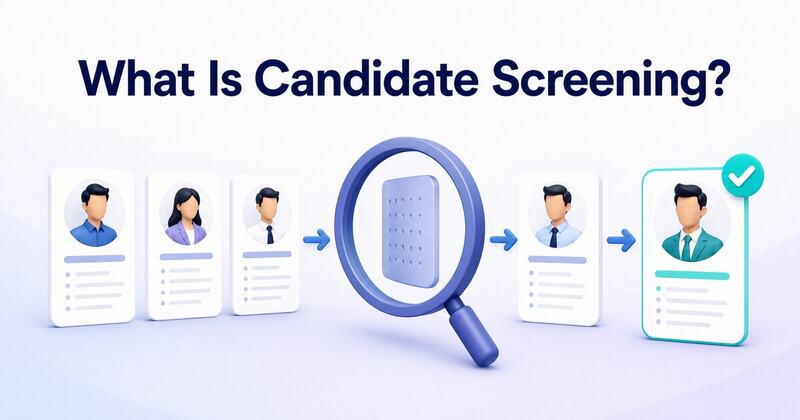
Candidate screening is the process of evaluating job applicants to determine who should move forward in the hiring process. It usually happens after applications are received and before detailed interviews begin.
Recruiters compare candidates against predefined job requirements. These requirements may include technical skills, relevant experience, qualifications or other role-specific competencies.
The goal is not simply to remove applicants. Effective screening identifies candidates who have meaningful evidence of their ability to perform the job.
A typical candidate screening process may involve:
- Reviewing applications and resumes
- Checking minimum job requirements
- Conducting initial screening calls
- Administering skills assessments
- Comparing results using structured criteria
- Shortlisting candidates for interviews
Each stage should answer a specific question about the candidate’s suitability.
Why Is Candidate Screening Important?
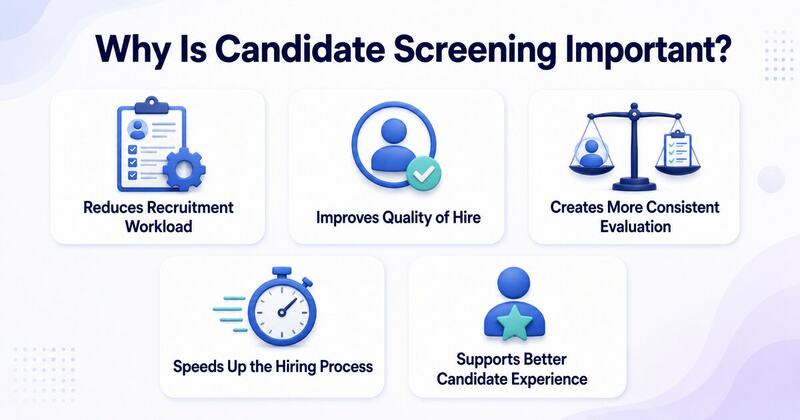
- Reduces Recruitment Workload
Screening helps recruiters identify unsuitable applications before investing time in detailed interviews.
This becomes particularly important during high-volume recruitment. Hiring teams can prioritize candidates who meet the essential requirements instead of reviewing every application with the same level of detail.
- Improves Quality of Hire
A candidate may have an impressive resume without possessing the practical skills required for the position.
Adding skills assessments, technical assessments and job-related screening methods gives recruiters more evidence before making interview decisions.
- Creates More Consistent Evaluation
Unstructured screening can vary significantly between recruiters.
One recruiter may prioritize education while another focuses on previous employers. Clear screening criteria give hiring teams a common framework for evaluating candidates.
- Speeds Up the Hiring Process
Poor screening can fill interview calendars with candidates who do not match the position.
Effective candidate screening narrows the applicant pool earlier. Recruiters can spend their interview time on candidates with stronger potential.
- Supports Better Candidate Experience
Long hiring processes can frustrate applicants.
Clear screening stages help candidates understand what comes next. Timely updates also prevent applicants from waiting unnecessarily for a decision.
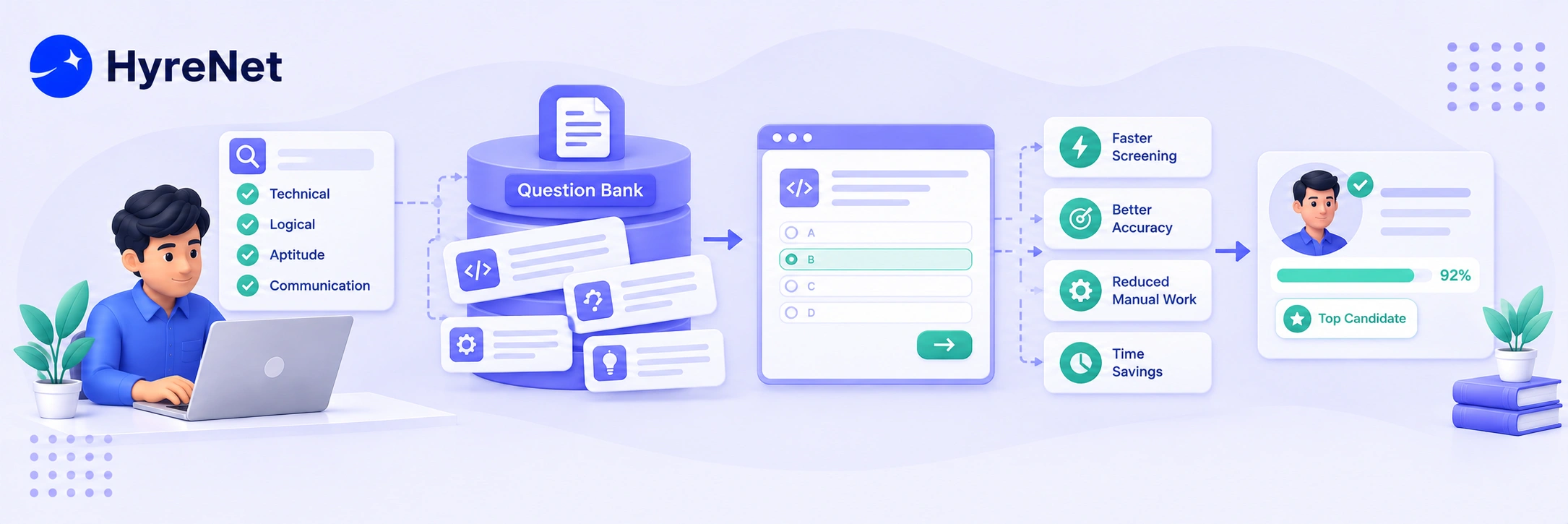
Make candidate screening smarter and more accurate with HyreNet’s data-backed hiring platform. Screen applicants faster, identify top talent with structured assessments, reduce manual review, improve hiring efficiency, and build a reliable recruitment workflow that supports better hiring decisions.
What Are the Best Candidate Screening Methods?
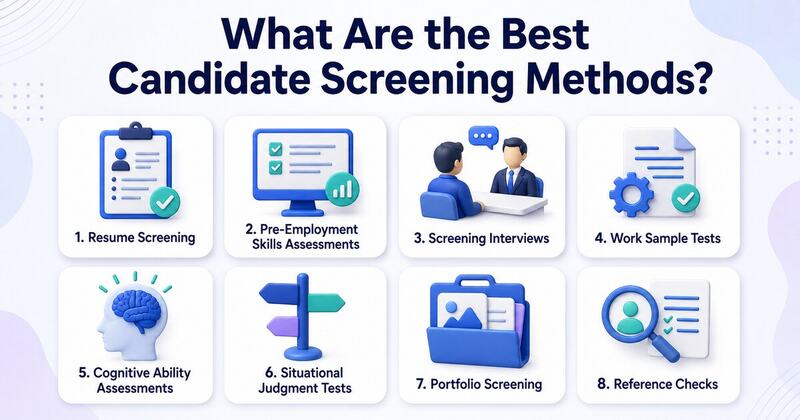
There is no single candidate assessment method that works for every job. The right approach depends on the skills and responsibilities associated with the position.
The following candidate assessment methods can provide recruiters with different types of evidence.
1. Resume Screening
Resume screening is usually the first step.
Recruiters review applications for essential qualifications, relevant experience and job-related skills. Applicant tracking systems can also help organize resumes or filter applications using predefined requirements.
However, resumes should not become the only screening method.
A resume tells recruiters what candidates say they have done. It does not always demonstrate how well they can perform a task.
Recruiters should therefore use resume screening as an initial filter rather than a complete evaluation.
2. Pre-Employment Skills Assessments
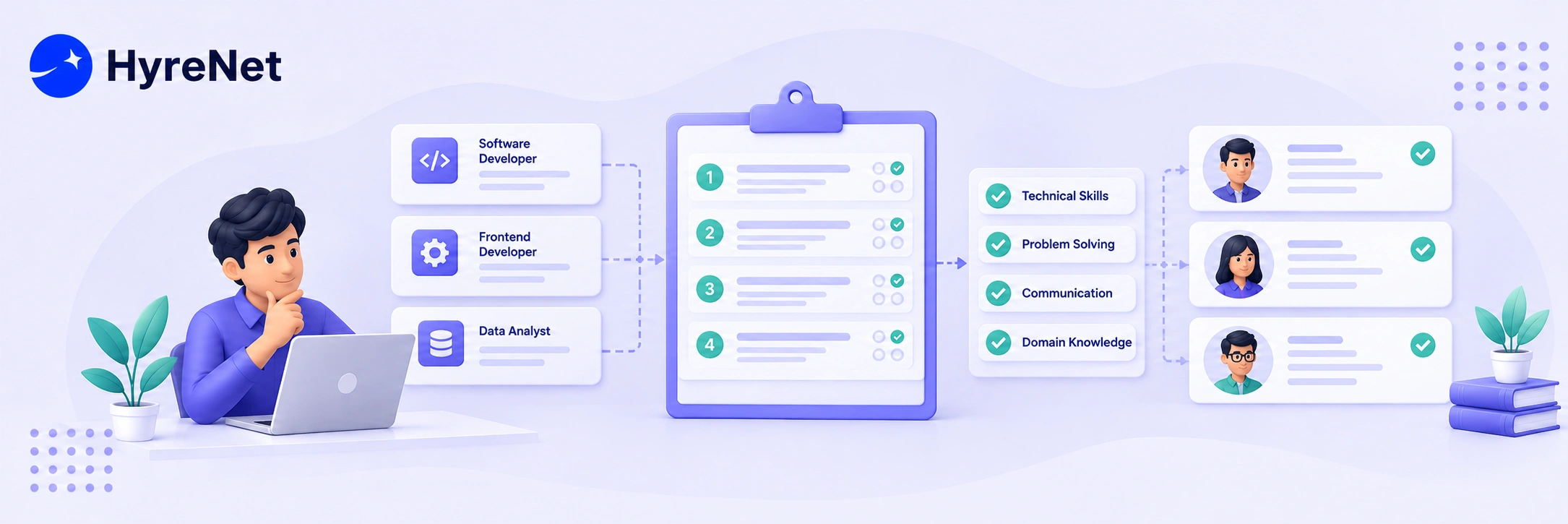
Skills assessments evaluate whether candidates can perform tasks related to the actual position.
A software developer might complete a coding assessment. A content writer could complete an editing exercise. A data analyst may need to interpret a dataset and explain the findings.
Assessments can measure:
- Technical knowledge
- Problem-solving ability
- Job-specific skills
- Communication
- Attention to detail
- Workplace judgment
The assessment should closely reflect the responsibilities candidates would handle after joining.
3. Screening Interviews
A short screening interview helps recruiters verify information before arranging a detailed interview.
These conversations can cover availability, relevant experience, role expectations and basic job requirements.
Recruiters should use a consistent set of core questions across candidates applying for the same position. This makes responses easier to compare.
4. Work Sample Tests
Work samples ask candidates to complete a realistic task similar to something they would perform on the job.
A designer may create a small visual concept. A salesperson might prepare a mock sales pitch. A customer support candidate could respond to a sample customer complaint.
This method moves screening beyond claims on a resume.
Recruiters can see how candidates approach realistic work and evaluate the final output using predefined criteria.
The task should remain reasonable in scope. Screening exercises should not become unpaid project work.
5. Cognitive Ability Assessments
Some positions require strong numerical reasoning, logical thinking or problem-solving ability.
Cognitive assessments can help measure these abilities through standardized questions.
These tests should only be used when the abilities being measured have a clear connection to job performance. Employers should avoid adding assessments simply because they are available.
6. Situational Judgment Tests
Situational judgment tests present candidates with realistic workplace scenarios.
Candidates choose or describe how they would respond to each situation.
For example, a customer service candidate might receive a scenario involving an unhappy customer. The response can show how the applicant prioritizes communication and problem resolution.
These assessments can be useful for roles where workplace decisions form an important part of everyday responsibilities.
7. Portfolio Screening
Portfolios provide direct evidence of previous work.
They are particularly valuable for writers, designers, developers and other professionals whose output can be demonstrated through completed projects.
Recruiters should evaluate portfolios against consistent criteria rather than relying entirely on personal preferences.
8. Reference Checks
Reference checks usually happen later in candidate screening.
They can help verify employment details and provide additional context about previous responsibilities.
Reference checks work best as supporting evidence. They should not replace skills assessments or structured interviews.
How Do Candidate Screening Methods Compare?
Different screening methods answer different hiring questions.
| Screening Method | What It Evaluates | Best Used For |
| Resume screening | Experience and qualifications | Initial filtering |
| Skills assessment | Practical ability | Technical and skill-based roles |
| Screening interview | Basic suitability and expectations | Early candidate verification |
| Work sample | Realistic job performance | Practical and creative roles |
| Cognitive assessment | Reasoning and problem solving | Roles requiring analytical thinking |
| Situational judgment test | Workplace decision making | Customer-facing and operational roles |
| Portfolio review | Previous work quality | Creative and technical positions |
| Reference check | Previous employment information | Later-stage verification |
How Does Automated Candidate Screening Work?
Automated candidate screening uses recruitment technology to support repetitive parts of the screening process.
An applicant tracking system may organize candidates based on predefined requirements. Assessment platforms can automatically send tests after applicants reach a certain stage. Scheduling tools can then invite shortlisted candidates to screening interviews.
Automation can be particularly useful when application volumes are high.
However, automated screening should not mean automatic decision-making.
Recruiters should understand the criteria being used and regularly review screening outcomes. Human oversight remains important when technology influences who progresses through the recruitment process.
How to Build an Effective Candidate Screening Process
Good candidate screening begins before the first resume arrives.
1. Define the Role Clearly
Start by identifying what successful performance actually requires.
Separate essential requirements from skills that can be learned after hiring. This prevents recruiters from rejecting promising candidates based on unnecessary criteria.
2. Create Standard Screening Criteria
Decide how candidates will be evaluated before reviewing applications.
For example, a technical position may include minimum technical knowledge followed by a coding assessment and structured interview.
Using the same core criteria improves consistency.
3. Match Assessments to the Job
Every assessment should have a purpose.
Do not give candidates a lengthy numerical reasoning test when numerical reasoning has little relevance to the role.
Job-related assessments produce more useful screening information and create a more reasonable candidate experience.
4. Use a Scoring Framework
Define how responses or assessments will be scored before evaluation begins.
A work sample might be rated on accuracy, task completion and role-specific skills.
Structured scoring makes candidate comparisons clearer and reduces reliance on general impressions.
5. Keep the Process Reasonable
More screening does not automatically mean better screening.
Too many assessments or interview stages can increase candidate drop-off. Use only the steps needed to gather meaningful hiring evidence.
6. Combine Multiple Data Points
One screening method rarely provides a complete picture.
A resume may demonstrate experience while an assessment demonstrates practical ability. A structured interview can then provide additional context.
Combining relevant evidence can support a more informed decision.
7. Review Screening Results
Track what happens to candidates after they pass screening.
Recruiters can compare screening scores with interview performance and eventual hiring outcomes. This can reveal whether current screening methods are identifying suitable candidates.
AI Tools for Candidate Screening
| AI tool | How it supports candidate screening |
| AI resume parser | Extracts skills, education, experience and contact details from resumes in a structured format. |
| AI resume screening tool | Matches candidate profiles with job requirements and helps recruiters shortlist relevant applicants faster. |
| Applicant tracking system | Centralizes applications and tracks each candidate through the hiring pipeline. |
| Skills assessment platform | Sends role-based tests and compares candidate performance through standardized scores. |
| AI chatbot | Answers basic candidate questions and collects initial screening details before recruiter review. |
| Interview scheduling tool | Lets shortlisted candidates choose available slots and reduces back-and-forth emails. |
| Video interview analysis tool | Helps review recorded interviews with structured evaluation support. Recruiters should use it carefully with human oversight. |
| Recruitment analytics dashboard | Tracks screening metrics such as pass rates, drop-off points, time to screen and assessment completion. |
Common Candidate Screening Mistakes to Avoid
Even a structured process can become ineffective when screening criteria are poorly designed.
- Using vague job requirements: Broad requirements make consistent candidate comparisons difficult.
- Over-relying on resumes: Previous job titles or employers do not automatically demonstrate current ability.
- Using irrelevant assessments: Tests that do not reflect the job add friction without providing useful evidence.
- Making screening too lengthy: Excessive assessments can cause qualified candidates to abandon the process.
- Relying entirely on automation: Automated recommendations still require appropriate criteria and human oversight.
- Changing standards between candidates: Different evaluation standards make results difficult to compare fairly.
How can technology improve candidate screening?
Technology can improve candidate screening through an AI-powered recruitment automation platform. It can parse resumes, match candidate profiles with job descriptions and rank applicants based on role-specific requirements.
A modern candidate assessment platform can also deliver coding tests, aptitude tests, communication tasks, domain-based quizzes and situational judgment tests. These assessments give recruiters measurable proof of skills instead of depending only on resumes.
Automation also helps with one common recruitment challenge. It reduces manual follow-ups by sending test links, reminders and status updates automatically. Recruiters can then track completion rates, scores and shortlisted profiles from one dashboard.
This makes screening faster and more structured. Recruiters still review the final context before making hiring decisions.
Conclusion
Candidate screening helps recruiters turn a large applicant pool into a focused shortlist of qualified candidates.
Resume screening can identify basic eligibility while skills assessments and work samples provide evidence of practical ability. Structured screening interviews and situational assessments can add further context.
The best approach combines relevant screening methods with clear evaluation criteria. It also keeps the process short enough to maintain candidate engagement.
Effective candidate screening is not about finding the most impressive resume. It is about identifying candidates who can demonstrate the skills and capabilities needed to succeed in the role.
FAQs
What is candidate screening?
Candidate screening is the process of evaluating job applicants against predefined role requirements before deciding who should progress to later hiring stages.
What are the best candidate screening methods?
Common methods include resume screening, skills assessments, work samples, screening interviews, situational judgment tests, portfolio reviews and reference checks.
How do you screen candidates effectively?
Define job requirements first and create consistent screening criteria. Use job-relevant assessments and structured scoring to compare candidates using meaningful evidence.
Can candidate screening be automated?
Yes. Technology can automate tasks such as application organization, assessment delivery and interview scheduling. Recruiters should maintain human oversight over important candidate decisions.
Why are skills assessments useful in candidate screening?
Skills assessments allow candidates to demonstrate practical abilities instead of relying entirely on qualifications or self-reported experience. They can help recruiters identify applicants who possess the skills required for the role.