All
Explore a variety of blog posts on our site.


Explore a variety of blog posts on our site.

30 Aug, 2026
5 Min Read
What happens when hiring teams need speed but cannot afford to lose human judgment? That is where the comparison between AI recruitment vs traditional recruitment becomes important. Traditional recruitment depends on recruiters for sourcing, screening, scheduling and interviews. AI recruitment supports the same process with automation, analytics and assessment tools. Both approaches solve different hiring […]


What happens when hiring teams need speed but cannot afford to lose human judgment? That is where the comparison between AI recruitment vs traditional recruitment becomes important. Traditional recruitment depends on recruiters for sourcing, screening, scheduling and interviews. AI recruitment supports the same process with automation, analytics and assessment tools.
Both approaches solve different hiring problems. Traditional recruitment brings context and human understanding. AI recruitment brings speed and structure. The best hiring process connects both so recruiters can save time without losing the judgment needed to choose the right candidate.
TL;DR
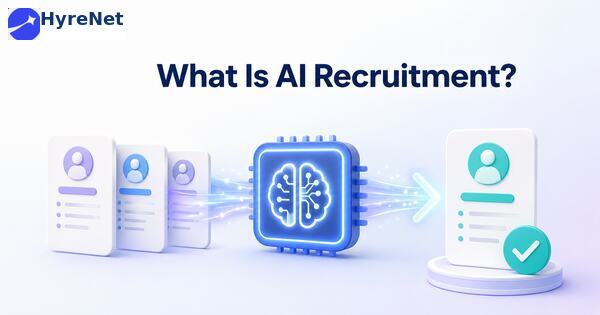
AI recruitment uses artificial intelligence and automation tools to support different stages of hiring. These tools can help recruiters source candidates, screen resumes, schedule interviews, send updates and analyze recruitment data.
For example, an AI resume screening tool can scan applications against job-related criteria. A chatbot can answer basic candidate questions. A recruitment analytics dashboard can show candidate conversion, assessment completion and candidate drop-off across the recruitment funnel.
Traditional recruitment relies on recruiters to handle tasks such as sourcing, resume screening and interview scheduling manually.
It gives teams greater control and supports direct candidate relationships. However, managing high application volumes can become a major recruitment challenge. Manual screening can also lead to inconsistent evaluation between recruiters.
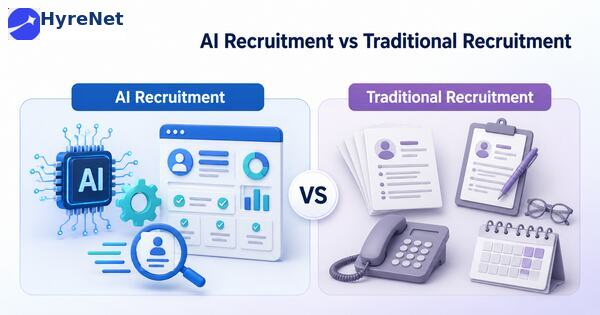
| Area | AI recruitment | Traditional recruitment |
| Resume screening | Uses AI tools to organize and shortlist profiles | Recruiters manually review applications |
| Candidate communication | Automated messages and chatbots support updates | Recruiters send emails and calls manually |
| Interview scheduling | Candidates choose available slots through tools | Scheduling depends on back-and-forth communication |
| Recruitment analytics | Dashboards track hiring metrics and trends | Data may be scattered across systems |
| Candidate screening | Uses predefined rules and assessments | Depends mainly on recruiter review |
| Speed | Faster for repetitive stages | Slower during high-volume hiring |
| Human judgment | Needed for review and final decisions | Central across every stage |
| Scalability | Easier to manage large applicant pools | Requires more recruiter time |
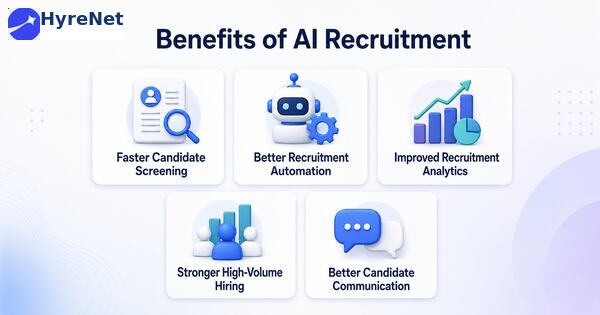
Manual resume screening can take several hours for a single role.
AI tools can organize applications based on predefined job requirements. Recruiters can then review a focused shortlist instead of starting with every resume manually.
This saves time and helps teams move qualified candidates forward faster.
Recruitment automation reduces repetitive administrative work.
Tools can send assessment links, schedule interviews and update candidates automatically. This allows recruiters to focus on interviews, hiring manager alignment and candidate engagement.
Automation also supports consistency because the same workflow can be applied to candidates at the same stage.
AI recruitment tools can collect data from different hiring stages.
Recruiters can track recruitment KPIs such as time to hire, cost per hire, source of hire and offer acceptance rate. They can also monitor assessment completion and candidate drop-off.
These insights help teams identify weak stages in the recruitment funnel.
Companies hiring for multiple roles often receive hundreds or thousands of applications.
AI recruitment helps organize this volume. It can prioritize candidates based on relevant criteria and reduce the pressure on recruiters.
This is useful for campus hiring, customer support roles, sales hiring and technical recruitment.
Candidates often leave the hiring process when they do not receive timely updates.
Automated messages can confirm applications, remind candidates about assessments and share interview instructions. This improves transparency and reduces unnecessary follow-ups.
Make modern hiring smarter with HyreNet’s AI-driven recruitment platform. Compare AI recruitment and traditional recruitment with clearer candidate insights, faster screening, structured assessments, reduced manual workload, and data-backed hiring workflows that help teams identify the right talent with confidence.
Recruiters can understand candidate motivation, career goals and communication style through direct conversations.
This matters in senior hiring and roles where culture fit and leadership potential are important.
A resume may not tell the full story.
A candidate with a career gap may still have strong skills. A person changing industries may bring valuable experience from another field.
Human recruiters can interpret these details more carefully than automated systems.
Traditional recruitment allows recruiters to adjust conversations based on candidate responses.
This flexibility is useful for complex roles where standard screening criteria may not capture everything.
Recruiters often build long-term relationships with candidates.
A candidate may not be the right fit today but could be suitable for a future role. Traditional recruitment supports this relationship-building more naturally.
AI-based recruitment can improve hiring but only when implemented carefully.
AI tools depend on the data and rules behind them.
Poorly designed criteria can screen out suitable candidates or reinforce bias. Recruiters should review the logic behind automated recommendations and audit outcomes regularly.
A system can rank candidates but it cannot understand every human context.
Recruiters should not treat AI recommendations as final decisions. Important candidate progression decisions should include human review.
Too much automation can make hiring feel impersonal.
Candidates may feel frustrated when they only interact with chatbots or automated emails. Recruiters should remain available for important questions and sensitive updates.
AI recruitment tools process personal candidate data.
Companies must evaluate how vendors store and use applicant information. Clear data retention policies and access controls are important.
Manual screening, scheduling and follow-ups take time.
This can become a serious recruitment challenge when companies need to fill roles quickly or manage high application volumes.
Different recruiters may evaluate the same resume differently.
One recruiter may focus on education while another prioritizes experience. Structured criteria are needed to make candidate screening more consistent.
Traditional recruitment often lacks strong data tracking.
Recruiters may know how many candidates applied but not where candidates dropped off or which source produced the best hires.
Recruiters spend a large part of their time on repetitive tasks.
This can reduce the time available for strategic hiring conversations and candidate engagement.
AI recruitment is most useful in repetitive and data-heavy hiring stages.
It works well for:
A remote hiring assessment can also be managed more easily with technology. Recruiters can send assessments, track completions and compare scores through a structured platform. These use cases improve hiring speed without removing recruiters from final decisions.
Traditional recruitment works best when roles require deeper human evaluation.
It is useful for:
Human recruiters can understand nuance, motivation and context more effectively.
The better approach depends on hiring needs.
AI recruitment is stronger for speed, structure and scale. Traditional recruitment is stronger for judgment, relationships and personal candidate engagement.
Most hiring teams need both.
A company can use AI tools to manage repetitive work and use recruiters for deeper evaluation. For example, technology can organize resumes and send assessments. Recruiters can then review shortlisted candidates, conduct interviews and make final recommendations.
This blended model gives teams the efficiency of AI in recruitment and the reliability of human judgment.
Recruiters should decide what matters before using any tool.
The criteria should reflect the actual job requirements. This prevents both manual and automated screening from becoming inconsistent.
Technology should support decisions rather than replace accountability.
Recruiters should review candidate shortlists and investigate unusual screening patterns.
Hiring teams should measure results across the recruitment funnel.
Useful KPIs include time to hire, source of hire, cost per hire, assessment completion and offer acceptance. These metrics show whether the process is improving.
Recruitment teams should monitor where candidates leave the process.
Long applications, unclear assessment instructions and delayed interview scheduling can increase candidate drop-off. Automation can help with reminders but the process still needs to feel reasonable.
Recruitment analytics can show which sourcing channels and screening stages perform best.
Teams should use this data to improve specific parts of hiring instead of making broad process changes without evidence.
Automated updates are useful but they should not replace all human interaction.
Recruiters should personally handle feedback, complex questions and final-stage conversations.
| Tool name | Purpose |
| HyreNet | Supports AI-powered candidate screening, assessments and recruitment workflows. |
| HireVue | Supports video interviews and structured candidate evaluation. |
| Greenhouse | Tracks candidates and manages structured hiring pipelines. |
| Lever | Helps manage candidate relationships and hiring stages. |
| Paradox | Uses conversational AI for candidate communication and scheduling. |
| Eightfold AI | Supports talent matching and skills-based candidate discovery. |
| HackerRank | Provides coding assessments for technical hiring. |
| TestGorilla | Offers skills tests for pre-employment assessment. |
| Calendly | Helps schedule interviews without repeated emails. |
| Tableau | Builds recruitment analytics dashboards for hiring KPIs. |
AI recruitment and traditional recruitment are not direct opposites. They solve different hiring problems.
AI recruitment helps teams move faster, automate repetitive tasks and track recruitment KPIs more effectively. Traditional recruitment brings human judgment, personal connection and contextual understanding.
The best hiring process combines both.
Recruiters caAI recruitment is better for speed, automation and high-volume hiring. Traditional recruitment is better for relationship-building, contextual judgment and final candidate evaluation.
n use technology for sourcing, screening, assessments and analytics. They can then apply human judgment during interviews, decision-making and candidate engagement.
The future of hiring is not about choosing machines over people. It is about building a smarter process where technology handles routine work and recruiters focus on decisions that truly need human insight.

A candidate may spend only a few minutes applying for a job but the experience can influence how they view the company for much longer.
Candidate experience covers every interaction a job seeker has with an employer during recruitment. It starts with the job post and continues through application, assessment, interviews, communication and final hiring decisions.
A strong candidate experience helps companies attract better talent, reduce candidate drop-off and protect their employer brand. A poor experience can push qualified applicants away even when the role itself is attractive.
This guide explains what candidate experience means, why it matters and how recruiters can improve it across the hiring process.
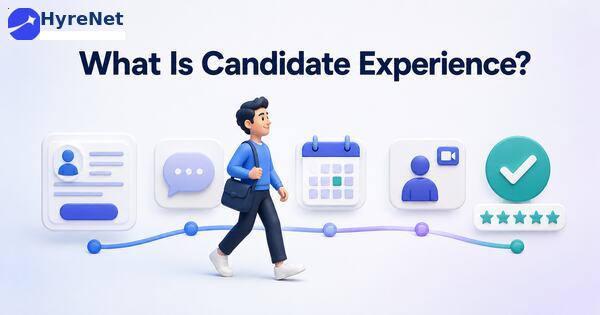
Candidate experience is the perception a job seeker develops about an employer during the recruitment process.
It is shaped by both major and minor interactions.
A candidate may judge the company based on:
Candidate experience therefore affects more than successful hires. Candidates who are rejected still leave the process with an opinion about the employer.
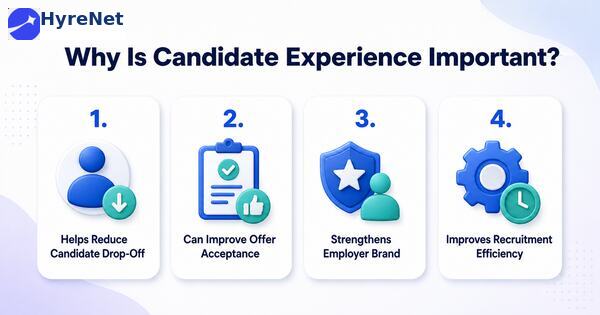
Candidates may leave the recruitment funnel when the process becomes too demanding or unclear.
Common reasons include:
Recruitment teams should identify where candidates leave and investigate what is causing the friction.
A candidate may receive several offers at the same time.
Salary matters but the recruitment experience also influences the decision.
Fast communication and organized interviews can make the employer appear more professional and reliable.
Applicants often discuss hiring experiences with friends or professional networks.
A poorly managed recruitment process can therefore affect people beyond the original candidate.
A respectful process helps employers maintain a stronger reputation even among rejected applicants.
Poor candidate experience often creates extra work for recruiters.
Candidates send repeated emails when they do not know their application status. Recruiters then spend more time answering questions that could have been prevented with clear communication.
A structured recruitment workflow reduces this unnecessary back-and-forth.
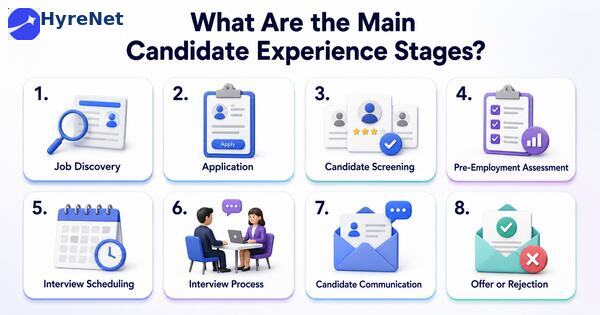
The experience starts before the application.
Candidates first evaluate whether the vacancy appears relevant and trustworthy.
A useful job description should clearly mention:
Employers should avoid vague phrases that do not explain what the candidate will actually do.
The next stage is the application itself.
A candidate should not need 30 minutes to complete a form for an initial application when a resume already contains most of the required information.
Application forms should request only necessary details.
Useful improvements include:
Every additional step creates another opportunity for candidate drop-off.
Screening and candidate assessment determines who moves forward.
Candidates may be evaluated through resume review, eligibility questions, screening calls or structured assessments. The criteria should relate directly to the role. For example, a developer may be evaluated on coding ability rather than only educational background. A sales candidate may be assessed on communication and objection handling instead of generic aptitude alone.
Assessments can improve hiring quality but poorly designed tests can damage candidate experience.
Candidates should know:
The assessment should also resemble actual job requirements. A technical candidate should not complete a lengthy generic test when the role mainly depends on practical coding skills.
Scheduling delays often create unnecessary friction. Traditional scheduling may require several emails to find a suitable time. Scheduling tools can allow candidates to select from available interview slots directly.
Recruiters should also consider:
A simple scheduling process can improve both recruiter productivity and candidate experience.
The interview is one of the most important stages in the candidate journey. Interviewers should understand the candidate’s background before the conversation begins. Candidates should not have to explain the same information repeatedly across several rounds.
A structured interview process should include:
This makes interviews more useful for both candidates and hiring teams.
Candidates should not have to guess what happens next.
Recruiters should communicate after important milestones such as:
Automated messages can handle basic updates. Recruiters should personally manage more sensitive communication.
Candidate experience continues until the recruitment process officially ends. Successful candidates need clear information about compensation, joining dates and onboarding requirements. Rejected candidates should also receive closure. Leaving applicants without any final communication can damage employer perception.
Improve candidate experience in recruitment with HyreNet’s smarter hiring platform. Create clearer assessments, reduce candidate drop-offs, simplify screening workflows, improve communication, and build a more candidate-friendly recruitment process that helps hiring teams attract and retain better talent.
A long hiring process can become a major recruitment challenge when several weeks pass between stages. Delays may cause candidates to lose interest or accept offers from other employers.
Candidates often become frustrated because they do not know how many stages remain.
Recruiters should explain the expected recruitment journey early.
Assessments should provide useful hiring information.
Too many tests can make candidates feel that the company does not value their time.
Candidates should not answer the same questions in every interview round.
Recruiters can prevent this by sharing interview notes and assigning clear evaluation areas to each interviewer.
Automated messages are useful but they should still provide meaningful information.
“Your application is under review” is less helpful when the candidate has already waited several weeks.
Updates should explain the actual status where possible.
Recruiters should review every stage from the candidate’s perspective.
Create a simple recruitment funnel such as:
Job View → Application → Screening → Assessment → Interview → Offer
Then identify:
This creates a clear starting point for improvement.
Recruitment teams can define internal response targets.
For example:
These targets make communication more consistent.
Assessments should answer a real hiring question.
For example:
Recruiters should remove tests that do not contribute meaningful evidence.
Every interview should have a defined purpose.
One round may assess technical skills.
Another may evaluate communication or team fit.
Repeating the same evaluation across several interviews wastes both candidate and recruiter time.
Automation works well for routine updates.
Recruiters should personally handle:
This maintains human connection without adding unnecessary manual work.
Candidates increasingly interact with recruitment processes through mobile devices.
Application forms and assessment platforms should work properly on smaller screens where the hiring method allows it.
Recruiters should test the actual candidate journey instead of assuming it works.
Technology can remove administrative friction from recruitment. The strongest use cases are usually repetitive tasks.
For example, an automated assessment reminder can reduce missed tests. A scheduling platform can remove several rounds of emails. A recruitment dashboard can show where candidates leave the funnel. Technology becomes useful when it makes the process easier rather than simply adding another system candidates must use.
| Metric | What It Measures |
| Application completion rate | Percentage of candidates who finish applying |
| Candidate drop-off rate | Percentage leaving at a specific hiring stage |
| Assessment completion rate | Candidates who complete assigned assessments |
| Interview attendance rate | Candidates who attend scheduled interviews |
| Time to interview | Speed from application to interview |
| Offer acceptance rate | Percentage of candidates accepting offers |
| Candidate satisfaction score | Candidate perception of the hiring process |
| Time to hire | Overall recruitment speed |
Recruiters should calculate candidate progression at every stage.
For example:
This funnel shows exactly where candidate numbers fall.
A significant drop between assessment invitation and assessment completion may indicate:
Recruiters can then investigate the specific stage instead of redesigning the entire recruitment process.
Useful applications of AI in recruitment include:
AI tools can organize large application volumes according to predefined criteria.
Recruiters can then focus on stronger matches.
Candidates can receive application confirmations and assessment reminders without waiting for manual recruiter action.
Automated scheduling can connect candidate availability with recruiter calendars.
AI-supported dashboards can help identify hiring delays and candidate drop-off patterns.
Note: AI should still support recruiters rather than become the only decision-maker. Human review remains important for hiring decisions that require judgment and context.
HyreNet can help recruitment teams create a more structured candidate journey through AI-supported screening, assessments and hiring workflows.
Recruiters can use the platform to manage candidate evaluation more consistently and reduce repetitive recruitment work.
A structured system can help teams:
This allows recruiters to spend less time on repetitive administration and more time on candidate engagement and decision-making.
Recruitment teams can use the following checklist to improve the process.
Candidate experience is not a separate part of recruitment. It is the result of how the entire hiring process is designed.
A clear job description creates the first impression. A simple application keeps candidates engaged. Relevant assessments make evaluation feel fair. Timely communication reduces uncertainty.
Recruitment technology can improve speed through automation, scheduling and analytics. Recruiters still provide the human judgment and communication candidates expect during important decisions.
The strongest candidate experience therefore combines efficient technology with a clear and human recruitment process.
Candidate experience is the overall impression a candidate develops from every interaction with an employer during recruitment.
Clear communication, simple applications, relevant assessments, faster scheduling and timely hiring decisions can improve candidate experience.
Long hiring processes, unclear communication, repetitive interviews and irrelevant assessments are common causes.
Recruiters can measure application completion, candidate drop-off, assessment completion, offer acceptance and candidate satisfaction.
AI can support faster screening, automated updates, interview scheduling and recruitment analytics. Human recruiters should remain involved in important hiring decisions.

LinkedIn reports that companies making the most skills-based searches are 12% more likely to make a quality hire. This shows why hiring data matters beyond simply tracking applications.
Hiring teams collect information at almost every recruitment stage. They know where candidates come from, how long hiring takes and how applicants perform in assessments. The challenge is turning this data into better hiring decisions.
Recruitment analytics helps teams identify slow stages, compare sourcing channels and understand candidate progression. The goal is not to track every metric. It is to use the right data to answer specific recruitment questions.
This guide explains recruitment analytics, important metrics and practical ways to use recruitment data for better hiring decisions.
Recruitment analytics is the process of collecting and analyzing hiring data to understand recruitment performance.
It measures different parts of the candidate journey from sourcing and application to screening, interviews and hiring. Recruiters can then use these insights to identify patterns and improve their hiring process.
Consider a company receiving 1,000 applications for a technical position. Recruitment data may show that 400 candidates reach an assessment but only 100 complete it.
The completion rate tells recruiters where candidates are leaving. The next step is understanding why. The assessment may be too long or candidates may receive unclear instructions.
This is where recruitment analytics becomes useful. It turns hiring activity into measurable information that teams can investigate and improve.
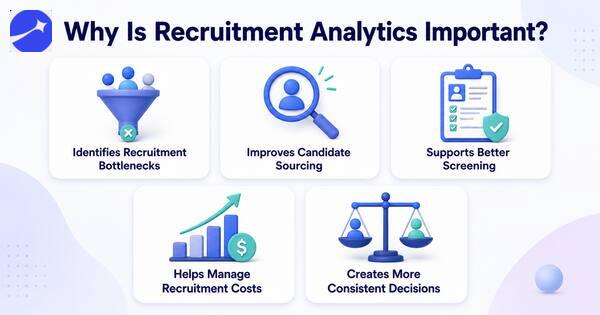
Recruitment analytics shows how long candidates spend at different stages.
A high time to hire may come from slow resume screening or delayed interviews. Identifying the exact stage allows recruiters to address the real problem.
Not every sourcing channel delivers the same results.
Recruiters can compare applications, qualified candidates, hiring assessment performance and eventual hires from job boards, referrals and other channels. This helps teams focus resources on sources that produce relevant candidates.
Screening data can reveal how candidates progress from applications to assessments and interviews.
A very low screening pass rate may indicate that the job advertisement is attracting unsuitable candidates. A very high pass rate may suggest that screening criteria are too broad.
Recruitment involves advertising costs, recruiter time and technology expenses.
Analytics helps companies understand what they spend to produce successful hires. Teams can then evaluate whether particular recruitment activities justify their cost.
Recruitment data gives hiring teams a common reference point.
Recruiters can use standardized assessment results and stage conversion data alongside interviews and other evidence. This reduces dependence on general impressions when evaluating the hiring process.
Make recruitment analytics more actionable with HyreNet’s data-backed hiring platform. Track key hiring metrics, improve candidate quality, reduce manual decision-making, identify recruitment bottlenecks, and build a smarter hiring workflow that helps teams make faster and more accurate talent decisions.
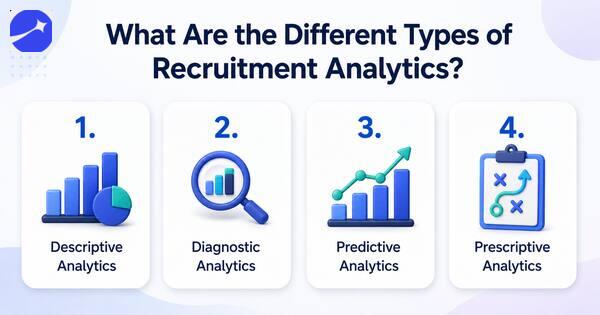
Descriptive analytics explains what has already happened.
It can answer questions such as:
This creates a baseline for understanding recruitment performance.
Diagnostic analytics examines why something happened.
Suppose assessment completion falls from 80% to 55%. Recruiters can investigate changes in assessment length, instructions or candidate communication.
This moves the analysis from identifying a problem to finding its possible cause.
Predictive recruitment analytics uses historical data and statistical models to estimate possible future outcomes.
For example, organizations may analyze previous hiring patterns to estimate future recruitment demand or expected time to fill.
Predictions should support planning rather than become automatic hiring decisions about individual candidates.
Prescriptive analytics focuses on possible actions.
Recruitment data may show that a particular sourcing channel produces qualified candidates at a lower cost. The team could then consider allocating more recruitment resources to that source.
Human judgment remains important when deciding how to act on these insights.
The right recruitment metrics depend on the question a hiring team wants to answer.
Several metrics are particularly useful for understanding overall recruitment performance.
Time to fill measures how long it takes to fill an open position.
It usually begins when a job is approved or opened and ends when a candidate accepts the offer.
A long time to fill can indicate sourcing difficulties or delays within the recruitment process.
Time to hire focuses on the candidate journey.
It measures the time between a candidate entering the hiring process and accepting an offer.
Tracking this metric helps teams understand how quickly suitable candidates move through screening, assessments and interviews.
Source of hire identifies where successful candidates originated.
Sources may include:
Recruiters can compare sources based on actual hiring outcomes rather than application volume alone.
Cost per hire measures the average recruitment cost associated with making a hire.
A simplified calculation is:
Cost per hire = Total recruitment costs ÷ Number of hires
Recruitment costs may include advertising, agency fees and recruitment technology expenses.
Candidate conversion rate measures how many applicants progress from one recruitment stage to another.
For example:
Stage conversion rate = Candidates reaching next stage ÷ Candidates entering current stage × 100
Suppose 200 candidates complete an assessment and 50 progress to interviews. The assessment-to-interview conversion rate is 25%.
Large changes between stages can highlight areas that need closer review.
Assessment completion rate measures how many invited candidates actually finish an assessment.
A low rate may indicate that the assessment is too long or poorly communicated. Technical problems can also affect completion.
This metric compares the number of candidates interviewed with the number receiving offers.
A team conducting 40 interviews to make two offers may need to examine its screening criteria.
Better early-stage screening can help recruiters spend interview time on more relevant candidates.
Offer acceptance rate measures the percentage of employment offers candidates accept.
A declining rate can indicate issues with compensation or hiring speed. Candidate expectations may also be misaligned earlier in the recruitment process.
Candidate drop-off measures how many applicants leave before completing a recruitment stage.
High drop-off during an application or assessment can become a major recruitment challenge. It may indicate that the process is too lengthy, unclear or difficult to complete.
| Recruitment metric | What it tells recruiters |
| Time to fill | How long positions remain open |
| Time to hire | How quickly candidates move through hiring |
| Source of hire | Which channels produce successful hires |
| Cost per hire | Average recruitment spending per hire |
| Conversion rate | How candidates progress between stages |
| Assessment completion | How many candidates finish assigned tests |
| Interview-to-offer ratio | How effectively screening produces strong interview candidates |
| Offer acceptance rate | How often candidates accept offers |
| Candidate drop-off | Where applicants leave the hiring process |
These metrics become more useful when analyzed together rather than separately.
Recruitment analytics can track performance across the entire hiring funnel.
At the sourcing stage, recruiters can compare candidate volume and source quality. During screening, they can monitor pass rates and processing time.
Assessment analytics can show completion rates and score distributions. Interview data can reveal how many candidates progress to offers.
Offer data then shows acceptance rates and hiring outcomes.
Connecting these stages gives recruiters a clearer view of the complete candidate journey.
For example, a sourcing channel may generate 500 applications but only five interviews. Another may generate 100 applications and produce 20 interviews.
The second source may provide greater value despite delivering fewer applicants.
Candidate screening generates valuable data about applicant progression.
Recruiters can analyze screening pass rates and assessment scores to understand whether their criteria are working as intended.
Suppose most applicants pass resume screening but fail the technical assessment. This could indicate that resume screening criteria do not accurately identify the required technical abilities.
Recruiters could then refine initial screening requirements or introduce a shorter skills check earlier.
Analytics therefore creates a feedback loop. Teams can measure results and adjust the process based on evidence.
AI can help recruitment teams process larger amounts of hiring data and identify patterns that may be difficult to spot manually.
AI-powered recruitment platforms may organize candidate data or identify unusual changes in recruitment metrics. Some tools can also summarize funnel performance and highlight stages with high drop-off.
However, AI-generated insights still require interpretation.
Recruiters should understand which data the system uses and how recommendations are generated. Human oversight becomes especially important when analytics influences decisions about individual candidates.
Collecting more data does not automatically improve recruitment.
Teams need a structured approach.
Define what you want to understand before selecting a metric.
A team struggling with slow hiring might focus on time to hire and stage duration. A team facing candidate drop-off may analyze application and assessment completion.
Metrics become difficult to compare when teams define them differently.
Establish consistent definitions for stages such as application, screening, assessment, interview and offer.
Avoid evaluating metrics in isolation.
High application volume may look positive until screening data reveals that most applicants are unsuitable.
Connecting sourcing, screening and hiring outcomes creates more useful insights.
A recruitment analytics dashboard can bring important metrics into one view.
Recruiters can monitor time to hire, candidate conversion and assessment completion without manually combining multiple spreadsheets.
Keep dashboards focused on metrics that support actual decisions.
A single month rarely provides enough context.
Compare recruitment performance across several hiring periods. Trends can reveal whether changes to screening, sourcing or remote hiring assessment workflows are producing sustained improvements.
Recruitment analytics relies on personal candidate information.
Organizations should establish appropriate access controls and retention policies. Teams should also understand how recruitment technology providers process and store candidate data.
Recruitment analytics turns hiring data into information recruiters can use to improve their processes.
Metrics such as time to hire, cost per hire and candidate conversion show what is happening across the recruitment funnel. Assessment completion and candidate drop-off can reveal where applicants encounter friction.
The strongest approach starts with a clear hiring question. Recruiters can then select relevant metrics and connect data across sourcing, screening, assessments and interviews.
Recruitment analytics is not about collecting the largest possible amount of data. It is about using the right data to make hiring processes more efficient and informed.

A strong resume does not always mean a strong candidate. Applicants can have similar qualifications on paper yet perform very differently once they start working. Recruiters therefore need a reliable way to identify candidates who genuinely match the role.
Candidate screening helps hiring teams narrow a large applicant pool into a smaller group of qualified candidates. The process can include resume screening, skills assessments, screening calls, and structured evaluation methods.
Effective screening also saves time later in the hiring process. Recruiters can focus interviews on candidates who have already demonstrated relevant skills or experience.
This guide explains how candidate screening works and explores the best methods for identifying top talent:
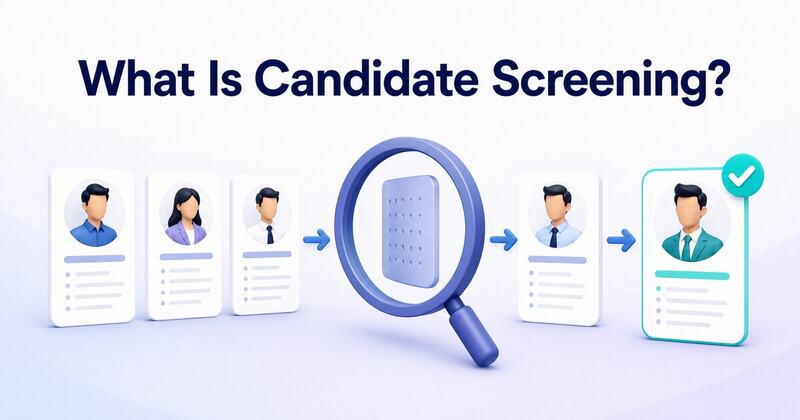
Candidate screening is the process of evaluating job applicants to determine who should move forward in the hiring process. It usually happens after applications are received and before detailed interviews begin.
Recruiters compare candidates against predefined job requirements. These requirements may include technical skills, relevant experience, qualifications or other role-specific competencies.
The goal is not simply to remove applicants. Effective screening identifies candidates who have meaningful evidence of their ability to perform the job.
A typical candidate screening process may involve:
Each stage should answer a specific question about the candidate’s suitability.
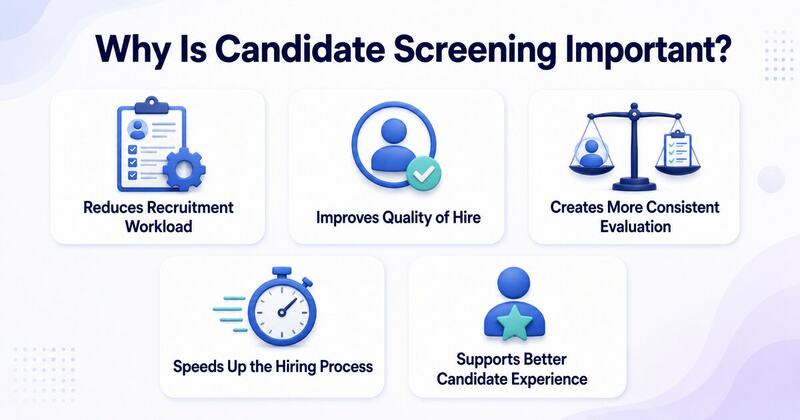
Screening helps recruiters identify unsuitable applications before investing time in detailed interviews.
This becomes particularly important during high-volume recruitment. Hiring teams can prioritize candidates who meet the essential requirements instead of reviewing every application with the same level of detail.
A candidate may have an impressive resume without possessing the practical skills required for the position.
Adding skills assessments, technical assessments and job-related screening methods gives recruiters more evidence before making interview decisions.
Unstructured screening can vary significantly between recruiters.
One recruiter may prioritize education while another focuses on previous employers. Clear screening criteria give hiring teams a common framework for evaluating candidates.
Poor screening can fill interview calendars with candidates who do not match the position.
Effective candidate screening narrows the applicant pool earlier. Recruiters can spend their interview time on candidates with stronger potential.
Long hiring processes can frustrate applicants.
Clear screening stages help candidates understand what comes next. Timely updates also prevent applicants from waiting unnecessarily for a decision.
Make candidate screening smarter and more accurate with HyreNet’s data-backed hiring platform. Screen applicants faster, identify top talent with structured assessments, reduce manual review, improve hiring efficiency, and build a reliable recruitment workflow that supports better hiring decisions.
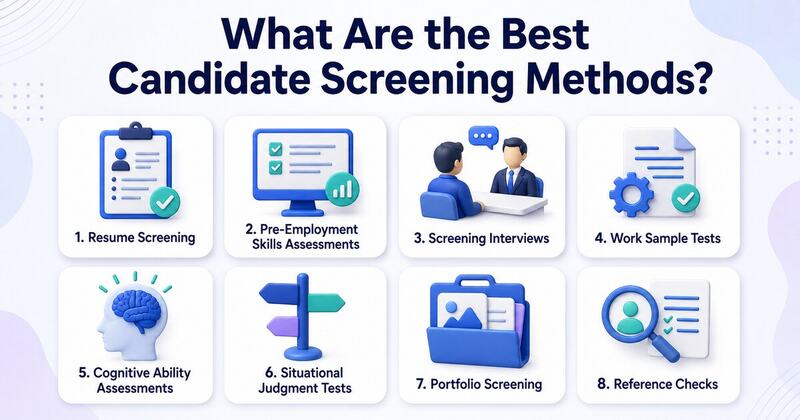
There is no single candidate assessment method that works for every job. The right approach depends on the skills and responsibilities associated with the position.
The following candidate assessment methods can provide recruiters with different types of evidence.
Resume screening is usually the first step.
Recruiters review applications for essential qualifications, relevant experience and job-related skills. Applicant tracking systems can also help organize resumes or filter applications using predefined requirements.
However, resumes should not become the only screening method.
A resume tells recruiters what candidates say they have done. It does not always demonstrate how well they can perform a task.
Recruiters should therefore use resume screening as an initial filter rather than a complete evaluation.
Skills assessments evaluate whether candidates can perform tasks related to the actual position.
A software developer might complete a coding assessment. A content writer could complete an editing exercise. A data analyst may need to interpret a dataset and explain the findings.
Assessments can measure:
The assessment should closely reflect the responsibilities candidates would handle after joining.
A short screening interview helps recruiters verify information before arranging a detailed interview.
These conversations can cover availability, relevant experience, role expectations and basic job requirements.
Recruiters should use a consistent set of core questions across candidates applying for the same position. This makes responses easier to compare.
Work samples ask candidates to complete a realistic task similar to something they would perform on the job.
A designer may create a small visual concept. A salesperson might prepare a mock sales pitch. A customer support candidate could respond to a sample customer complaint.
This method moves screening beyond claims on a resume.
Recruiters can see how candidates approach realistic work and evaluate the final output using predefined criteria.
The task should remain reasonable in scope. Screening exercises should not become unpaid project work.
Some positions require strong numerical reasoning, logical thinking or problem-solving ability.
Cognitive assessments can help measure these abilities through standardized questions.
These tests should only be used when the abilities being measured have a clear connection to job performance. Employers should avoid adding assessments simply because they are available.
Situational judgment tests present candidates with realistic workplace scenarios.
Candidates choose or describe how they would respond to each situation.
For example, a customer service candidate might receive a scenario involving an unhappy customer. The response can show how the applicant prioritizes communication and problem resolution.
These assessments can be useful for roles where workplace decisions form an important part of everyday responsibilities.
Portfolios provide direct evidence of previous work.
They are particularly valuable for writers, designers, developers and other professionals whose output can be demonstrated through completed projects.
Recruiters should evaluate portfolios against consistent criteria rather than relying entirely on personal preferences.
Reference checks usually happen later in candidate screening.
They can help verify employment details and provide additional context about previous responsibilities.
Reference checks work best as supporting evidence. They should not replace skills assessments or structured interviews.
Different screening methods answer different hiring questions.
| Screening Method | What It Evaluates | Best Used For |
| Resume screening | Experience and qualifications | Initial filtering |
| Skills assessment | Practical ability | Technical and skill-based roles |
| Screening interview | Basic suitability and expectations | Early candidate verification |
| Work sample | Realistic job performance | Practical and creative roles |
| Cognitive assessment | Reasoning and problem solving | Roles requiring analytical thinking |
| Situational judgment test | Workplace decision making | Customer-facing and operational roles |
| Portfolio review | Previous work quality | Creative and technical positions |
| Reference check | Previous employment information | Later-stage verification |
Automated candidate screening uses recruitment technology to support repetitive parts of the screening process.
An applicant tracking system may organize candidates based on predefined requirements. Assessment platforms can automatically send tests after applicants reach a certain stage. Scheduling tools can then invite shortlisted candidates to screening interviews.
Automation can be particularly useful when application volumes are high.
However, automated screening should not mean automatic decision-making.
Recruiters should understand the criteria being used and regularly review screening outcomes. Human oversight remains important when technology influences who progresses through the recruitment process.
Good candidate screening begins before the first resume arrives.
Start by identifying what successful performance actually requires.
Separate essential requirements from skills that can be learned after hiring. This prevents recruiters from rejecting promising candidates based on unnecessary criteria.
Decide how candidates will be evaluated before reviewing applications.
For example, a technical position may include minimum technical knowledge followed by a coding assessment and structured interview.
Using the same core criteria improves consistency.
Every assessment should have a purpose.
Do not give candidates a lengthy numerical reasoning test when numerical reasoning has little relevance to the role.
Job-related assessments produce more useful screening information and create a more reasonable candidate experience.
Define how responses or assessments will be scored before evaluation begins.
A work sample might be rated on accuracy, task completion and role-specific skills.
Structured scoring makes candidate comparisons clearer and reduces reliance on general impressions.
More screening does not automatically mean better screening.
Too many assessments or interview stages can increase candidate drop-off. Use only the steps needed to gather meaningful hiring evidence.
One screening method rarely provides a complete picture.
A resume may demonstrate experience while an assessment demonstrates practical ability. A structured interview can then provide additional context.
Combining relevant evidence can support a more informed decision.
Track what happens to candidates after they pass screening.
Recruiters can compare screening scores with interview performance and eventual hiring outcomes. This can reveal whether current screening methods are identifying suitable candidates.
| AI tool | How it supports candidate screening |
| AI resume parser | Extracts skills, education, experience and contact details from resumes in a structured format. |
| AI resume screening tool | Matches candidate profiles with job requirements and helps recruiters shortlist relevant applicants faster. |
| Applicant tracking system | Centralizes applications and tracks each candidate through the hiring pipeline. |
| Skills assessment platform | Sends role-based tests and compares candidate performance through standardized scores. |
| AI chatbot | Answers basic candidate questions and collects initial screening details before recruiter review. |
| Interview scheduling tool | Lets shortlisted candidates choose available slots and reduces back-and-forth emails. |
| Video interview analysis tool | Helps review recorded interviews with structured evaluation support. Recruiters should use it carefully with human oversight. |
| Recruitment analytics dashboard | Tracks screening metrics such as pass rates, drop-off points, time to screen and assessment completion. |
Even a structured process can become ineffective when screening criteria are poorly designed.
Technology can improve candidate screening through an AI-powered recruitment automation platform. It can parse resumes, match candidate profiles with job descriptions and rank applicants based on role-specific requirements.
A modern candidate assessment platform can also deliver coding tests, aptitude tests, communication tasks, domain-based quizzes and situational judgment tests. These assessments give recruiters measurable proof of skills instead of depending only on resumes.
Automation also helps with one common recruitment challenge. It reduces manual follow-ups by sending test links, reminders and status updates automatically. Recruiters can then track completion rates, scores and shortlisted profiles from one dashboard.
This makes screening faster and more structured. Recruiters still review the final context before making hiring decisions.
Candidate screening helps recruiters turn a large applicant pool into a focused shortlist of qualified candidates.
Resume screening can identify basic eligibility while skills assessments and work samples provide evidence of practical ability. Structured screening interviews and situational assessments can add further context.
The best approach combines relevant screening methods with clear evaluation criteria. It also keeps the process short enough to maintain candidate engagement.
Effective candidate screening is not about finding the most impressive resume. It is about identifying candidates who can demonstrate the skills and capabilities needed to succeed in the role.

Recruiters spend a significant part of their day on repetitive administrative work. They review applications, schedule interviews, send follow-ups and update candidate records. These tasks are essential but they can leave less time for meaningful candidate conversations and hiring decisions.
Recruitment automation changes this process by using software to handle repetitive and rule-based hiring tasks. It can help recruiters screen applications faster and maintain consistent communication throughout the hiring journey.
However, automation works best when it supports recruiters rather than replacing their judgment. Companies need to understand where automation adds value and where human involvement remains essential.
This guide explains recruitment automation, its benefits and challenges and the best practices for implementing it effectively.
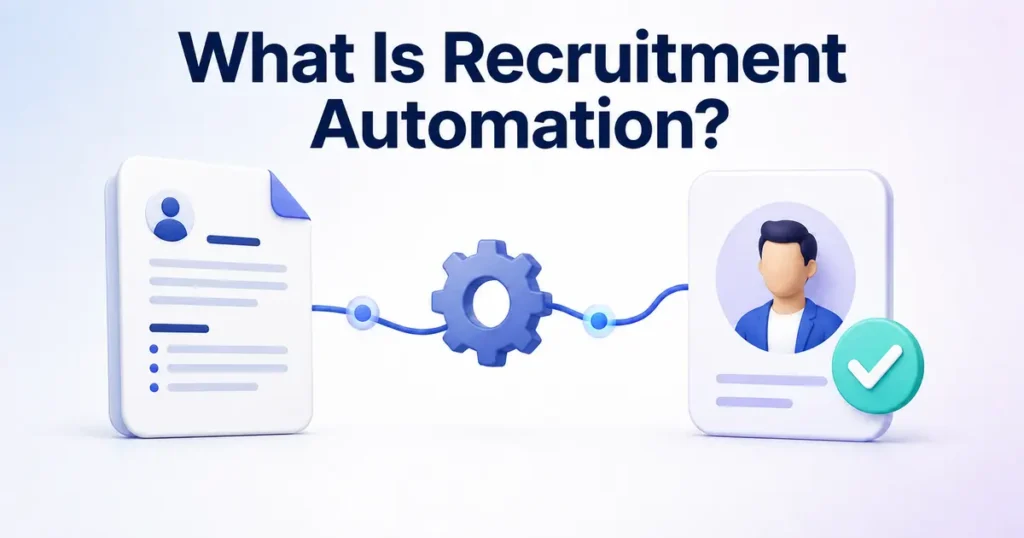
Recruitment automation is the use of technology to automate repetitive tasks within the hiring process. These tasks can include candidate sourcing, resume screening, interview scheduling, assessment management and candidate communication.
Recruitment teams can define rules or workflows for specific hiring activities. The system then completes those activities automatically when certain conditions are met.
Consider a company that receives 2,000 applications for 20 open positions. Reviewing every resume manually can take considerable time. Recruitment automation software can organize applications and identify candidates based on predefined job requirements. Recruiters can then focus their attention on the most relevant profiles.
Automation can support different stages of recruitment without removing recruiters from the decision-making process.
Recruitment automation connects different hiring activities through predefined workflows and software tools.
A typical automated recruitment process may work like this:
Make recruitment automation more efficient and candidate-friendly with HyreNet’s smart hiring platform. Automate repetitive screening tasks, streamline candidate evaluation, reduce manual workload, improve hiring accuracy, and build a structured recruitment process that helps teams hire faster without losing quality.
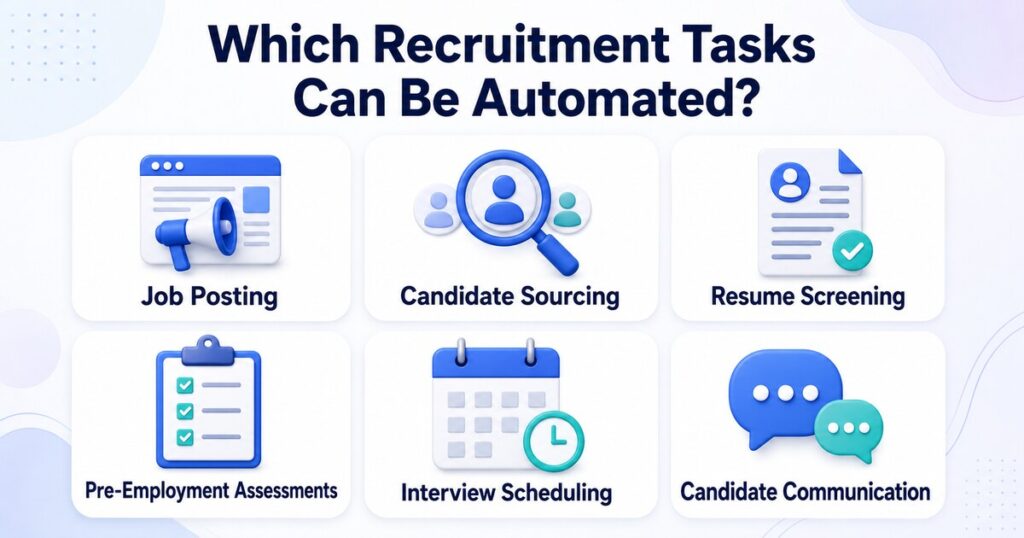
Not every recruitment activity should be automated. However, several repetitive tasks are well suited to automation.
Recruiters often advertise the same vacancy across several platforms. Recruitment automation tools can distribute job postings across selected channels from one system.
This saves time and helps teams maintain consistent job information across platforms.
Some recruitment tools can search talent databases or existing candidate pools based on predefined requirements.
Recruiters can use these recommendations as a starting point rather than searching every profile manually.
High-volume roles can attract hundreds or thousands of applications. Automated screening tools can organize applications based on job-related criteria such as skills, qualifications or experience.
Recruiters should still review shortlisted candidates before making important decisions.
Automation platforms can send technical, aptitude or job-specific technical assessments after candidates reach a particular recruitment stage.
Results can be collected within the same hiring workflow. This makes it easier for recruiters to compare candidates using consistent criteria.
Scheduling becomes complicated when recruiters need to coordinate multiple calendars.
Automated scheduling tools allow candidates to select available interview slots. Confirmation emails and reminders can also be triggered automatically.
Recruitment teams can automate application confirmations, interview reminders and basic status updates.
Candidates receive timely information while recruiters spend less time sending repetitive emails.
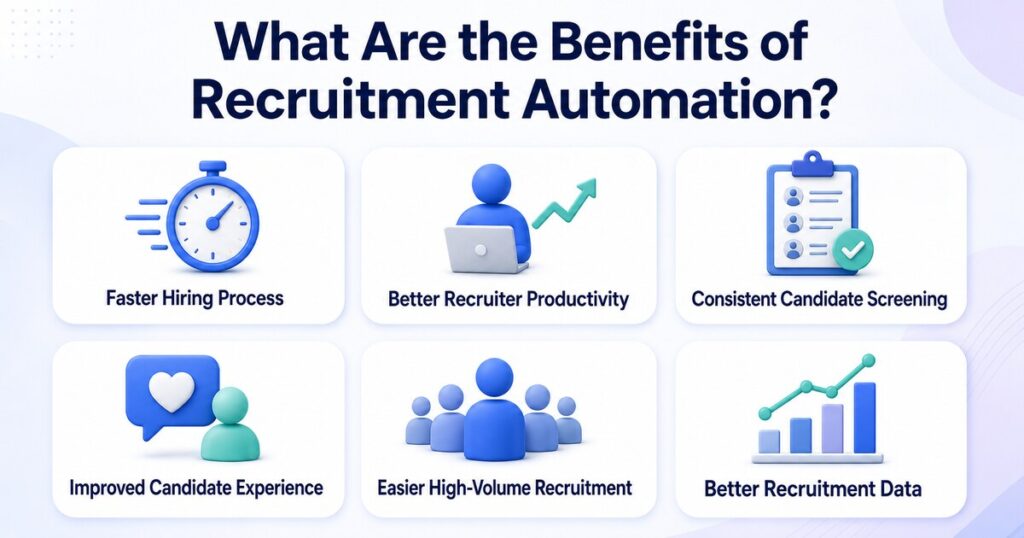
The value of recruitment automation goes beyond saving a few hours of administrative work. A well-designed system can improve several parts of the hiring process.
Manual screening and scheduling can create unnecessary delays.
Automation moves qualified candidates through routine recruitment stages more quickly. Recruiters can then spend more time evaluating applicants who require closer attention.
This can help reduce time to hire without rushing important hiring decisions.
Recruiters should spend their time understanding candidates and evaluating suitability rather than repeatedly updating spreadsheets or sending scheduling emails.
Automation handles many administrative tasks in the background. Recruiters can focus on interviews, candidate engagement and hiring strategy.
Different recruiters may interpret applications differently.
Structured automation can apply the same predefined screening criteria across applicants. A remote hiring assessment can also help teams evaluate candidates consistently across locations. This creates a more consistent initial evaluation process.
However, companies should regularly review those criteria to ensure they remain relevant and fair.
Candidates often become frustrated when they receive no updates after applying.
Automated confirmations and reminders can keep candidates informed throughout the recruitment process. Scheduling tools also reduce unnecessary back-and-forth communication.
A smoother process can create a more professional candidate experience.
Manual processes become difficult to manage when thousands of candidates apply within a short period.
Recruitment automation helps companies organize applications and assessments at scale. Recruiters can manage larger candidate pools without increasing repetitive administrative work at the same rate.
Automated recruitment systems can capture information across different hiring stages.
Teams can track metrics such as application volume, assessment completion, interview progression and time to hire. These insights can reveal bottlenecks within the recruitment funnel.
Recruitment automation can improve efficiency but poor implementation can create new problems.
Recruiters may assume an automated recommendation is always accurate.
A system can only work with the data and rules behind it. Poor criteria can lead to poor recommendations. Human review remains important for decisions that affect candidate progression.
Automated hiring systems may produce unfair outcomes when their underlying data or screening criteria contain bias.
Employers should regularly review screening rules and test automated systems for unintended patterns. Job-related criteria should guide candidate evaluation.
Automation can improve communication but excessive automation can make recruitment feel impersonal.
Candidates may become frustrated when every interaction is handled by templates or chatbots. Recruiters should remain available for questions and meaningful conversations.
Recruitment teams often use multiple platforms for sourcing, assessments, interviews and applicant tracking.
Poor integrations can create duplicate records or fragmented candidate information. Companies should evaluate compatibility before introducing another recruitment tool.
Recruitment systems process personal candidate information.
Companies need appropriate access controls and data retention policies. They should also understand how recruitment vendors collect, process and store candidate data.
The main difference lies in how repetitive work is managed.
| Area | Traditional Recruitment | Recruitment Automation |
| Resume screening | Primarily manual | Automated support with recruiter review |
| Interview scheduling | Emails and calls | Automated scheduling workflows |
| Candidate updates | Manually sent | Trigger-based communication |
| Assessments | Manually assigned | Automatically assigned |
| Data tracking | Spreadsheets or separate tools | Centralized workflow data |
| Scalability | Requires more manual effort | Handles higher volumes efficiently |
| Human involvement | Required across most tasks | Focused on higher-value decisions |
Automation does not remove the need for recruiters. It changes where recruiters spend their time.
Recruitment automation delivers better results when companies introduce it with a clear purpose.
Do not automate a process simply because automation is available.
Review the existing hiring workflow and identify where recruiters lose the most time. Common bottlenecks include resume screening, scheduling and repeated candidate follow-ups.
Start with the processes where automation can solve a measurable problem.
Technology can organize information and automate repetitive steps. It should not become the only decision-maker for hiring.
Recruiters should review candidate evidence before rejection or selection decisions. Human oversight becomes particularly important when automated systems influence candidate rankings.
Automated screening should focus on requirements that actually matter for the role.
A software developer may need specific programming knowledge. A customer support role may require communication and problem-solving skills.
Clear criteria make automated screening more meaningful.
Automated messages are useful for confirmations and reminders.
Sensitive conversations deserve direct human communication. Recruiters should personally handle complex questions, interview feedback and important hiring updates whenever appropriate.
Recruitment automation involves significant amounts of personal information.
Review vendor security standards before implementation. Define who can access candidate data and how long information should remain within the system.
Automation should produce measurable improvements.
Recruitment teams can monitor:
These metrics can show whether automation is solving the intended problem.
Hiring requirements change over time.
A screening rule that worked six months ago may no longer match the role. Teams should regularly review automated workflows and update criteria when job requirements change.
The best recruitment automation software depends on the company’s hiring volume and existing recruitment process.
Start by identifying the tasks that need improvement. A small company may primarily need automated scheduling and candidate communication. A large employer may require sourcing, screening, assessments and analytics within one workflow.
Evaluate each platform based on:
A long feature list does not automatically make a platform suitable. The right solution should reduce friction within the existing recruitment process.
Recruitment automation is becoming more intelligent as artificial intelligence becomes part of hiring technology.
AI tools can help recruitment teams organize candidate information and identify relevant skills. It can also support candidate matching and recruitment analytics.
The biggest opportunity is not removing recruiters from hiring. It is reducing administrative work so recruiters can spend more time on areas that require context and human judgment.
Organizations that combine structured automation with meaningful human involvement are more likely to create an efficient and candidate-friendly recruitment process.
Recruitment automation helps companies reduce repetitive hiring work and manage larger candidate pools more efficiently. It can support resume screening, assessments, interview scheduling, candidate communication and recruitment analytics.
However, automation should have clear boundaries. Poor screening rules or excessive reliance on automated recommendations can affect both hiring quality and candidate experience.
Start with genuine recruitment bottlenecks. Automate repetitive processes and measure the results. Keep recruiters involved wherever context, fairness and judgment matter.
The goal is not to automate recruitment completely. It is to give recruiters better tools so they can spend more time making better hiring decisions.

A recruiter may receive 300 resumes for one open position. Reading each application can take several hours. It also leaves less time for interviews and candidate communication.
AI Resume Screening helps hiring teams manage this workload. It reads resumes and compares candidate information with the role’s requirements. The system then highlights applicants whose skills and experience appear relevant.
AI can make early screening faster. However, it should support recruiters rather than make final hiring decisions alone.

AI Resume Screening is the use of artificial intelligence to review and organize job applications.
The software extracts information from resumes and compares it with predefined hiring criteria. It may identify:
The system may then score, rank or group candidates. Recruiters can use these results to decide which applications need closer review.
For example, a company hiring a Python developer may look for Python, Django, APIs and database experience. The AI screening tool can identify resumes that mention these skills and place them higher in the review list.
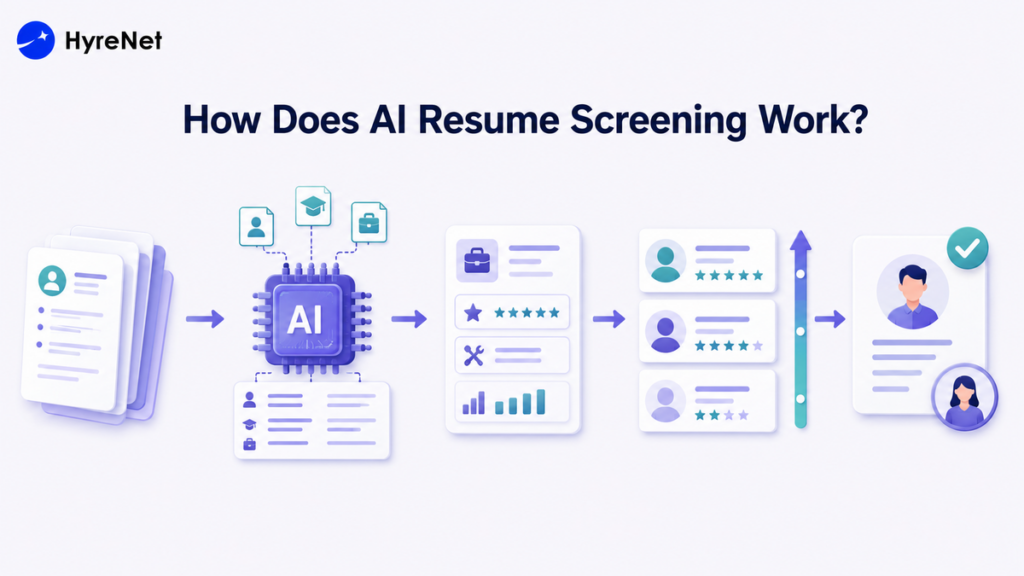
AI Resume Screening usually follows a structured process.
The hiring team first identifies the essential requirements for the position.
These may include:
Clear requirements produce more useful results. A vague job description may cause the system to recommend unsuitable candidates.
Applicants upload resumes through a careers page or applicant tracking system.
The screening software reads each document and converts the information into structured data. It may separate details into sections such as skills, education and work history.
The software looks for information connected with the job requirements.
For example, a resume for a digital marketing role may be checked for:
The system may also recognize similar terms. For instance, it may connect “search optimization” with “SEO” depending on how advanced the tool is.
The system compares candidate information with the criteria selected by the recruiter.
It may check:
This comparison helps the system estimate candidate relevance.
Applicants may receive a match score based on the screening criteria.
A candidate with several relevant skills may receive a higher score. Another applicant may receive a lower score because important qualifications are missing.
The score should guide the recruiter. It should not automatically prove that one candidate is better than another.
Recruiters review the recommended candidates before moving them forward.
They may also check lower-ranked applications to identify:
Make AI resume screening more accurate and recruitment-ready with HyreNet’s smart hiring platform. Screen resumes faster, shortlist qualified candidates, reduce manual review, improve hiring efficiency, and support better talent decisions with structured workflows built for modern recruitment teams.
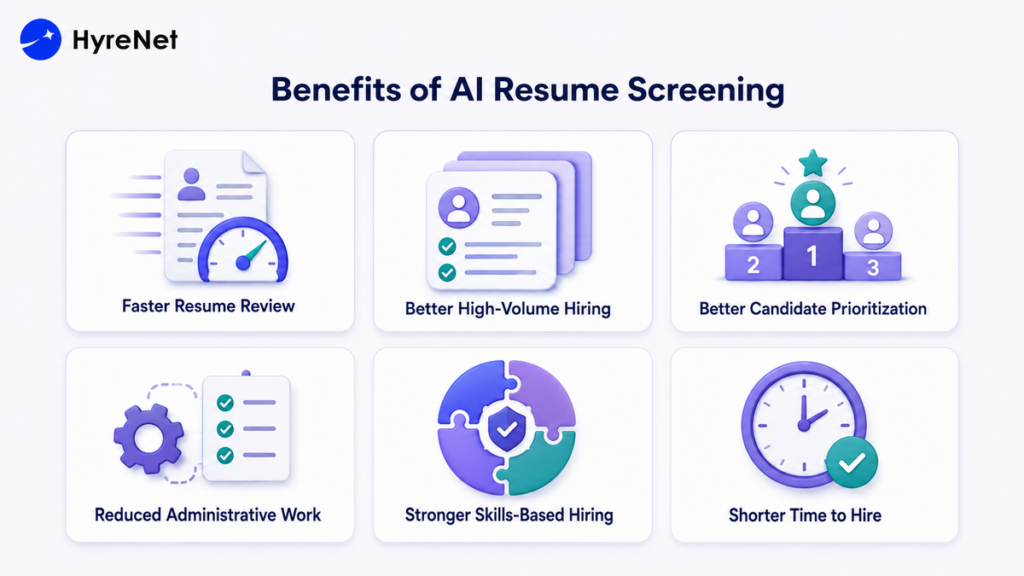
AI can process large numbers of applications much faster than manual screening.
Recruiters can spend less time sorting resumes and more time speaking with suitable candidates.
Large companies may receive thousands of applications for graduate programs or customer service roles.
AI Resume Screening helps them organize these applications without increasing the workload for every recruiter.
The system applies the same selected criteria to each resume.
This creates a more consistent first-stage review than relying on different recruiters to scan applications using personal preferences.
AI helps recruiters identify applications that appear closely connected with the role.
Hiring teams can review stronger matches first while still keeping other applications available for human review.
Recruiters often spend hours sorting resumes into categories.
AI can automate tasks such as:
This allows recruiters to focus on interviews and candidate experience.
Traditional resume screening may place too much importance on degrees or previous job titles.
AI screening can help recruiters focus more on skills. A candidate may have a different title but still possess the experience required for the position.
Delayed screening can cause strong candidates to accept other offers.
Faster resume review allows recruiters to contact suitable applicants earlier and move them through the hiring process more efficiently.
AI Resume Screening is useful but not perfect.
These challenges make human oversight essential to ensure AI-driven decisions remain accurate, fair and aligned with hiring requirements.
Employers can improve AI screening by following these practices:
HyreNet helps employers create a more structured hiring process.
The platform can support:
Recruiters can use resume information to identify relevant candidates. They can then use structured assessments to check whether those candidates can perform important job tasks.
For example, a developer may complete a coding test after the resume screening stage. A content writer may take a writing assessment. A customer service candidate may respond to a realistic support scenario.
This gives recruiters stronger evidence than a resume alone.
AI Resume Screening helps recruiters review applications faster and manage large candidate pools. It can improve consistency and reduce repetitive administrative work.
The quality of the results depends on the job criteria and the screening process. Employers should review AI recommendations and check for unfair outcomes.
HyreNet helps businesses combine candidate screening with structured skill assessments. This supports faster shortlisting while keeping human judgement central to final hiring decisions.

Nearly 79% of HR professionals believe skills assessment scores are as important as or more important than traditional hiring criteria. Yet many employers still rely heavily on resumes and interviews that may not reveal a candidate’s actual abilities.
A pre-employment assessment helps employers evaluate job-related skills, knowledge and workplace behaviour before making an offer. It supports faster screening and gives candidates a fair opportunity to demonstrate their abilities.
However, the assessment must reflect the actual role to deliver meaningful results. This guide explores the major types of pre-employment assessments along with their benefits and best practices.
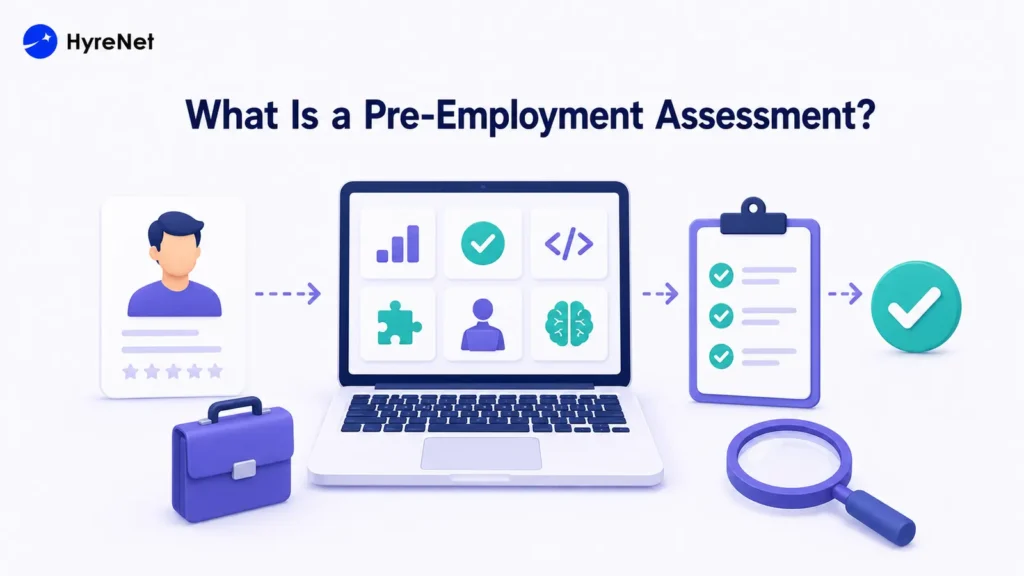
A pre-employment assessment is a structured test used to evaluate candidates before hiring. It measures job-related skills, knowledge, cognitive ability, communication or workplace judgment.
The assessment should reflect the role’s actual responsibilities. Employers should use it alongside resume screening, structured interviews and reference checks rather than as the only hiring method.
Resumes and interviews can be influenced by personal impressions. Different interviewers may also apply different standards.
A structured assessment gives candidates comparable tasks and uses predefined scoring criteria. This helps recruiters evaluate proven abilities and determine:
Assessment results help recruiters prioritize qualified candidates. Final decisions should also consider interviews, experience and other relevant evidence.
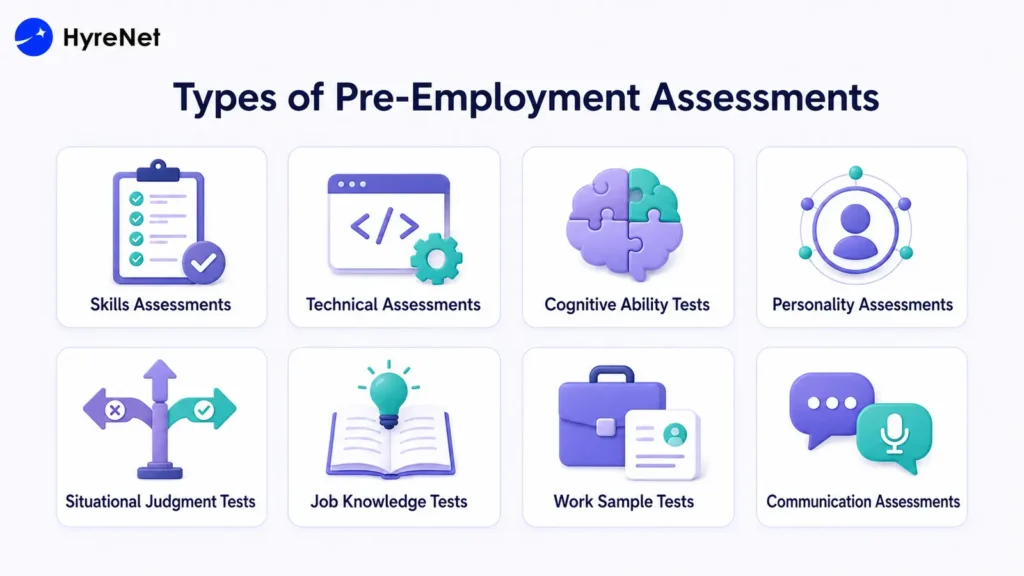
The right hiring assessment depends on the position. A developer may complete a coding test, while a customer service applicant may respond to support scenarios.
Skills assessments measure a candidate’s ability to complete practical job tasks.
Common examples include:
These assessments show whether candidates can apply their knowledge in realistic situations.
Technical assessments evaluate specialized knowledge required for roles in software development, engineering, cybersecurity, data science and IT.
They may include multiple-choice questions, coding challenges, debugging exercises or case studies. The difficulty should match the position’s seniority level.
Cognitive ability tests measure logical reasoning, numerical ability, verbal comprehension and problem-solving skills.
These tests can indicate how quickly candidates process information and learn new concepts. Questions should remain relevant to the role and avoid unnecessary complexity.
Personality assessments examine workplace preferences and behavioral tendencies such as dependability, adaptability and collaboration.
Employers should use these results as supporting evidence. Personality scores should not independently determine whether a candidate receives an offer.
Situational judgment tests present realistic workplace scenarios and ask candidates to select the most appropriate response.
They help measure decision-making, communication and conflict resolution. They also give applicants a clearer view of situations they may face in the role.
Job knowledge tests measure a candidate’s understanding of industry terms, regulations, procedures or professional practices.
They are most useful for positions that require candidates to possess essential knowledge before joining.
Work sample tests require candidates to complete a task similar to the actual job.
A marketer may create a campaign outline. A developer may build a small feature. An accountant may review a financial statement.
These tests provide direct evidence of job performance. Employers should keep assignments reasonable and avoid using unpaid candidate work commercially.
Communication assessments evaluate written or verbal communication for customer service, sales, marketing, leadership and remote roles.
Candidates may write an email, deliver a presentation or handle a simulated customer call. A scoring rubric should measure clarity, accuracy, tone and organization.
Build a smarter pre-employment assessment process with HyreNet’s data-backed hiring platform. Evaluate candidates with structured skill tests, improve hiring efficiency, reduce mis-hires, increase quality of hire, and create a more reliable recruitment workflow for better talent decisions.
Here are the most common types of pre-employment assessments employers use to evaluate candidates.
A pre-employment assessment gives employers clear evidence of a candidate’s job-related skills and knowledge. The assessment should match the role and use consistent scoring. It should also remain accessible and fair.
HyreNet helps businesses assess candidates at scale and identify qualified applicants faster. Combined with structured interviews and recruiter judgement, it supports more confident hiring decisions.

A hiring assessment can look successful on paper and still fail where it matters. High completion rates and clean scores mean little if the final hires do not perform well, stay long, or match the role. That is why hiring assessment metrics are essential. They help teams measure accuracy, fairness, candidate experience, and long-term hiring value. Want to know if your hiring assessments are actually improving recruitment decisions?
Read the full blog to learn the key metrics that reveal assessment accuracy and long-term hiring success.
Hiring assessments are only useful when they help you make better hiring decisions. That is why measuring their success is so important. It shows whether your tests are helping you find candidates who are skilled and likely to perform well after hiring. Metrics like completion rate, candidate drop-off, predictive validity, quality of hire, and new hire retention help you understand what is working and what needs improvement.
They also reveal if an assessment is too long, unclear, biased, or disconnected from the actual role. When companies track these insights properly, they can create a fairer hiring process, improve candidate experience, and make recruitment decisions with more confidence.
Assessment completion rate shows how many candidates finish the assessment after receiving it. It is one of the first indicators of candidate engagement and assessment usability.
Formula: Assessment Completion Rate = Completed Assessments ÷ Assessments Sent × 100
A low completion rate can point to poor communication, excessive test length, unclear instructions, or weak candidate interest. A strong completion rate suggests that the assessment feels relevant and manageable. Recruitment teams should review completion rate by role, source, seniority, and assessment type. A coding test for senior engineers should not be benchmarked against a short aptitude test for entry-level roles.
Strategic takeaway: Track completion rate with candidate drop-off data. A high abandonment rate after the first few questions may signal friction. A drop near the end may suggest assessment fatigue.
Candidate drop-off rate measures the percentage of candidates who leave the hiring assessment before submission. This metric is especially useful for identifying a major recruitment challenge: where the process loses qualified candidates before they complete the assessment.
Formula: Candidate Drop-Off Rate = Candidates Who Started but Did Not Complete ÷ Candidates Who Started × 100
A long or poorly structured assessment can reduce candidate participation. Strong candidates may leave the process if the test feels unrelated to the role or demands unpaid work beyond a reasonable scope. This is critical for competitive hiring, where skilled candidates often have multiple options.
Strategic takeaway: Review drop-off by assessment stage. A timed section, technical upload, or personality questionnaire may be creating avoidable friction.
Pass rate tells you how many candidates meet the required benchmark. Score distribution shows whether assessment results are meaningfully spread across high, medium, and low performers.
Formula: Pass Rate = Candidates Who Passed ÷ Candidates Who Completed the Assessment × 100
A very high pass rate may mean the assessment is too easy or the benchmark is too low. A very low pass rate may suggest unrealistic job criteria, poor sourcing, or a test that does not reflect actual work demands. Score distribution adds more depth because it reveals whether the assessment can separate strong candidates from average ones.
Strategic takeaway: Use score bands instead of a single pass or fail view. A healthy assessment should help recruiters identify top-tier candidates, borderline candidates, and clear mismatches.
Predictive validity measures how well assessment scores relate to future job performance. This is one of the most important hiring assessment metrics because it answers a direct business question: did the test predict success on the job?
How to measure: Compare assessment scores with post-hire outcomes such as performance ratings, sales results, productivity benchmarks, project quality, customer feedback, or manager evaluations after three, six, or twelve months.
Personnel selection research has long examined which tools best predict job performance. SIOP’s review of newer research notes that structured interviews may be among the strongest predictors of job performance, which supports the use of structured, role-relevant evaluation methods rather than informal judgment alone.
Strategic takeaway: An assessment should not be treated as valid because it feels rigorous. It should show a measurable relationship with performance outcomes.
Quality of hire measures the value a new employee brings after being hired. It connects assessment decisions with real workplace results.
Common formula: Quality of Hire = Performance Score + Retention Score + Hiring Manager Satisfaction + Time-to-Productivity Score ÷ Number of Metrics Used
Quality of hire is stronger than process-only metrics because it looks beyond speed. A quick hire who leaves in three months or underperforms is not a successful hiring outcome.
Strategic takeaway: Track quality of hire by assessment type. This shows which tests produce employees who perform well and stay longer.
Ready to make hiring assessments more accurate, fair, and outcome-driven? HyreNet helps recruitment teams evaluate candidates with smarter assessment workflows, clearer performance insights, and data-backed hiring decisions. Build a process that reduces guesswork, improves candidate quality, and helps you identify the right talent with confidence.
Time to productivity measures how long a new hire takes to reach expected performance standards. It is especially valuable for sales, customer support, engineering, operations, and other roles with measurable output.
Formula: Time to Productivity = Date Productivity Benchmark Is Reached − Start Date
A strong hiring assessment should identify candidates who can ramp up within a realistic timeline. Shorter ramp-up time often means the assessment measured role-relevant skills, problem-solving ability, and practical readiness.
Strategic takeaway: Compare time to productivity across score bands. Candidates with higher assessment scores should ideally reach productivity faster. A weak relationship may mean the assessment is measuring the wrong capabilities.
New hire retention rate shows how many hires stay for a defined period after selection. Most companies track this at 90 days, six months, and twelve months.
Formula: New Hire Retention Rate = New Hires Still Employed After Period ÷ Total New Hires in That Period × 100
Retention should be interpreted carefully. SHRM cautions that retention can be affected by factors outside individual hire quality, such as management, team culture, compensation, and career growth. Still, it remains a useful signal when reviewed with performance and hiring manager feedback.
Strategic takeaway: Use retention as part of a wider quality-of-hire score. It should not stand alone as proof that an assessment works.
Hiring manager satisfaction measures whether shortlisted candidates meet role expectations. It adds practical context to assessment data because hiring managers see how candidates perform in interviews, assignments, and team discussions.
How to measure: Use a short scorecard after interviews or hiring decisions. Ask hiring managers to rate candidate relevance, technical fit, communication quality, problem-solving ability, and readiness for the role.
This metric is useful because a test can produce high scores without producing strong shortlists. Hiring manager feedback helps recruitment teams check whether the assessment aligns with real role needs.
Strategic takeaway: Measure satisfaction at two stages: after shortlist review and after 60 to 90 days of employee performance.
Interview-to-offer ratio shows how many interviewed candidates are needed to make one offer. It reflects shortlist quality and assessment screening strength.
Formula: Interview-to-Offer Ratio = Number of Interviewed Candidates ÷ Number of Offers Made
A lower ratio often means the assessment is filtering candidates effectively before interviews. A high ratio may show that assessment scores are not aligned with hiring manager expectations or that the benchmark is too broad.
Strategic takeaway: Track this metric before and after assessment changes. A better assessment should reduce unnecessary interview volume without reducing candidate quality.
Offer acceptance rate measures how many selected candidates accept the final offer. Although it is not only an assessment metric, it reflects the overall credibility and candidate experience of the hiring process.
Formula: Offer Acceptance Rate = Offers Accepted ÷ Offers Extended × 100
Candidates may reject offers after a poor assessment experience, especially when tests are too long, unclear, or disconnected from the role. A fair and well-communicated assessment can improve candidate trust, even among those who do not receive an offer.
Strategic takeaway: Review offer acceptance alongside candidate feedback. A declining acceptance rate may point to process fatigue or weak communication.
Adverse impact ratio helps companies examine whether an assessment creates unequal selection outcomes across protected groups. The EEOC’s Uniform Guidelines describe the four-fifths rule, where adverse impact is generally indicated when one group’s selection rate is less than 80% of the group with the highest selection rate. The EEOC also clarifies that this is a rule of thumb, not a final legal conclusion.
Formula: Adverse Impact Ratio = Selection Rate of Group A ÷ Selection Rate of Group with Highest Selection Rate
This metric is essential for fair hiring assessments. A test may look objective, but it can still produce unequal outcomes if questions, scoring, access requirements, or test conditions disadvantage certain groups.
Strategic takeaway: Audit adverse impact regularly and review the job relevance of every assessment component. Fairness and validity should move together.
Candidate experience score measures how candidates feel about the assessment process. It can be gathered through short surveys after completion or after the hiring process ends.
Useful survey questions:
Candidate experience matters because hiring assessments also shape employer reputation. A relevant test can strengthen trust. A confusing or excessive test can reduce candidate interest, especially among experienced professionals.
Strategic takeaway: Segment feedback by candidates who passed, failed, dropped off, and accepted offers. This gives a fuller view of assessment perception.
The best hiring assessment metrics do more than measure activity. They show whether assessments help teams identify capable candidates, reduce weak-fit hires, protect fairness, and improve long-term workforce outcomes. Completion rate, pass rate, and time to hire explain process performance. Predictive validity, quality of hire, retention, and time to productivity reveal business value. Fairness and candidate experience metrics protect trust. A strong assessment system should answer one clear question: are hiring decisions becoming more accurate, fair, and outcome-driven over time?

A resume can show experience, but it cannot prove how well a developer writes code. That is why recruiters need a reliable coding assessment platform before moving candidates into technical interviews. The right platform helps hiring teams screen developers faster, compare candidates fairly, and identify job-ready talent with stronger confidence.
A weak platform creates the opposite problem. It can increase candidate drop-off, produce unclear scores, and make technical hiring harder than it needs to be. Recruiters need more than an online coding test tool. They need a structured evaluation system that supports accuracy, fairness, and candidate experience.
Read this blog to understand what recruiters should look for before choosing a coding assessment platform.
A coding assessment platform is a recruitment tool used to test programming, debugging, problem-solving, and technical skills before or during the hiring process. It allows recruiters and hiring managers to evaluate candidates through structured coding tests, technical quizzes, project-based tasks, and sometimes live coding interviews.
A strong platform helps companies assess developers based on actual ability rather than resume keywords alone. It can test skills in languages such as Python, Java, JavaScript, C++, SQL, and other role-specific technologies.
Recruiters use coding assessment platforms for software developer hiring, campus recruitment, tech screening, lateral hiring, and large-scale recruitment drives.
The first thing recruiters should check is whether the platform offers role-specific assessments. Generic coding questions may not give useful hiring signals.
A frontend developer test should check UI logic, JavaScript, component structure, and framework understanding. A backend developer test should check APIs, database logic, data handling, and error management. A data engineer test should check SQL, pipelines, and data transformation logic.
A good coding assessment platform should support different roles, seniority levels, and skill requirements. Recruiters should be able to choose tests based on actual job responsibilities.
Recruiters should choose a platform that supports the programming languages required for their hiring needs. Common languages may include Python, Java, JavaScript, C, C++, C#, PHP, Ruby, Go, SQL, and TypeScript.
Language support matters because developers should be tested in the tools they will use at work. A backend role in Java should not be evaluated through a generic logic test alone.
The platform should also support frameworks, databases, and technical environments where possible. This makes the assessment closer to real development work.
Strong coding assessments should reflect practical work scenarios. Puzzle-style questions can test logic, but they may not always predict job readiness.
Recruiters should look for platforms that offer real-world coding tasks. These may include building APIs, fixing bugs, writing SQL queries, improving code quality, or completing small application workflows.
Real-world questions help recruiters understand whether candidates can work on actual business problems. They also create a better candidate experience because the test feels relevant to the role.
A good coding assessment platform should allow recruiters to adjust test difficulty. Junior, mid-level, and senior developers should not receive the same assessment.
Junior candidates may need tests focused on fundamentals, syntax, debugging, and simple problem-solving. Mid-level developers may need role-based tasks with practical constraints. Senior developers may need system design, architecture reasoning, and code review exercises.
Difficulty customization helps recruiters avoid unfair comparisons. It also improves hiring accuracy because candidates are assessed against role-appropriate expectations.
Online coding assessments need strong authenticity checks, especially when companies are trying to solve recruitment challenges linked to cheating, unreliable scores, and weak candidate validation. Recruiters should look for plagiarism detection, code similarity checks, browser monitoring, tab-switch alerts, copy-paste tracking, and question randomization.
These features help hiring teams identify suspicious patterns. They do not replace human judgment, but they improve trust in assessment results.
A strong platform should also support follow-up validation. Recruiters can ask shortlisted candidates to explain their submitted code during a technical discussion, which makes the hiring process more reliable and skill-focused.
Candidate experience is one of the most important parts of technical hiring. A platform may have strong features, but candidates may still drop off if the test feels confusing or too long.
Recruiters should check whether the platform offers clear instructions, smooth login, mobile-friendly communication, stable test access, and realistic time limits.
The assessment interface should be simple and reliable. Candidates should spend their time solving the problem, not struggling with the platform.
A coding assessment platform should provide more than a final score. Recruiters need detailed reports that explain candidate strengths and weaknesses.
Useful reports may show correctness, code quality, execution time, edge-case handling, debugging performance, and language proficiency. Some platforms also offer skill-wise breakdowns across logic, syntax, algorithms, SQL, or framework knowledge.
Structured reports help recruiters make better shortlist decisions. They also help hiring managers understand why a candidate should move forward.
Choose the right coding assessment platform with HyreNet’s structured technical hiring workflows. Evaluate role-specific coding skills, reduce manual screening, track candidate performance, and make recruiter decisions easier with smarter assessments built for accurate, fair, and scalable tech hiring.
Every company has different hiring needs. Recruiters should choose a platform that allows custom test creation.
Custom tests help teams assess skills that match their tech stack, product workflows, and role expectations. Hiring managers can add internal-style problems, role-based scenarios, or project-specific tasks.
This is especially useful for startups, product companies, IT services firms, and teams hiring for specialized engineering roles.
A coding assessment platform becomes stronger when it supports live coding interviews. Recruiters can use assessments for early screening and live interviews for deeper validation.
Live coding tools should support shared code editors, interviewer notes, real-time collaboration, test playback, and structured scorecards.
This helps technical interviewers evaluate communication, problem-solving depth, and response to feedback. It also connects the screening stage with the final technical round.
Recruiters should check whether the platform integrates with applicant tracking systems and HR tools. Integration reduces manual work and keeps candidate data organized.
A strong integration can help recruiters send test invites, track completion, review scores, and update candidate stages from one workflow.
This matters for recruitment teams handling multiple roles or large hiring pipelines. Less manual work means fewer errors and faster decisions.
A good coding assessment platform should provide analytics that improve the hiring process over time. Recruiters should be able to track completion rate, drop-off rate, average score, pass rate, time taken, and role-wise performance.
These insights reveal where the process needs improvement. A low completion rate may show that the test is too long. A very high pass rate may mean the assessment is too easy. A very low pass rate may show poor sourcing or unrealistic benchmarks.
Analytics help recruiters build a more accurate and efficient technical hiring process.
Fair evaluation matters in developer hiring. Recruiters should look for platforms that support standard scoring, consistent questions, role-based rubrics, and structured evaluation criteria.
A consistent process helps reduce subjective judgment during early screening. Every candidate receives the same test conditions and is measured against the same benchmark.
Fairness also improves candidate trust. Candidates are more likely to respect a hiring process that feels clear, relevant, and structured.
A coding assessment platform should do more than host online coding tests. It should help recruiters identify job-ready developers, improve screening accuracy, reduce interview workload, and protect candidate experience.
The best platform is role-relevant, fair, secure, easy to use, and rich in hiring insights. Recruiters should choose a solution that supports both technical evaluation and long-term hiring quality.

In today’s competitive job market, finding the right talent quickly and efficiently can be challenging. That’s where HyreNet’s recruitment platform steps in. As a leading AI-powered solution, HyreNet empowers companies to streamline their hiring processes, ensuring they attract and identify top talent with ease. Trusted by over 50 companies, HyreNet offers a suite of features designed to simplify recruitment while maintaining the highest standards of candidate evaluation. Here are five reasons why HyreNet is the go-to choice for businesses looking to enhance their talent acquisition strategies.
HyreNet provides tools to create role-specific assessments effortlessly. You can customize templates by importing questions via CSV, setting the duration, and shuffling questions to match your needs. Whether hiring for junior positions or senior roles, you can create and reuse templates across multiple tests, ensuring consistency and efficiency. HyreNet also offers a unique shuffling feature, where the order of questions varies for each candidate, enhancing the assessment's integrity.
Additionally, HyreNet offers lifetime free customized question generation. Questions are tailored to your company's requirements, covering various formats like objective, programming, and video questions. The platform also includes real-world project problem statements that candidates can develop using frameworks like React, Vue.js, and AngularJS, offering a deeper evaluation of their practical skills.
Integrity is crucial in recruitment assessments, and HyreNet takes this seriously with its AI-powered proctoring. The platform continuously monitors candidates’ faces during the test, capturing video throughout to ensure focus and prevent cheating. If multiple faces are detected on the screen or if someone else attempts to take the test, the system will flag the incident.
Additionally, if a candidate's face is not visible during the assessment, it will be detected, ensuring the authenticity of the test-taking process. HyreNet also detects if a candidate switches to another tab during the test, taking screenshots and logging the event for review. If programming content is copied from another site, it will be detected, and the copied content can be viewed in the report by recruiters. This comprehensive monitoring system ensures that genuine candidates succeed, giving you confidence in your hiring decisions.
HyreNet provides detailed insights into candidate performance through its robust reporting features. Access reports that include leaderboards, skill assessments, and other critical metrics. The platform also records candidate videos and captures screenshots of any suspicious activities, all compiled into a thorough report. These insights help you identify top talent and make informed, data-driven decisions.
Moreover, recruiters can take advantage of role-based access controls, ensuring that team members have the appropriate level of access based on their role, which helps maintain security and organization within the hiring process.
Managing recruitment assessments is simple with HyreNet’s integrated calendar, accessible directly from the dashboard. The calendar displays upcoming and completed tests, giving you a clear overview of your recruitment schedule. The dashboard also shows recent tests, the number of candidates who attended, and those hired, making it easy to track your recruitment progress. This feature helps you stay organized and ensures that your hiring process runs smoothly. In addition, HyreNet supports 15+ programming languages for programming tests. Recruiters can choose to include all languages or limit the assessment to a select few, ensuring that the tests align with the specific needs of the role.
HyreNet’s user-friendly interface makes it easy to navigate and manage your recruitment assessments. You can quickly import questions in bulk using CSV, streamlining the setup process. Additionally, HyreNet offers 24/7 technical support, so any questions or issues are resolved promptly.
This allows you to focus on finding the right talent without worrying about technical challenges. Furthermore, HyreNet provides lifetime support for its customizable question generation service, ensuring your assessments remain relevant and aligned with your evolving hiring needs.
HyreNet is not just another recruitment platform; it’s a comprehensive solution designed to transform your hiring process. With its customizable assessments, advanced AI features, and user-friendly interface, HyreNet ensures you’re equipped to make the best hiring decisions, quickly and efficiently. Ready to experience the future of talent acquisition? Don’t miss out on the opportunity to elevate your hiring strategy—schedule a demo today and see how HyreNet can help you secure the top talent your company needs to succeed.

Recruitment are the frontline of building a successful organization, yet they come with numerous obstacles. From attracting the right talent to ensuring a smooth and efficient hiring process, recruiters must overcome various recruitment challenges to secure the best candidates. Fortunately, modern assessment platforms provide effective solutions, helping companies streamline their recruitment efforts. Here are the top 10 recruitment challenges and how they can be addressed.
One of the most common recruitment challenges is reaching the right candidates. With a vast pool of applicants, it can be difficult to identify those who truly meet the specific needs of the role. This issue worsens when job descriptions are vague or overly broad, leading to many unqualified applicants. Ensuring job postings are clear, precise, and targeted is essential for attracting the right talent.
Solution: Crafting a detailed, accurate job description that precisely outlines the role's requirements attracts qualified candidates, streamlining the recruitment process.
Lengthy hiring processes can be detrimental to both the company and the candidates involved. Delays in filling positions can lead to increased workload for current employees, decreased productivity, and potential loss of top candidates who may accept offers elsewhere. Reducing the time-to-hire is crucial for maintaining operational efficiency and securing the best talent.
Solution: Efficient use of remote hiring options and platforms such as HyreNet speeds up the recruitment process, reducing time-to-hire significantly.
A candidate's decision to accept a job offer is heavily influenced by their hiring experience. A cumbersome or disorganized recruitment process can create a negative impression of the company, leading candidates to decline offers or speak poorly of the organization. Ensuring a smooth, efficient, and respectful hiring process is vital for maintaining a positive employer reputation.
Solution: Tailoring interview rounds to job requirements and rapidly announcing results ensures a smooth and positive hiring experience for candidates.
An efficient recruitment process is crucial for companies to attract top talent and stay competitive. Inefficiencies, such as lengthy decision-making or poor communication, can result in lost opportunities and higher costs. Streamlining recruitment workflows, from candidate sourcing to final selection, is necessary to improve hiring outcomes and reduce unnecessary expenses.
Solution: Conducting tests online, ranking candidates based on skills, supported by data visualization and efficient data management through platforms like HyreNet, streamlines the recruitment process.
Recruiting for multiple roles at once can lead to confusion and inefficiencies, particularly if follow-up procedures are not well-managed. Without proper tracking, candidates may be overlooked or the process may stall, leading to delays in filling crucial positions. Effective management of multi-role recruitment is necessary to ensure that all candidates are properly evaluated and the hiring process remains on track.
Solution: Using customizable assessment platforms like HyreNet helps manage multiple roles simultaneously by tracking hiring stages, candidate data, and test reports efficiently.
Maintaining fairness in recruitment is essential for fostering diversity and inclusion within an organization. Biases in the hiring process, whether conscious or unconscious, can lead to the exclusion of qualified candidates and create a homogenous workforce. Ensuring that recruitment practices are transparent and based on merit is crucial for attracting and retaining diverse talent.
Solution: Implementing transparent, skill-based recruitment with talent assessments ensures that all candidates are evaluated fairly and without bias.
Skill shortages present a significant hurdle in recruitment, particularly in specialized industries. When there is a lack of candidates with the necessary expertise, it becomes challenging to fill positions effectively. This shortage can slow down the hiring process and force companies to compromise on the quality of hires, ultimately impacting business performance.
Solution: Implementing tests and interviews tailored to assess role-specific skills helps identify candidates who can effectively meet the job's demands.
The rapid pace of technological advancement can pose challenges for recruitment, particularly for companies that struggle to keep up with new tools and platforms. Failure to adapt can lead to outdated hiring practices that hinder the ability to attract and evaluate candidates effectively. Staying current with technological trends is essential for maintaining a competitive edge in recruitment.
Solution: Customizing talent assessments according to the latest technology and role-specific needs ensures the recruitment process stays up-to-date and effective.
Recruitment can be a costly endeavor, particularly if the process is prolonged or inefficient. High expenses related to advertising, interviewing, and onboarding can strain a company’s budget. Implementing cost-effective recruitment strategies is essential for balancing the need to attract top talent with the necessity of maintaining financial health.
Solution: Leveraging remote hiring platforms reduces recruitment costs by streamlining the hiring process and eliminating unnecessary expenses.
A strong employer brand is key to attracting top talent, but building and maintaining this brand requires consistent effort. Candidates are drawn to well-regarded companies, not just for their products or services, but also for their workplace culture and values. Negative perceptions or lack of engagement can significantly deter potential applicants.
Solution: Engaging with people by responding to queries —whether positive or negative—helps to build a strong employer brand that attracts quality candidates.

In today’s competitive job market, reducing hiring costs without compromising on the quality of hires is more important than ever. Companies are seeking innovative solutions that not only streamline recruitment processes but also help reduce inefficiencies. HyreNet, an AI-powered assessment platform, offers a comprehensive and cost-effective solution, helping businesses save time, money, and resources while ensuring they hire the right candidates. Here's how HyreNet can help your company cut hiring costs by up to 40%.
The traditional hiring process is often expensive and time-consuming, requiring multiple rounds of interviews, travel expenses, and administrative costs. HyreNet's online assessments allow candidates to complete tests remotely, reducing these inefficiencies. Whether candidates are applying from the same city or a different continent, businesses can eliminate travel and logistics expenses by assessing candidates from anywhere. This drastically cuts down on the time and costs associated with manual interview scheduling, in-person assessments, and travel reimbursements. As a result, HyreNet helps companies reduce hiring costs and make faster, more informed decisions.
One of the main challenges in recruitment is filtering out unqualified applicants early in the process. HyreNet’s AI-driven assessments provide an efficient solution by automatically identifying candidates that meet specific criteria. This means recruiters can focus their time and resources on interviewing the most promising candidates, significantly reducing the time and money spent on screening unsuitable applicants. The platform’s AI technology also ensures that every candidate is evaluated fairly and objectively, resulting in better outcomes with lower hiring costs.
Managing and storing candidate data is a hidden expense that many companies fail to account for. The cost of organizing large volumes of candidate information and assessment results can add up, particularly for companies that handle a high volume of applicants. HyreNet simplifies this by offering centralized data storage and reporting, which ensures that all assessment results, candidate videos, and reports are stored in one easily accessible location. Not only does this eliminate the need for expensive third-party data storage solutions, but it also provides recruiters with actionable insights that help them make smarter hiring decisions. With built-in analytics and reporting, companies can easily track their hiring metrics and optimize their processes, further reducing costs.
For businesses of all sizes, managing recruitment costs effectively is crucial. Whether you’re hiring for one role or filling multiple positions across different departments, HyreNet offers flexible pricing options tailored to your specific needs. Companies only pay for what they use, making it a scalable solution for small, medium, and large enterprises alike. This flexibility ensures that businesses can maintain control over their hiring budget without sacrificing access to the powerful features HyreNet offers. As your company grows and hiring demands increase, the platform can scale with you, helping to reduce hiring costs while still providing top-tier assessment tools.
Building new assessments from scratch for every role can be both time-consuming and costly. HyreNet’s customizable templates allow recruiters to design assessments tailored to specific job roles and reuse them across different positions. This feature is especially valuable for companies that frequently hire for similar roles. By reducing the time and effort spent on creating and designing new assessments for each role, businesses can significantly lower the cost of recruitment. Moreover, the platform’s ability to shuffle questions, set durations, and adjust assessments on the fly enables recruiters to further optimize their hiring process, saving time and money at every stage.
Hiring the right candidate goes beyond assessing technical skills. Today, companies are looking for well-rounded individuals who also fit into the company culture. HyreNet’s comprehensive candidate reports offer detailed insights into a candidate’s skills, personality traits, and performance during assessments. This rich data allows recruiters to make more informed decisions, reducing the risk of a poor hire, which can be an expensive mistake. By providing all the necessary information upfront, HyreNet reduces the chances of needing to rehire for the same position, contributing to cost-effective recruitment.
One of the risks associated with remote assessments is the possibility of cheating. HyreNet’s AI-powered proctoring tools help ensure the integrity of every assessment, preventing candidates from gaining unfair advantages. This feature not only maintains the quality and reliability of test results but also saves costs by reducing the need for live proctors or in-person assessments. With AI proctoring, companies can confidently hire candidates who have passed a thorough and fair assessment, minimizing the risk of hiring underqualified individuals and the costs associated with mis-hiring.
Every day that a job remains vacant can cost a company money in lost productivity. HyreNet shortens time-to-hire by streamlining the entire recruitment process, from initial screening to final hiring decision. Faster hires mean companies can fill critical positions more quickly, reducing downtime and boosting productivity. In addition, by automating many aspects of the hiring process, HyreNet reduces the manual workload for HR teams, allowing them to process more candidates in less time, further cutting hiring costs.
With these features and capabilities, HyreNet helps businesses reduce hiring costs without compromising on quality, speed, or efficiency. Whether you're looking to save on travel expenses, reduce the time spent on interviews, or streamline data management, HyreNet provides a robust solution designed to meet the demands of modern recruitment.