
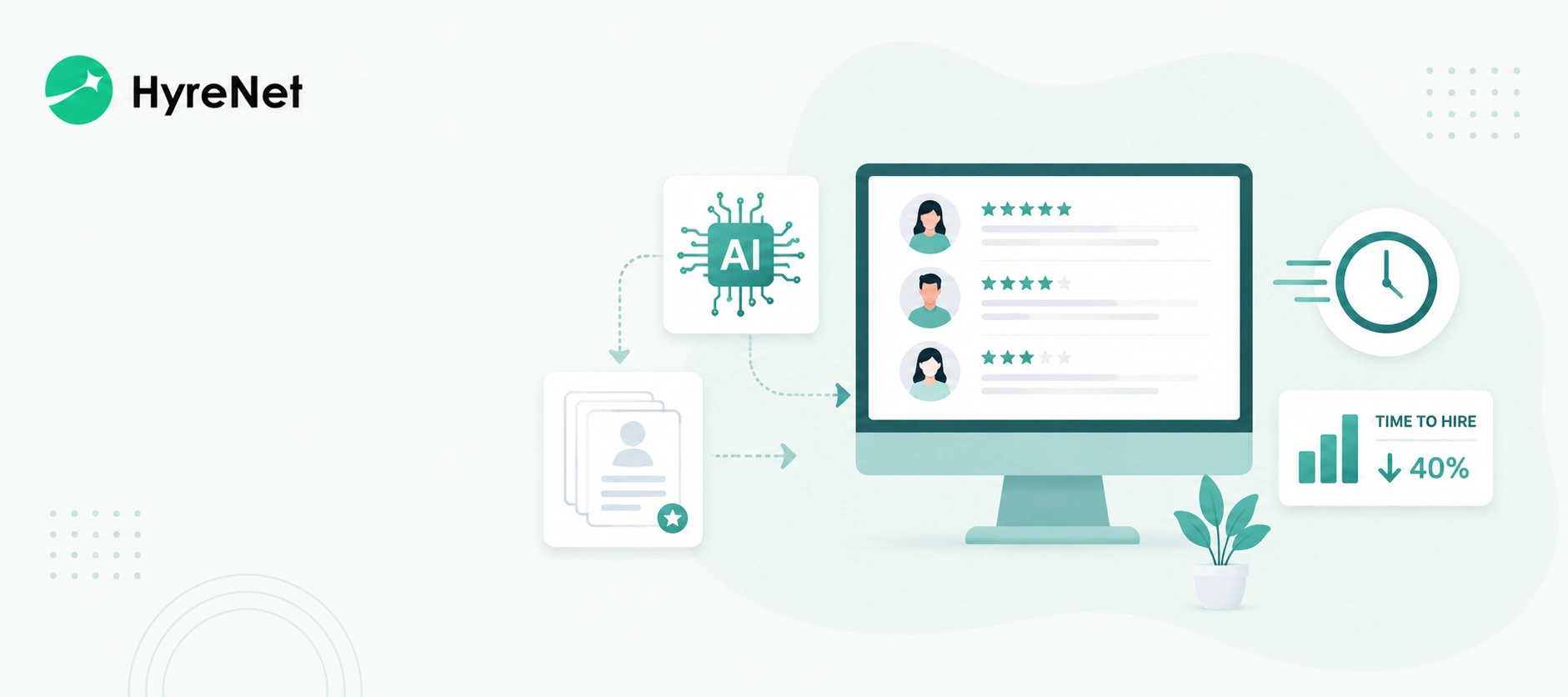

Hiring the right candidate already takes effort. Recruiters have to post jobs, screen resumes, follow up with candidates, schedule interviews, coordinate with hiring managers, and keep the pipeline moving. The real problem starts when the process takes too long. A strong candidate may apply today, but delayed calls, interviews, and feedback can push them toward another offer. This is why time-to-hire matters.
AI recruitment software helps recruiters speed up slow hiring stages. It reduces manual screening, improves candidate matching, automates communication, and helps teams make faster decisions. Want to hire faster with less manual work? Read our blog to learn how AI recruitment software can reduce time-to-hire and improve hiring decisions.
TL;DR Summary
- AI recruitment software reduces time-to-hire by automating resume screening, candidate matching, scheduling, and follow-ups.
- Recruiters can use AI tools to identify qualified candidates faster instead of manually checking every resume.
- Technical assessments and AI-proctored tests help verify real skills before interviews.
- Automated communication keeps candidates engaged and reduces drop-offs.
- AI works best when it supports recruiter judgment, not when it replaces human decisions.
What Is AI Recruitment Software?
AI recruitment software is a hiring tool that uses artificial intelligence to support different parts of recruitment. It can help recruiters screen resumes, match candidates to roles, schedule interviews, send updates, assess skills, and analyze hiring performance. The goal is pretty simple. AI handles repetitive work so recruiters can focus on better conversations and stronger hiring decisions. AI recruitment software can support tasks such as:
- Resume screening
- Candidate matching
- Job description writing
- Interview scheduling
- Candidate communication
- Technical assessments
- AI proctoring
- Hiring analytics
- Talent pipeline management
Companies using AI-driven screening cut time-to-hire by up to 75%, compared to traditional manual resume review methods.
How AI Recruitment Software Reduces Time-to-Hire
1. Automates Resume Screening
Manual resume screening slows hiring, especially when one role attracts hundreds of applications. AI tools can scan resumes against the job description and highlight candidates who match the required skills, experience, and qualifications.
This reduces the first screening delay through:
- Skill-based resume matching
- Automatic shortlisting of relevant profiles
- Filtering of underqualified applications
- Detection of required certifications or tools
- Faster movement from application to recruiter review
2. Finds Better Matches From the Talent Pool
Many companies already have strong candidates in their database, but recruiters may not find them quickly. AI search can rediscover past applicants, silver-medalist candidates, and existing talent pool profiles for new roles.
This helps recruiters fill pipelines faster by identifying:
- Past applicants suited for new openings
- Candidates with similar role experience
- Profiles matching must-have technical skills
- Passive candidates already in the system
- Strong fits without posting the job again
3. Speeds Up Skill Assessment
Technical hiring becomes slow when weak candidates reach interviews. AI-powered assessment platforms test real ability before the interview stage, so only stronger candidates move ahead.
This improves technical screening with:
- Auto-sent coding tests
- Role-based assessments
- Instant scoring and reports
- SQL, debugging, and cloud-based tasks
- Faster technical shortlist creation
4. Automates Interview Scheduling
Interview scheduling often gets stuck in back-and-forth messages. AI scheduling tools connect calendars, share available slots, and send confirmations without manual coordination.
This saves time by managing:
- Candidate slot selection
- Calendar invite creation
- Interview reminders
- Rescheduling requests
- Hiring manager availability checks
5. Sends Timely Candidate Updates
Candidates lose interest when communication is slow. Automated updates keep them informed after applications, assessments, interviews, and final decisions.
This reduces drop-offs through:
- Application status messages
- Assessment link reminders
- Interview confirmation emails
- Follow-up notifications
- Rejection or next-step updates
6. Protects Remote Assessments
Remote hiring saves time, but it can create test integrity risks. AI proctoring and plagiarism checks help recruiters trust assessment results without adding extra manual review.
This keeps remote evaluations reliable with:
- Webcam-based monitoring
- Browser activity tracking
- Copy-paste detection
- Duplicate answer checks
- Suspicious behavior alerts
7. Creates Clear Hiring Reports
Hiring decisions get delayed when feedback is scattered across calls, emails, and notes. AI-generated reports bring candidate performance, assessment scores, and interview feedback into one clear view.
This supports faster decisions with:
- Candidate score summaries
- Skill gap analysis
- Side-by-side comparisons
- Interview feedback records
- Clear recommendations for the next step
8. Identifies Pipeline Bottlenecks
Recruiters cannot fix delays without knowing where they happen. Hiring analytics show which stage takes the most time and where candidates are dropping off.
This helps teams improve the process by tracking:
- Resume review time
- Assessment completion time
- Interview scheduling gaps
- Hiring manager feedback delays
- Offer-stage drop-offs
Nearly 88% of employers say AI has helped them reduce hiring bias and made shortlisting faster and more accurate.
A Simple AI Hiring Workflow to Reduce Time-to-Hire
Step 1: Create a Clear Job Description
Start by using AI to draft a focused job description based on the role, required skills, experience level, location, work mode, and key responsibilities. This helps recruiters avoid vague job posts that attract too many irrelevant applications.
A strong AI-assisted job description should clearly include:
- Must-have technical skills
- Nice-to-have skills
- Experience level
- Job responsibilities
- Work mode and interview process
Step 2: Screen Resumes Automatically
Use AI resume screening to filter candidates based on role-specific criteria. Instead of manually checking every application, recruiters can set must-have filters such as years of experience, tools, certifications, location, and notice period.
Recruiters should still review the shortlisted profiles before moving candidates ahead. This keeps the process faster without removing human judgment.
Step 3: Send Skill Assessments Early
Send skill assessments before the first technical interview. This helps recruiters verify real ability before hiring managers spend time on calls.
For technical roles, this can include:
- Coding tests
- SQL questions
- Debugging tasks
- Cloud-based scenarios
- Role-specific assessments
This step helps remove weak-fit candidates early and creates a stronger technical shortlist.
Step 4: Automate Candidate Updates
Use AI recruitment software to send timely updates at every stage. Candidates should not wait for days without knowing what happens next.
Recruiters can automate:
- Application confirmation emails
- Assessment links
- Test reminders
- Interview confirmations
- Next-step updates
This keeps candidates engaged and reduces manual follow-ups.
Step 5: Schedule Interviews Faster
Use calendar-based scheduling tools to remove back-and-forth messages. Candidates can choose from available slots, while recruiters avoid manually coordinating with hiring managers.
This helps speed up:
- First recruiter calls
- Technical interviews
- Panel interviews
- Rescheduled interviews
- Final discussion rounds
Faster scheduling reduces candidate drop-offs and keeps the hiring pipeline active.
Step 6: Use Structured Scorecards
Ask hiring managers to share feedback through structured scorecards instead of scattered messages or informal comments.
A good scorecard should cover:
- Technical skills
- Communication
- Problem-solving
- Role fit
- Final recommendation
This makes evaluation consistent and helps recruiters get clearer feedback faster.
Step 7: Track Bottlenecks Weekly
Review hiring data every week to find where candidates are getting stuck. The delay may come from resume review, assessment completion, interview scheduling, feedback collection, or offer approval.
Recruiters should track:
- Time spent in each hiring stage
- Candidate drop-off points
- Assessment completion rates
- Hiring manager feedback delays
- Offer acceptance timelines
Small fixes at the slowest stage can reduce time-to-hire across the full pipeline.
How HyreNet Helps Reduce Time-to-Hire
HyreNet helps recruiters make technical hiring simpler and faster. Recruiters can assess coding skills, run AI-proctored tests, automate evaluations, and compare candidates through structured reports.
This reduces manual screening and helps hiring teams focus on candidates with real technical proficiency. With HyreNet, recruiters can:
- Create coding and technical assessments
- Run AI-proctored exams
- Reduce manual resume dependency
- Compare candidates with clear reports
- Shortlist stronger technical talent faster
HyreNet is useful for recruiters hiring software developers, frontend developers, backend developers, data analysts, QA engineers, DevOps engineers, and other technical roles.
Conclusion
Reducing time-to-hire is not only about moving faster. It is about removing delays without lowering hiring quality. AI recruitment software helps recruiters automate repetitive tasks, screen candidates faster, verify skills earlier, schedule interviews smoothly, and keep candidates engaged.
The best hiring teams will use AI as a support system, not as a replacement for human judgment. Recruiters still need to understand people, ask better questions, guide hiring managers, and protect candidate experience. AI simply gives them more time to do that well.
FAQs
What is AI recruitment software?
AI recruitment software is a hiring tool that uses artificial intelligence to support resume screening, candidate matching, scheduling, assessments, communication, and hiring analytics.
How does AI recruitment software reduce time-to-hire?
It reduces time-to-hire by automating manual screening, improving candidate matching, sending faster updates, scheduling interviews, and helping teams make quicker decisions.
Can AI recruitment software improve candidate quality?
Yes. AI recruitment software can improve candidate quality when used with skill assessments, structured interviews, and recruiter review.
Is AI recruitment software useful for technical hiring?
Yes. It is especially useful for technical hiring because recruiters can combine AI screening with coding tests, debugging tasks, role-based assessments, and AI-proctored exams.
Should recruiters fully depend on AI for hiring decisions?
No. Recruiters should use AI to support hiring decisions. Final decisions should include human review, structured interviews, assessment results, and hiring manager feedback.