


A recruiter may receive 300 resumes for one open position. Reading each application can take several hours. It also leaves less time for interviews and candidate communication.
AI Resume Screening helps hiring teams manage this workload. It reads resumes and compares candidate information with the role’s requirements. The system then highlights applicants whose skills and experience appear relevant.
AI can make early screening faster. However, it should support recruiters rather than make final hiring decisions alone.
TL;DR
- AI Resume Screening helps recruiters review large applicant volumes faster.
- It matches resumes against skills, experience and role-specific criteria.
- Key benefits include faster screening, better prioritization and reduced administrative work.
- Common risks include keyword dependence, bias, missed transferable skills and limited context.
- The best approach combines AI screening with human review, skills assessments and structured interviews.
What Is AI Resume Screening?

AI Resume Screening is the use of artificial intelligence to review and organize job applications.
The software extracts information from resumes and compares it with predefined hiring criteria. It may identify:
- Technical and workplace skills
- Previous job titles
- Years of relevant experience
- Education and certifications
- Industry knowledge
- Employment history
- Tools and technologies used
- Keywords related to the role
The system may then score, rank or group candidates. Recruiters can use these results to decide which applications need closer review.
For example, a company hiring a Python developer may look for Python, Django, APIs and database experience. The AI screening tool can identify resumes that mention these skills and place them higher in the review list.
How Does AI Resume Screening Work?
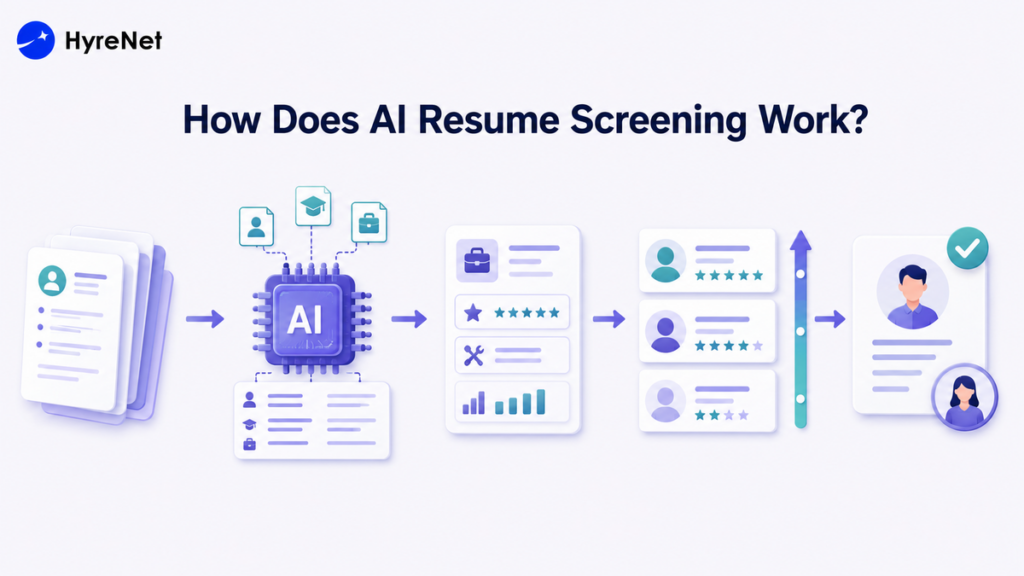
AI Resume Screening usually follows a structured process.
1. Recruiters Define the Role
The hiring team first identifies the essential requirements for the position.
These may include:
- Required technical skills
- Minimum experience
- Important certifications
- Relevant industry knowledge
- Location or work eligibility
- Preferred tools and platforms
Clear requirements produce more useful results. A vague job description may cause the system to recommend unsuitable candidates.
2. Candidates Submit Their Resumes
Applicants upload resumes through a careers page or applicant tracking system.
The screening software reads each document and converts the information into structured data. It may separate details into sections such as skills, education and work history.
3. The System Extracts Relevant Information
The software looks for information connected with the job requirements.
For example, a resume for a digital marketing role may be checked for:
- Search engine optimization
- Google Analytics
- Paid advertising
- Content marketing
- Campaign reporting
- Social media management
The system may also recognize similar terms. For instance, it may connect “search optimization” with “SEO” depending on how advanced the tool is.
4. AI Compares Each Resume With the Job
The system compares candidate information with the criteria selected by the recruiter.
It may check:
- How many required skills appear
- How recent the experience is
- Whether the candidate worked in a similar role
- Whether essential qualifications are present
- How closely the candidate’s background matches the position
This comparison helps the system estimate candidate relevance.
5. Candidates Receive Scores or Rankings
Applicants may receive a match score based on the screening criteria.
A candidate with several relevant skills may receive a higher score. Another applicant may receive a lower score because important qualifications are missing.
The score should guide the recruiter. It should not automatically prove that one candidate is better than another.
6. Recruiters Review the Results
Recruiters review the recommended candidates before moving them forward.
They may also check lower-ranked applications to identify:
- Transferable skills
- Career changes
- Employment gaps
- Unusual job titles
- Relevant freelance experience
- Strong experience described using different terms
Make AI resume screening more accurate and recruitment-ready with HyreNet’s smart hiring platform. Screen resumes faster, shortlist qualified candidates, reduce manual review, improve hiring efficiency, and support better talent decisions with structured workflows built for modern recruitment teams.
Benefits of AI Resume Screening
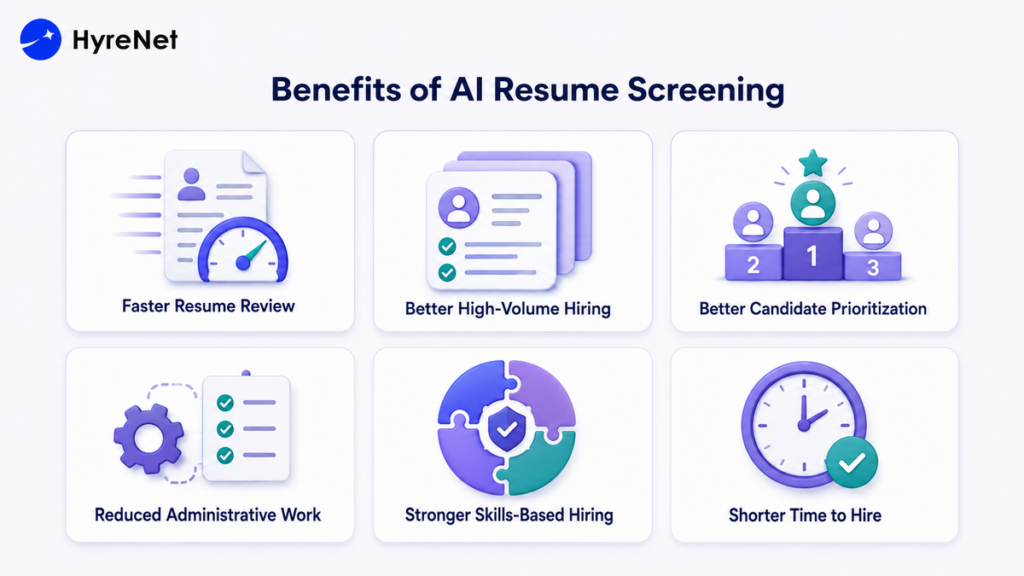
- Faster Resume Review
AI can process large numbers of applications much faster than manual screening.
Recruiters can spend less time sorting resumes and more time speaking with suitable candidates.
- Better High-Volume Hiring
Large companies may receive thousands of applications for graduate programs or customer service roles.
AI Resume Screening helps them organize these applications without increasing the workload for every recruiter.
- More Consistent Initial Screening
The system applies the same selected criteria to each resume.
This creates a more consistent first-stage review than relying on different recruiters to scan applications using personal preferences.
- Better Candidate Prioritization
AI helps recruiters identify applications that appear closely connected with the role.
Hiring teams can review stronger matches first while still keeping other applications available for human review.
- Reduced Administrative Work
Recruiters often spend hours sorting resumes into categories.
AI can automate tasks such as:
- Identifying required skills
- Grouping candidates by experience
- Flagging missing qualifications
- Detecting duplicate applications
- Organizing candidates by role
- Creating an initial shortlist
This allows recruiters to focus on interviews and candidate experience.
- Stronger Skills-Based Hiring
Traditional resume screening may place too much importance on degrees or previous job titles.
AI screening can help recruiters focus more on skills. A candidate may have a different title but still possess the experience required for the position.
- Shorter Time to Hire
Delayed screening can cause strong candidates to accept other offers.
Faster resume review allows recruiters to contact suitable applicants earlier and move them through the hiring process more efficiently.
Common Challenges of AI Resume Screening
AI Resume Screening is useful but not perfect.
- Keyword dependence: A qualified candidate may use different terms from those included in the job description.
- Limited context: AI may not understand why a person changed careers or took a break from work.
- Resume formatting issues: Complex designs, tables and graphics may prevent some systems from reading information correctly.
- Historical bias: A system trained on past hiring data may repeat unfair patterns from earlier recruitment decisions.
- Overreliance on scores: A high resume score does not confirm that a person can perform the job.
- Missing transferable skills: Candidates from different industries may have relevant abilities that the system does not recognize.
- Candidate privacy: Resumes contain personal data that employers must collect, store and process carefully.
These challenges make human oversight essential to ensure AI-driven decisions remain accurate, fair and aligned with hiring requirements.
Best Practices for AI Resume Screening
Employers can improve AI screening by following these practices:
- Define essential requirements: Separate genuine job needs from preferences that are not necessary.
- Use skill-based criteria: Focus on abilities that directly connect with the role.
- Avoid excessive keywords: Do not require candidates to use one exact term when similar experience may be relevant.
- Review rejected applications: Check a sample of rejected resumes to identify qualified candidates the system may have missed.
- Test resume formats: Confirm that the software can read common PDF and Word document layouts.
- Monitor screening results: Review whether certain candidate groups are being excluded at higher rates.
- Keep recruiters involved: Human reviewers should approve shortlists and rejection decisions.
- Protect candidate data: Collect only necessary information and limit access to authorised team members.
- Update the criteria: Change screening rules whenever the responsibilities of the role change.
- Use multiple evaluation methods: Combine resume screening with skills assessments and structured interviews.
How HyreNet Supports Smarter Candidate Screening
HyreNet helps employers create a more structured hiring process.
The platform can support:
- Role-specific candidate screening
- Automated application review
- Consistent candidate comparison
- Skills-based assessments
- Centralised candidate information
- Faster high-volume recruitment
- Reduced manual screening work
- Data-backed shortlisting decisions
Recruiters can use resume information to identify relevant candidates. They can then use structured assessments to check whether those candidates can perform important job tasks.
For example, a developer may complete a coding test after the resume screening stage. A content writer may take a writing assessment. A customer service candidate may respond to a realistic support scenario.
This gives recruiters stronger evidence than a resume alone.
Conclusion
AI Resume Screening helps recruiters review applications faster and manage large candidate pools. It can improve consistency and reduce repetitive administrative work.
The quality of the results depends on the job criteria and the screening process. Employers should review AI recommendations and check for unfair outcomes.
HyreNet helps businesses combine candidate screening with structured skill assessments. This supports faster shortlisting while keeping human judgement central to final hiring decisions.
FAQs
What is AI Resume Screening?
AI Resume Screening uses artificial intelligence to read resumes and compare candidate information with job requirements.
How does AI screen a resume?
The system extracts skills, experience and qualifications. It then compares these details with the hiring criteria selected by the recruiter.
Can AI reject candidates automatically?
Some systems can automatically filter candidates. Employers should review rejection rules and keep human oversight in the process.
What are the benefits of AI Resume Screening?
It supports faster resume review, consistent screening, reduced manual work and better candidate prioritization.
Is AI Resume Screening accurate?
Accuracy depends on the quality of the job description and screening criteria. Recruiters should always review the results before making decisions.