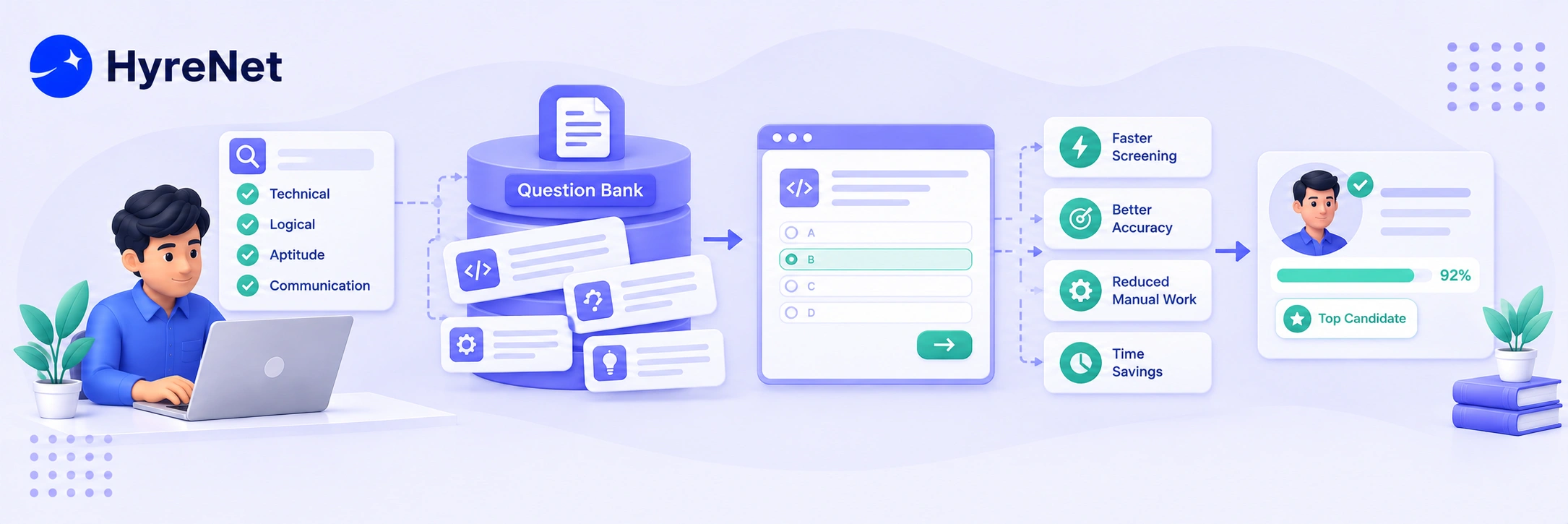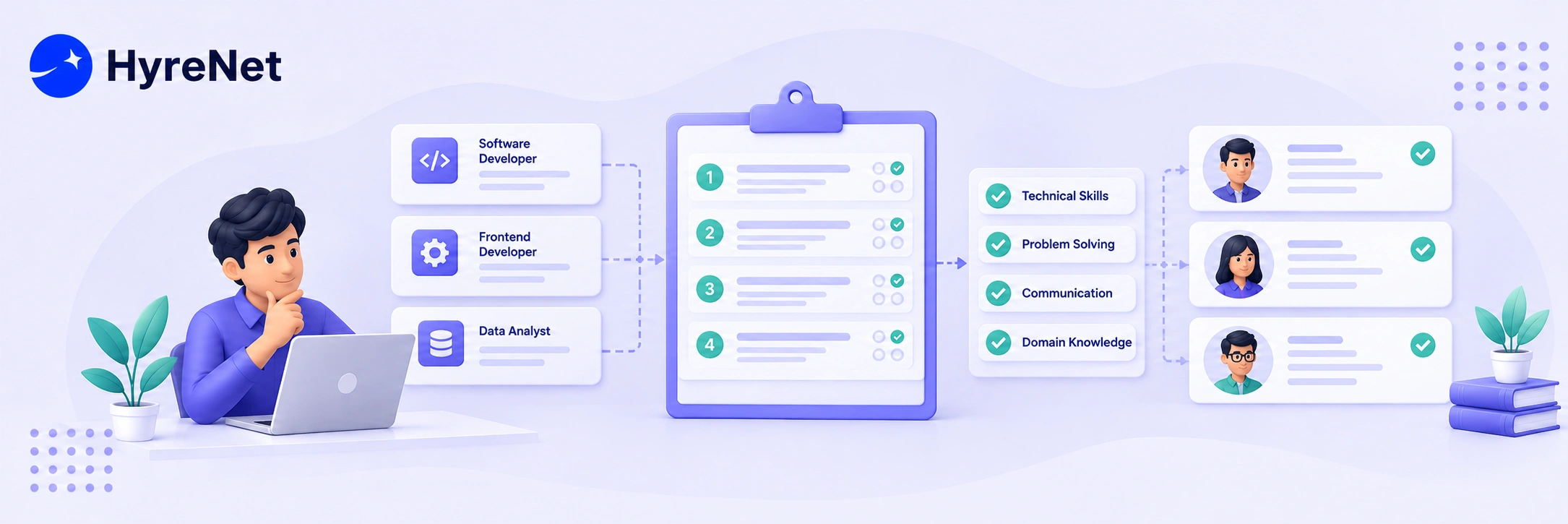



Nearly 79% of HR professionals believe skills assessment scores are as important as or more important than traditional hiring criteria. Yet many employers still rely heavily on resumes and interviews that may not reveal a candidate’s actual abilities.
A pre-employment assessment helps employers evaluate job-related skills, knowledge and workplace behaviour before making an offer. It supports faster screening and gives candidates a fair opportunity to demonstrate their abilities.
However, the assessment must reflect the actual role to deliver meaningful results. This guide explores the major types of pre-employment assessments along with their benefits and best practices.
TL;DR
- Pre-employment assessments measure job-related skills, knowledge and workplace abilities before hiring.
- Common types include skills tests, technical assessments, work samples and situational judgment tests.
- Structured assessments support faster screening, consistent evaluation and skills-based hiring.
- Tests should stay job-relevant, focused and supported by predefined scoring criteria.
- The best results come from combining assessments with structured interviews and human judgment.
What Is a Pre-Employment Assessment?
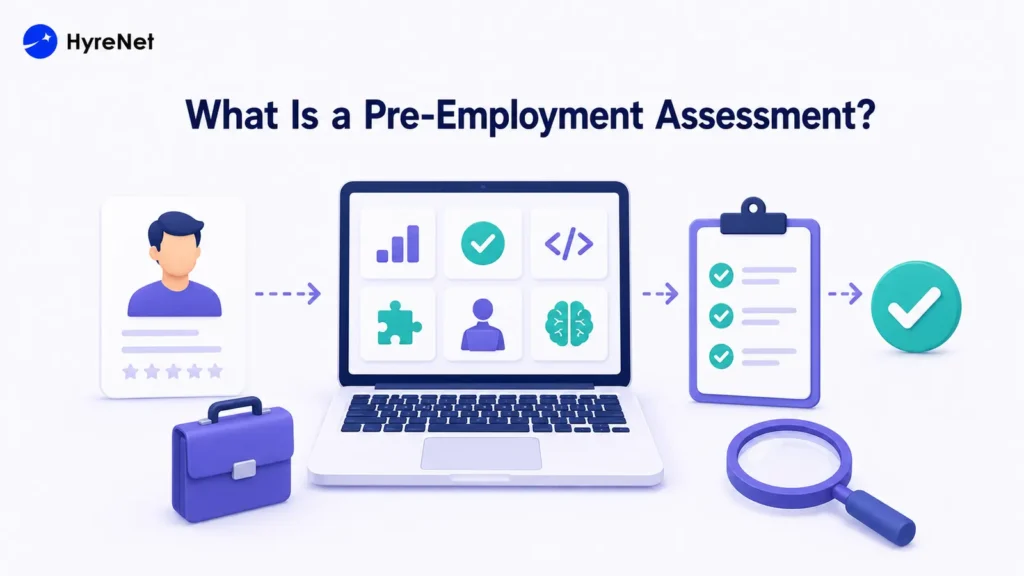
A pre-employment assessment is a structured test used to evaluate candidates before hiring. It measures job-related skills, knowledge, cognitive ability, communication or workplace judgment.
The assessment should reflect the role’s actual responsibilities. Employers should use it alongside resume screening, structured interviews and reference checks rather than as the only hiring method.
Why Are Pre-Employment Assessments Important?
Resumes and interviews can be influenced by personal impressions. Different interviewers may also apply different standards.
A structured assessment gives candidates comparable tasks and uses predefined scoring criteria. This helps recruiters evaluate proven abilities and determine:
- Job Readiness: Can the candidate perform the role’s core tasks?
- Technical Knowledge: Does the candidate understand essential concepts?
- Problem-Solving Ability: How does the candidate handle realistic challenges?
- Communication Skills: Can the candidate communicate clearly and accurately?
- Interview Eligibility: Which applicants should advance?
Assessment results help recruiters prioritize qualified candidates. Final decisions should also consider interviews, experience and other relevant evidence.
Types of Pre-Employment Assessments
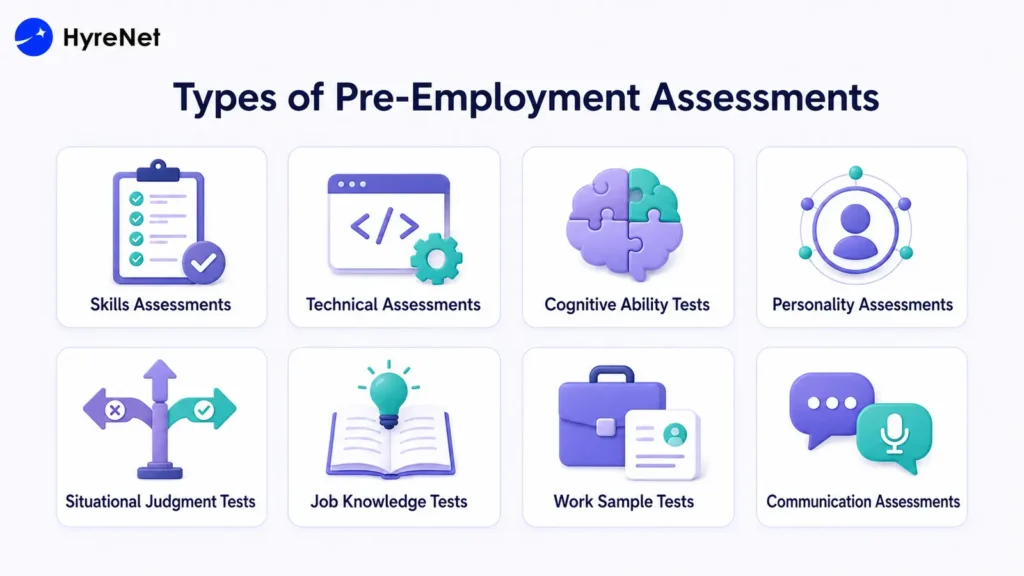
The right hiring assessment depends on the position. A developer may complete a coding test, while a customer service applicant may respond to support scenarios.
1. Skills Assessments
Skills assessments measure a candidate’s ability to complete practical job tasks.
Common examples include:
- Coding exercises for developers
- Writing tests for content roles
- Spreadsheet tasks for finance roles
- Typing tests for data entry roles
- Design tasks for creative roles
- Sales simulations for business development roles
These assessments show whether candidates can apply their knowledge in realistic situations.
2. Technical Assessments
Technical assessments evaluate specialized knowledge required for roles in software development, engineering, cybersecurity, data science and IT.
They may include multiple-choice questions, coding challenges, debugging exercises or case studies. The difficulty should match the position’s seniority level.
3. Cognitive Ability Tests
Cognitive ability tests measure logical reasoning, numerical ability, verbal comprehension and problem-solving skills.
These tests can indicate how quickly candidates process information and learn new concepts. Questions should remain relevant to the role and avoid unnecessary complexity.
4. Personality Assessments
Personality assessments examine workplace preferences and behavioral tendencies such as dependability, adaptability and collaboration.
Employers should use these results as supporting evidence. Personality scores should not independently determine whether a candidate receives an offer.
5. Situational Judgment Tests
Situational judgment tests present realistic workplace scenarios and ask candidates to select the most appropriate response.
They help measure decision-making, communication and conflict resolution. They also give applicants a clearer view of situations they may face in the role.
6. Job Knowledge Tests
Job knowledge tests measure a candidate’s understanding of industry terms, regulations, procedures or professional practices.
They are most useful for positions that require candidates to possess essential knowledge before joining.
7. Work Sample Tests
Work sample tests require candidates to complete a task similar to the actual job.
A marketer may create a campaign outline. A developer may build a small feature. An accountant may review a financial statement.
These tests provide direct evidence of job performance. Employers should keep assignments reasonable and avoid using unpaid candidate work commercially.
8. Communication Assessments
Communication assessments evaluate written or verbal communication for customer service, sales, marketing, leadership and remote roles.
Candidates may write an email, deliver a presentation or handle a simulated customer call. A scoring rubric should measure clarity, accuracy, tone and organization.
Build a smarter pre-employment assessment process with HyreNet’s data-backed hiring platform. Evaluate candidates with structured skill tests, improve hiring efficiency, reduce mis-hires, increase quality of hire, and create a more reliable recruitment workflow for better talent decisions.
Benefits of Pre-Employment Assessments
- More Objective Comparisons: Standardized questions and scoring criteria help recruiters compare candidates using consistent evidence.
- Faster Initial Screening: Automated assessments identify applicants who meet essential requirements before interviews begin.
- Better Skills Evaluation: Practical tasks reveal whether candidates can apply their knowledge to real work.
- Consistent Hiring Standards: Shared assessment criteria create greater consistency across interviewers, teams and locations.
- Improved Role Alignment: Results reveal candidate strengths and help recruiters match applicants with suitable positions.
- More Focused Interviews: Assessment data allows interviewers to explore experience and working methods instead of repeating basic screening questions.
Best Practices for Pre-Employment Assessments
- Begin With a Job Analysis: Identify the skills and competencies required for the role. Every question should reflect a genuine job requirement.
- Choose the Right Assessment Type: Match the test to the position. Use coding tests for developers, work samples for designers and situational tests for managers.
- Keep the Assessment Focused: Test only essential skills. Keep early-stage assessments short and share the expected completion time.
- Use Predefined Scoring Criteria: Create a clear rubric before reviewing responses. This supports fair and consistent evaluation.
- Validate the Assessment: Confirm that the test measures relevant abilities and connects with successful job performance.
- Monitor Fairness and Adverse Impact: Review results across candidate groups. Follow applicable employment laws and address any unfair exclusion patterns.
- Provide Reasonable Accommodations: Offer extra time or accessible formats where required. Clearly explain how candidates can request support.
- Protect Candidate Data: Collect only necessary information. Explain how data will be stored and restrict access to authorised users.
- Combine Multiple Sources of Evidence: Use assessments alongside structured interviews, experience and other relevant information.
- Review the Process Regularly: Update questions and scoring standards as roles change. Track completion rates, feedback and hiring outcomes.
Common Pre-Employment Assessment Mistakes
Here are the most common types of pre-employment assessments employers use to evaluate candidates.
- Skipping Job Analysis: Failing to define the skills and competencies required for the role can lead to irrelevant or misleading assessment questions.
- Using the Wrong Assessment Type: Selecting tests that do not match the job, such as using generic quizzes instead of role-specific work samples or situational tasks.
- Making Assessments Too Long: Overly lengthy tests can discourage candidates and reduce completion rates, especially in early hiring stages.
- Lack of Clear Scoring Criteria: Not using a predefined rubric can result in inconsistent and subjective evaluation of candidate responses.
- Failing to Validate the Assessment: Using tests that are not linked to actual job performance reduces their effectiveness in predicting success.
- Ignoring Fairness and Adverse Impact: Not reviewing outcomes across different candidate groups can lead to unintentional bias or legal risks.
- Not Offering Reasonable Accommodations: Failing to support candidates with accessibility needs can exclude qualified applicants and create compliance issues.
- Weak Data Protection Practices: Collecting unnecessary personal data or failing to secure candidate information can compromise privacy and trust.
- Relying on a Single Evaluation Method: Using only assessments without supporting evidence such as interviews or experience can lead to incomplete hiring decisions.
- Neglecting Regular Review and Updates: Not updating assessments as roles evolve can make them outdated and less relevant over time.
How HyreNet Supports Smarter Candidate Assessment
- Role-Specific Assessments: HyreNet helps employers evaluate candidates through tests aligned with the skills and responsibilities of each position.
- Automated Initial Screening: Recruiters can assess applicants before interviews and quickly identify candidates who meet essential job requirements.
- Consistent Candidate Scoring: Standardised criteria allow hiring teams to compare applicants fairly instead of relying only on resumes or personal impressions.
- Centralised Result Management: Recruiters can review candidate scores and assessment outcomes from one platform for faster decision-making.
- Reduced Manual Work: Automated assessments reduce repetitive screening tasks and allow recruiters to focus on qualified applicants.
- Skills-Based Hiring: HyreNet helps employers prioritise demonstrated abilities over qualifications, job titles or interview confidence.
- Data-Backed Decisions: Assessment results provide recruiters with measurable evidence while keeping human judgement central to final hiring decisions.
- Scalable Recruitment: Businesses can assess large candidate pools efficiently without increasing the workload for their hiring teams.
Conclusion
A pre-employment assessment gives employers clear evidence of a candidate’s job-related skills and knowledge. The assessment should match the role and use consistent scoring. It should also remain accessible and fair.
HyreNet helps businesses assess candidates at scale and identify qualified applicants faster. Combined with structured interviews and recruiter judgement, it supports more confident hiring decisions.
FAQs
What is the purpose of a pre-employment assessment?
A pre-employment assessment measures skills, knowledge or behaviours related to a job. Employers use the results to screen applicants and support more informed hiring decisions.
What are the most common types of pre-employment tests?
Common options include skills tests, technical assessments, cognitive ability tests, personality questionnaires, situational judgement tests and work sample exercises.
Are pre-employment assessments reliable?
A properly designed and validated assessment can provide useful hiring evidence. Its reliability depends on job relevance, consistent administration and a clear scoring process.
At what stage should employers conduct an assessment?
Employers may use a short assessment during initial screening. More detailed work samples are usually better for shortlisted candidates later in the hiring process.
Can a candidate fail a pre-employment assessment?
Employers may establish minimum scores for essential job requirements. However, they should use justified benchmarks and consider assessment results alongside other relevant evidence.