
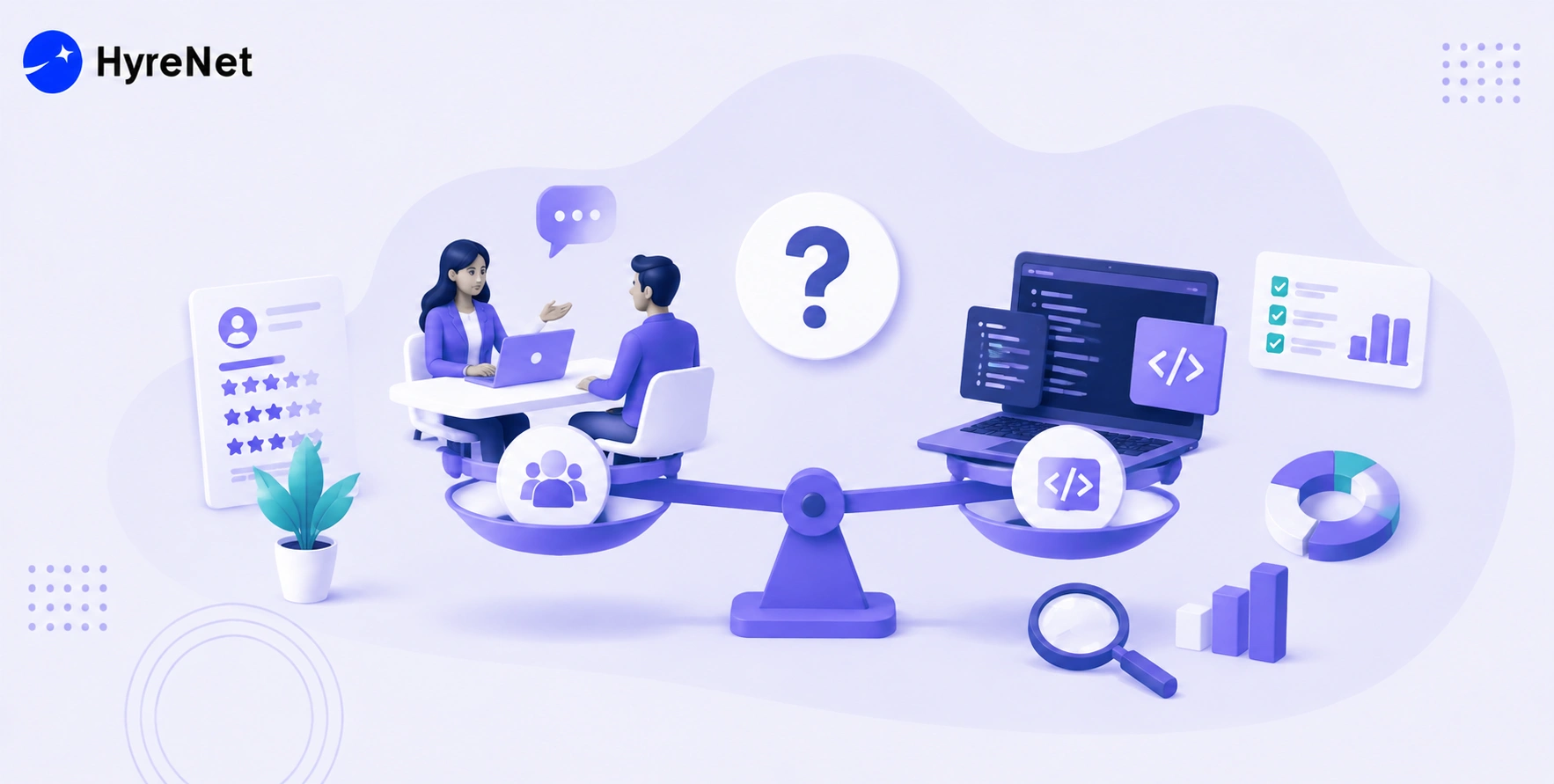

Two candidates apply for the same role. One breezes through a friendly, free-flowing interview and gets hired on gut feeling. The other completes a structured evaluation and a hands-on skills test.
Six months later, only one of them is actually thriving in the role. This is the real-world stakes behind the Structured Interviews vs Technical Assessments debate.
Both methods exist to answer the same basic question: will this person actually succeed in the job? But they go about it in very different ways, and recruiters often assume one is simply better than the other. The honest answer is more nuanced than that.
This blog breaks down the Structured Interviews vs Technical Assessments question in detail, covering what each method actually measures, what the research says about their accuracy, and when combining them beats picking just one.
TL;DR Summary
- Structured interviews use the same questions and scoring rubric for every candidate, reducing bias and guesswork
- Technical assessments test real, hands-on ability directly, rather than relying on how someone talks about their skills
- Research consistently ranks both methods among the strongest predictors of job performance, well above unstructured interviews
- Neither method alone is a clear universal winner, since they measure different things
- Combining both tends to outperform either one used on its own
- The right choice often depends on the role, not a fixed rule
What Structured Interviews Actually Measure
Understanding this side of the Structured Interviews vs Technical Assessments comparison starts with what a structured interview actually looks like in practice.
A structured interview asks every candidate the same set of job-relevant questions, scored against a consistent rubric, instead of letting the conversation wander wherever the interviewer feels like taking it.
- Consistent questions: Every candidate answers the same core questions, which makes comparisons fair
- Behavioral and situational focus: Questions often ask candidates to describe past experiences or how they would handle a specific scenario
- Scored independently: Interviewers rate answers against a fixed rubric before comparing notes, which reduces groupthink
- Strong research backing: Large scale studies have repeatedly found structured interviews to be one of the strongest predictors of job performance, often outperforming casual, unstructured conversations by a wide margin
What Technical Assessments Actually Measure
This is the other half of the Structured Interviews vs Technical Assessments equation, and it works very differently from a conversation-based evaluation.
A technical assessment gives candidates a real task, like writing code, solving a case study, or completing a role-specific exercise, and scores the actual output.
- Direct evidence of ability: Instead of asking someone to describe their skills, the candidate demonstrates them
- Objective scoring: Many assessments can be scored automatically or against a clear rubric, reducing subjective judgment
- Scales well: A well designed test can be given to hundreds of applicants at once, which interviews cannot easily match
- Research also ranks these highly: Job knowledge tests and work sample exercises consistently appear near the top of validated hiring methods in large meta-analyses
Structured Interviews vs Technical Assessments: A Side-by-Side Look
| Factor | Structured Interviews | Technical Assessments |
|---|---|---|
| What it measures | Judgment, communication, past behavior | Hands-on, job-specific ability |
| Scalability | Limited by interviewer time | Easy to run at high volume |
| Bias reduction | Strong, if scored consistently | Strong, especially with automated scoring |
| Candidate experience | Feels personal, but can feel inconsistent | Feels objective, if clearly job-relevant |
| Best used for | Roles needing judgment, communication, leadership | Roles needing demonstrable technical skill |
This comparison is really the core of the Structured Interviews vs Technical Assessments question. Each method is strong in areas the other one is weaker in, which is exactly why picking a permanent winner misses the point.
What the Research Actually Says
Multiple large-scale studies place both methods among the strongest predictors of on-the-job performance, far ahead of unstructured, free-flowing interviews. Some research even shows unstructured interviews carry less than half the predictive power of a properly run structured interview.
Technical, job-specific assessments tend to land in a similar range, sometimes edging slightly ahead depending on the study and the role being measured.
The real takeaway from the Structured Interviews vs Technical Assessments research is not that one method dominates, but that both dramatically outperform casual, unscored conversations.
What the Numbers Show
A few data points help put the Structured Interviews vs Technical Assessments comparison in perspective.
- Structured interviews consistently rank among the top predictors of job performance in large scale research, with validity scores roughly double that of unstructured, casual interviews
- Technical and job knowledge assessments score in a similar top tier, often landing close behind or even ahead of structured interviews depending on the specific study
- Unstructured interviews remain one of the weakest predictors despite still being the most commonly used hiring method at many companies
- Combining multiple validated methods consistently produces stronger predictions than relying on any single method alone
The pattern across the research is clear. The real gap is not between structured interviews and technical assessments, it is between structured, evidence-based methods and casual, unscored ones.
When Combining Both Works Best
Rather than treating Structured Interviews vs Technical Assessments as a competition, the strongest hiring processes rarely pick just one method. They layer both together, using each one where it naturally fits.
- Screen early with a technical assessment: Filter for real, demonstrated skill before investing interview time
- Use structured interviews for judgment and fit: Once technical ability is confirmed, a scored interview helps assess communication, problem solving, and team fit
- Score both independently: Avoid letting one strong interview performance excuse a weak assessment score, or vice versa
- Weight them based on the role: A highly technical role might weight the assessment more heavily, while a leadership role might weight the interview more
Platforms like HyreNet are built around exactly this layered approach, combining skills testing with structured evaluation tools so recruiters are not forced to choose one method over the other.
Common Mistakes When Choosing Between Them
Recruiters navigating the Structured Interviews vs Technical Assessments decision tend to fall into a few predictable traps.
- Treating interviews as purely conversational: An unstructured, free-flowing interview loses most of the predictive power a structured one offers
- Using a generic technical assessment: A test that does not closely match real job tasks tells you far less than a role-specific one
- Relying on only one method: Skipping either structured interviews or technical assessments entirely leaves a real gap in what you actually learn about a candidate
- Letting one great answer override a weak assessment: A charming interview should not erase a clearly failed skills test, and the reverse is also true
For more on how modern platforms are solving these exact hiring gaps, do check out HyreNet’s breakdown of common recruitment challenges.
Conclusion
The Structured Interviews vs Technical Assessments debate does not really have a single winner, because both methods measure different, equally important things. Structured interviews reveal judgment and communication. Technical assessments reveal real, hands-on ability.
The strongest hiring processes stop treating this as an either-or choice and instead use both, each in the place it naturally fits. That combination is what consistently outperforms relying on just one method alone.
FAQs
Which method should come first in the hiring process?
Many recruiters run the technical assessment earlier, since it filters for real ability quickly, before investing time in a longer structured interview.
Are technical assessments only useful for engineering roles?
No. Any role with a demonstrable skill, like writing, data analysis, or customer scenario handling, can use a relevant assessment, not just coding roles.
Can a structured interview really eliminate bias completely?
Not completely, but using the same questions and a shared scoring rubric significantly reduces bias compared to a free-flowing, unstructured conversation.
Is it ever fine to skip the technical assessment for senior roles?
It depends on the role. Senior roles often shift toward case studies or strategic exercises rather than skipping evaluation of ability entirely.
How long should a technical assessment take to avoid losing candidates?
Most well designed assessments stay under 45 minutes, since longer tests increase drop off without meaningfully improving the signal they provide.