


A candidate may spend only a few minutes applying for a job but the experience can influence how they view the company for much longer.
Candidate experience covers every interaction a job seeker has with an employer during recruitment. It starts with the job post and continues through application, assessment, interviews, communication and final hiring decisions.
A strong candidate experience helps companies attract better talent, reduce candidate drop-off and protect their employer brand. A poor experience can push qualified applicants away even when the role itself is attractive.
This guide explains what candidate experience means, why it matters and how recruiters can improve it across the hiring process.
TL;DR Summary
- Candidate experience covers every interaction between a candidate and an employer.
- Clear communication and simple hiring steps improve engagement.
- Long applications and delayed updates can increase candidate drop-off.
- Recruitment technology can improve speed but human interaction still matters.
- The best candidate experience is clear, respectful and consistent.
What Is Candidate Experience?
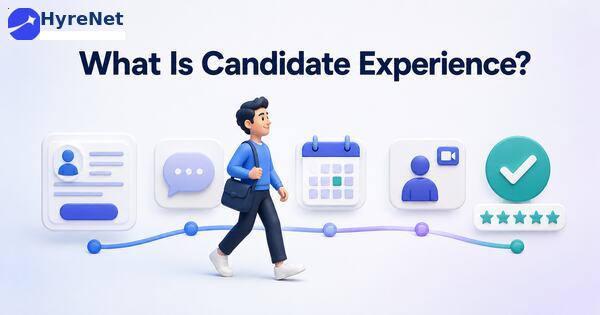
Candidate experience is the perception a job seeker develops about an employer during the recruitment process.
It is shaped by both major and minor interactions.
A candidate may judge the company based on:
- How clearly the job is explained
- How easy the application is to complete
- How quickly recruiters respond
- How relevant the assessment feels
- How prepared interviewers appear
- How long the hiring process takes
- How professionally rejection is handled
Candidate experience therefore affects more than successful hires. Candidates who are rejected still leave the process with an opinion about the employer.
Why Is Candidate Experience Important in Recruitment?
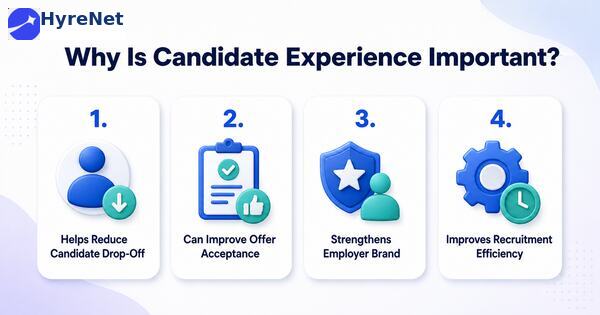
1. It Helps Reduce Candidate Drop-Off
Candidates may leave the recruitment funnel when the process becomes too demanding or unclear.
Common reasons include:
- Very long application forms
- Multiple unnecessary interview rounds
- Delayed recruiter responses
- Unclear assessment instructions
- Repeated requests for the same information
Recruitment teams should identify where candidates leave and investigate what is causing the friction.
2. It Can Improve Offer Acceptance
A candidate may receive several offers at the same time.
Salary matters but the recruitment experience also influences the decision.
Fast communication and organized interviews can make the employer appear more professional and reliable.
3. It Strengthens Employer Brand
Applicants often discuss hiring experiences with friends or professional networks.
A poorly managed recruitment process can therefore affect people beyond the original candidate.
A respectful process helps employers maintain a stronger reputation even among rejected applicants.
4. It Improves Recruitment Efficiency
Poor candidate experience often creates extra work for recruiters.
Candidates send repeated emails when they do not know their application status. Recruiters then spend more time answering questions that could have been prevented with clear communication.
A structured recruitment workflow reduces this unnecessary back-and-forth.
What Are the Main Candidate Experience Stages?
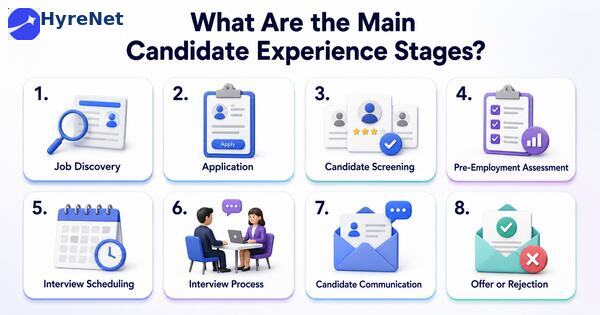
1. Job Discovery
The experience starts before the application.
Candidates first evaluate whether the vacancy appears relevant and trustworthy.
A useful job description should clearly mention:
- Role responsibilities
- Required skills
- Experience expectations
- Work location
- Employment type
- Major selection stages
Employers should avoid vague phrases that do not explain what the candidate will actually do.
2. Application
The next stage is the application itself.
A candidate should not need 30 minutes to complete a form for an initial application when a resume already contains most of the required information.
Application forms should request only necessary details.
Useful improvements include:
- Resume upload
- Mobile-friendly forms
- Autofill support
- Clear progress indicators
- Fewer mandatory questions
Every additional step creates another opportunity for candidate drop-off.
3. Candidate Screening
Screening and candidate assessment determines who moves forward.
Candidates may be evaluated through resume review, eligibility questions, screening calls or structured assessments. The criteria should relate directly to the role. For example, a developer may be evaluated on coding ability rather than only educational background. A sales candidate may be assessed on communication and objection handling instead of generic aptitude alone.
4. Pre-Employment Assessment
Assessments can improve hiring quality but poorly designed tests can damage candidate experience.
Candidates should know:
- Why the assessment is required
- What skills it measures
- How long it takes
- When it must be completed
- What technology is required
The assessment should also resemble actual job requirements. A technical candidate should not complete a lengthy generic test when the role mainly depends on practical coding skills.
5. Interview Scheduling
Scheduling delays often create unnecessary friction. Traditional scheduling may require several emails to find a suitable time. Scheduling tools can allow candidates to select from available interview slots directly.
Recruiters should also consider:
- Candidate time zones
- Working professionals’ schedules
- Interview duration
- Rescheduling options
A simple scheduling process can improve both recruiter productivity and candidate experience.
6. Interview Process
The interview is one of the most important stages in the candidate journey. Interviewers should understand the candidate’s background before the conversation begins. Candidates should not have to explain the same information repeatedly across several rounds.
A structured interview process should include:
- Defined evaluation criteria
- Role-specific questions
- Clear interviewer responsibilities
- Consistent scoring methods
This makes interviews more useful for both candidates and hiring teams.
7. Candidate Communication
Candidates should not have to guess what happens next.
Recruiters should communicate after important milestones such as:
- Application received
- Screening completed
- Assessment assigned
- Interview scheduled
- Interview completed
- Hiring decision made
Automated messages can handle basic updates. Recruiters should personally manage more sensitive communication.
8. Offer or Rejection
Candidate experience continues until the recruitment process officially ends. Successful candidates need clear information about compensation, joining dates and onboarding requirements. Rejected candidates should also receive closure. Leaving applicants without any final communication can damage employer perception.
Improve candidate experience in recruitment with HyreNet’s smarter hiring platform. Create clearer assessments, reduce candidate drop-offs, simplify screening workflows, improve communication, and build a more candidate-friendly recruitment process that helps hiring teams attract and retain better talent.
What Creates a Poor Candidate Experience?
- Long Hiring Processes
A long hiring process can become a major recruitment challenge when several weeks pass between stages. Delays may cause candidates to lose interest or accept offers from other employers.
- Unclear Recruitment Timelines
Candidates often become frustrated because they do not know how many stages remain.
Recruiters should explain the expected recruitment journey early.
- Excessive Assessments
Assessments should provide useful hiring information.
Too many tests can make candidates feel that the company does not value their time.
- Repetitive Interviews
Candidates should not answer the same questions in every interview round.
Recruiters can prevent this by sharing interview notes and assigning clear evaluation areas to each interviewer.
- Generic Communication
Automated messages are useful but they should still provide meaningful information.
“Your application is under review” is less helpful when the candidate has already waited several weeks.
Updates should explain the actual status where possible.
How Can Recruiters Improve Candidate Experience?
1. Map the Entire Candidate Journey
Recruiters should review every stage from the candidate’s perspective.
Create a simple recruitment funnel such as:
Job View → Application → Screening → Assessment → Interview → Offer
Then identify:
- Where delays occur
- Where candidates drop out
- Which steps create repeated questions
- Which stages require too much manual work
This creates a clear starting point for improvement.
2. Set Service-Level Timelines
Recruitment teams can define internal response targets.
For example:
- Application acknowledgment: Immediate
- Assessment invitation: Within one business day
- Interview update: Within two business days
- Final decision communication: Within a defined hiring timeline
These targets make communication more consistent.
3. Make Assessments Role-Specific
Assessments should answer a real hiring question.
For example:
- Can this developer write usable code?
- Can this salesperson handle an objection?
- Can this support candidate respond clearly to a customer?
- Can this analyst interpret business data?
Recruiters should remove tests that do not contribute meaningful evidence.
4. Reduce Unnecessary Interview Rounds
Every interview should have a defined purpose.
One round may assess technical skills.
Another may evaluate communication or team fit.
Repeating the same evaluation across several interviews wastes both candidate and recruiter time.
5. Personalize Important Communication
Automation works well for routine updates.
Recruiters should personally handle:
- Final interview communication
- Offer discussions
- Salary negotiations
- Detailed candidate questions
- Sensitive rejection conversations
This maintains human connection without adding unnecessary manual work.
6. Make Hiring Mobile-Friendly
Candidates increasingly interact with recruitment processes through mobile devices.
Application forms and assessment platforms should work properly on smaller screens where the hiring method allows it.
Recruiters should test the actual candidate journey instead of assuming it works.
How Can Recruitment Technology Improve Candidate Experience?
Technology can remove administrative friction from recruitment. The strongest use cases are usually repetitive tasks.
Recruitment Technology Can Support:
- Application confirmation
- Resume organization
- Candidate screening
- Assessment delivery
- Interview scheduling
- Automated reminders
- Candidate status updates
- Recruitment analytics
For example, an automated assessment reminder can reduce missed tests. A scheduling platform can remove several rounds of emails. A recruitment dashboard can show where candidates leave the funnel. Technology becomes useful when it makes the process easier rather than simply adding another system candidates must use.
Which Candidate Experience Metrics Should Recruiters Track?
| Metric | What It Measures |
| Application completion rate | Percentage of candidates who finish applying |
| Candidate drop-off rate | Percentage leaving at a specific hiring stage |
| Assessment completion rate | Candidates who complete assigned assessments |
| Interview attendance rate | Candidates who attend scheduled interviews |
| Time to interview | Speed from application to interview |
| Offer acceptance rate | Percentage of candidates accepting offers |
| Candidate satisfaction score | Candidate perception of the hiring process |
| Time to hire | Overall recruitment speed |
How Can Recruiters Measure Candidate Drop-Off?
Recruiters should calculate candidate progression at every stage.
For example:
- 1,000 candidates view the job
- 300 start an application
- 220 complete the application
- 120 reach assessment
- 70 complete the assessment
- 25 attend interviews
- 5 receive offers
This funnel shows exactly where candidate numbers fall.
A significant drop between assessment invitation and assessment completion may indicate:
- The hiring assessment is too long
- Instructions are unclear
- Candidates receive insufficient reminders
- The test does not feel relevant
- Technical issues are affecting completion
Recruiters can then investigate the specific stage instead of redesigning the entire recruitment process.
How Can AI Improve Candidate Experience?
Useful applications of AI in recruitment include:
- Faster Screening
AI tools can organize large application volumes according to predefined criteria.
Recruiters can then focus on stronger matches.
- Automated Candidate Updates
Candidates can receive application confirmations and assessment reminders without waiting for manual recruiter action.
- Smarter Scheduling
Automated scheduling can connect candidate availability with recruiter calendars.
- Recruitment Analytics
AI-supported dashboards can help identify hiring delays and candidate drop-off patterns.
Note: AI should still support recruiters rather than become the only decision-maker. Human review remains important for hiring decisions that require judgment and context.
How Can HyreNet Improve Candidate Experience?
HyreNet can help recruitment teams create a more structured candidate journey through AI-supported screening, assessments and hiring workflows.
Recruiters can use the platform to manage candidate evaluation more consistently and reduce repetitive recruitment work.
A structured system can help teams:
- Screen candidates more efficiently
- Deliver job-relevant assessments
- Track candidate progress
- Reduce manual coordination
- Manage high-volume hiring
- Maintain clearer recruitment workflows
This allows recruiters to spend less time on repetitive administration and more time on candidate engagement and decision-making.
Candidate Experience Best Practices
Recruitment teams can use the following checklist to improve the process.
Before Applications
- Write accurate job descriptions.
- Explain essential skills clearly.
- Mention the major recruitment stages.
During Screening
- Use predefined evaluation criteria.
- Avoid unnecessary screening questions.
- Keep assessments relevant to actual job responsibilities.
During Interviews
- Make scheduling simple.
- Prepare interviewers in advance.
- Avoid repeating the same questions across rounds.
- Explain next steps after each interview.
After Interviews
- Share hiring updates promptly.
- Communicate delays instead of remaining silent.
- Provide clear offers and joining instructions.
- Close rejected applications professionally.
Conclusion
Candidate experience is not a separate part of recruitment. It is the result of how the entire hiring process is designed.
A clear job description creates the first impression. A simple application keeps candidates engaged. Relevant assessments make evaluation feel fair. Timely communication reduces uncertainty.
Recruitment technology can improve speed through automation, scheduling and analytics. Recruiters still provide the human judgment and communication candidates expect during important decisions.
The strongest candidate experience therefore combines efficient technology with a clear and human recruitment process.
FAQs
1. What does candidate experience mean?
Candidate experience is the overall impression a candidate develops from every interaction with an employer during recruitment.
2. What improves candidate experience?
Clear communication, simple applications, relevant assessments, faster scheduling and timely hiring decisions can improve candidate experience.
3. What causes poor candidate experience?
Long hiring processes, unclear communication, repetitive interviews and irrelevant assessments are common causes.
4. How do you measure candidate experience?
Recruiters can measure application completion, candidate drop-off, assessment completion, offer acceptance and candidate satisfaction.
5. How can AI improve candidate experience?
AI can support faster screening, automated updates, interview scheduling and recruitment analytics. Human recruiters should remain involved in important hiring decisions.