
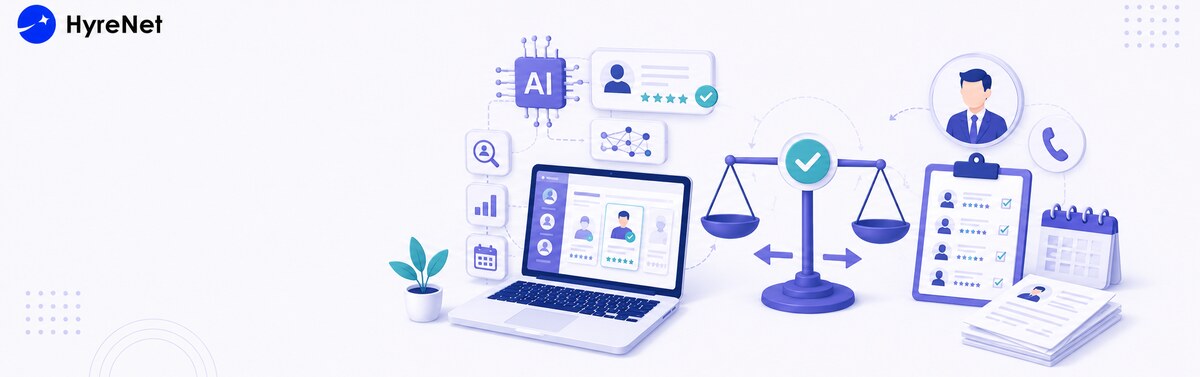

What happens when hiring teams need speed but cannot afford to lose human judgment? That is where the comparison between AI recruitment vs traditional recruitment becomes important. Traditional recruitment depends on recruiters for sourcing, screening, scheduling and interviews. AI recruitment supports the same process with automation, analytics and assessment tools.
Both approaches solve different hiring problems. Traditional recruitment brings context and human understanding. AI recruitment brings speed and structure. The best hiring process connects both so recruiters can save time without losing the judgment needed to choose the right candidate.
TL;DR
- AI recruitment improves speed, automation and scalability.
- Traditional recruitment offers stronger human judgment and connection.
- AI works best for screening, scheduling and analytics.
- Recruiters remain essential for interviews and final decisions.
- The best approach combines AI efficiency with human oversight.
- Generative AI reduces recruiter workload by 20% on average, according to LinkedIn’s 2025 Future of Recruiting report.
- 75% of HR professionals say AI will make human judgment more important in the next five years, according to SHRM.
- In an AI-assisted hiring study of 37,000 junior developer applicants, 54% from the AI pipeline passed the final interview compared with 34% from the traditional pipeline.
What Is AI Recruitment?
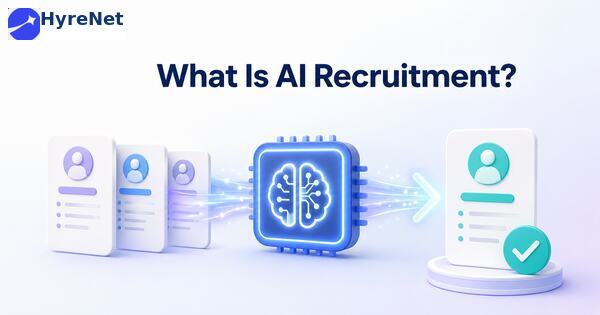
AI recruitment uses artificial intelligence and automation tools to support different stages of hiring. These tools can help recruiters source candidates, screen resumes, schedule interviews, send updates and analyze recruitment data.
For example, an AI resume screening tool can scan applications against job-related criteria. A chatbot can answer basic candidate questions. A recruitment analytics dashboard can show candidate conversion, assessment completion and candidate drop-off across the recruitment funnel.
What Is Traditional Recruitment?
Traditional recruitment relies on recruiters to handle tasks such as sourcing, resume screening and interview scheduling manually.
It gives teams greater control and supports direct candidate relationships. However, managing high application volumes can become a major recruitment challenge. Manual screening can also lead to inconsistent evaluation between recruiters.
AI Recruitment vs Traditional Recruitment at a Glance
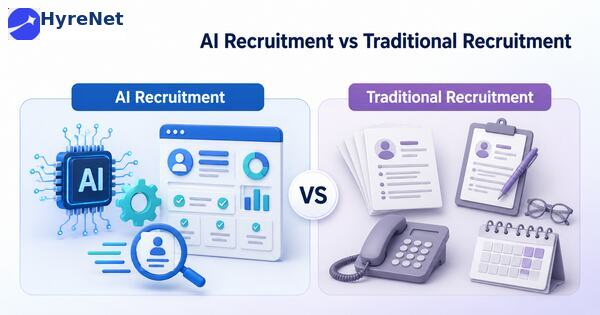
| Area | AI recruitment | Traditional recruitment |
| Resume screening | Uses AI tools to organize and shortlist profiles | Recruiters manually review applications |
| Candidate communication | Automated messages and chatbots support updates | Recruiters send emails and calls manually |
| Interview scheduling | Candidates choose available slots through tools | Scheduling depends on back-and-forth communication |
| Recruitment analytics | Dashboards track hiring metrics and trends | Data may be scattered across systems |
| Candidate screening | Uses predefined rules and assessments | Depends mainly on recruiter review |
| Speed | Faster for repetitive stages | Slower during high-volume hiring |
| Human judgment | Needed for review and final decisions | Central across every stage |
| Scalability | Easier to manage large applicant pools | Requires more recruiter time |
Benefits of AI Recruitment
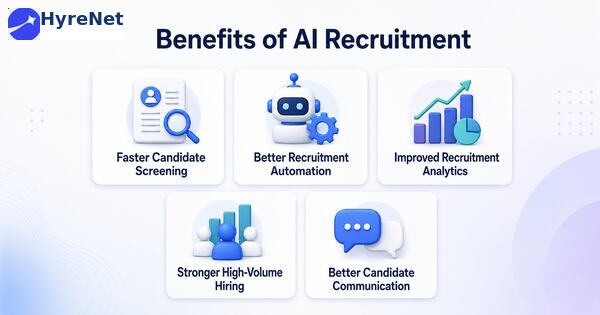
- Faster Candidate Screening
Manual resume screening can take several hours for a single role.
AI tools can organize applications based on predefined job requirements. Recruiters can then review a focused shortlist instead of starting with every resume manually.
This saves time and helps teams move qualified candidates forward faster.
- Better Recruitment Automation
Recruitment automation reduces repetitive administrative work.
Tools can send assessment links, schedule interviews and update candidates automatically. This allows recruiters to focus on interviews, hiring manager alignment and candidate engagement.
Automation also supports consistency because the same workflow can be applied to candidates at the same stage.
- Improved Recruitment Analytics
AI recruitment tools can collect data from different hiring stages.
Recruiters can track recruitment KPIs such as time to hire, cost per hire, source of hire and offer acceptance rate. They can also monitor assessment completion and candidate drop-off.
These insights help teams identify weak stages in the recruitment funnel.
- Stronger High-Volume Hiring
Companies hiring for multiple roles often receive hundreds or thousands of applications.
AI recruitment helps organize this volume. It can prioritize candidates based on relevant criteria and reduce the pressure on recruiters.
This is useful for campus hiring, customer support roles, sales hiring and technical recruitment.
- Better Candidate Communication
Candidates often leave the hiring process when they do not receive timely updates.
Automated messages can confirm applications, remind candidates about assessments and share interview instructions. This improves transparency and reduces unnecessary follow-ups.
Make modern hiring smarter with HyreNet’s AI-driven recruitment platform. Compare AI recruitment and traditional recruitment with clearer candidate insights, faster screening, structured assessments, reduced manual workload, and data-backed hiring workflows that help teams identify the right talent with confidence.
Benefits of Traditional Recruitment
- Stronger Human Connection
Recruiters can understand candidate motivation, career goals and communication style through direct conversations.
This matters in senior hiring and roles where culture fit and leadership potential are important.
- Better Contextual Judgment
A resume may not tell the full story.
A candidate with a career gap may still have strong skills. A person changing industries may bring valuable experience from another field.
Human recruiters can interpret these details more carefully than automated systems.
- Flexible Evaluation
Traditional recruitment allows recruiters to adjust conversations based on candidate responses.
This flexibility is useful for complex roles where standard screening criteria may not capture everything.
- Relationship-Based Hiring
Recruiters often build long-term relationships with candidates.
A candidate may not be the right fit today but could be suitable for a future role. Traditional recruitment supports this relationship-building more naturally.
Challenges of AI Recruitment
AI-based recruitment can improve hiring but only when implemented carefully.
- Risk of Unfair Screening
AI tools depend on the data and rules behind them.
Poorly designed criteria can screen out suitable candidates or reinforce bias. Recruiters should review the logic behind automated recommendations and audit outcomes regularly.
- Over-Reliance on Technology
A system can rank candidates but it cannot understand every human context.
Recruiters should not treat AI recommendations as final decisions. Important candidate progression decisions should include human review.
- Candidate Experience Issues
Too much automation can make hiring feel impersonal.
Candidates may feel frustrated when they only interact with chatbots or automated emails. Recruiters should remain available for important questions and sensitive updates.
- Data Privacy Concerns
AI recruitment tools process personal candidate data.
Companies must evaluate how vendors store and use applicant information. Clear data retention policies and access controls are important.
Challenges of Traditional Recruitment
- Slower Hiring Process
Manual screening, scheduling and follow-ups take time.
This can become a serious recruitment challenge when companies need to fill roles quickly or manage high application volumes.
- Inconsistent Screening
Different recruiters may evaluate the same resume differently.
One recruiter may focus on education while another prioritizes experience. Structured criteria are needed to make candidate screening more consistent.
- Limited Visibility
Traditional recruitment often lacks strong data tracking.
Recruiters may know how many candidates applied but not where candidates dropped off or which source produced the best hires.
- Higher Manual Workload
Recruiters spend a large part of their time on repetitive tasks.
This can reduce the time available for strategic hiring conversations and candidate engagement.
Where AI Recruitment Works Best
AI recruitment is most useful in repetitive and data-heavy hiring stages.
It works well for:
- Resume parsing and application organization
- Initial candidate screening
- Interview scheduling
- Assessment delivery
- Recruitment automation workflows
- Candidate status updates
- Recruitment analytics dashboards
- High-volume hiring campaigns
A remote hiring assessment can also be managed more easily with technology. Recruiters can send assessments, track completions and compare scores through a structured platform. These use cases improve hiring speed without removing recruiters from final decisions.
Where Traditional Recruitment Works Best
Traditional recruitment works best when roles require deeper human evaluation.
It is useful for:
- Senior leadership hiring
- Executive search
- Relationship-based recruitment
- Sensitive candidate conversations
- Final interview evaluation
- Compensation discussions
- Culture and team alignment
Human recruiters can understand nuance, motivation and context more effectively.
Which Approach Is Better?
The better approach depends on hiring needs.
AI recruitment is stronger for speed, structure and scale. Traditional recruitment is stronger for judgment, relationships and personal candidate engagement.
Most hiring teams need both.
A company can use AI tools to manage repetitive work and use recruiters for deeper evaluation. For example, technology can organize resumes and send assessments. Recruiters can then review shortlisted candidates, conduct interviews and make final recommendations.
This blended model gives teams the efficiency of AI in recruitment and the reliability of human judgment.
Best Practices for Using AI and Traditional Recruitment Together
- Define Clear Screening Criteria
Recruiters should decide what matters before using any tool.
The criteria should reflect the actual job requirements. This prevents both manual and automated screening from becoming inconsistent.
- Keep Human Oversight
Technology should support decisions rather than replace accountability.
Recruiters should review candidate shortlists and investigate unusual screening patterns.
- Track Recruitment KPIs
Hiring teams should measure results across the recruitment funnel.
Useful KPIs include time to hire, source of hire, cost per hire, assessment completion and offer acceptance. These metrics show whether the process is improving.
- Reduce Candidate Drop-Off
Recruitment teams should monitor where candidates leave the process.
Long applications, unclear assessment instructions and delayed interview scheduling can increase candidate drop-off. Automation can help with reminders but the process still needs to feel reasonable.
- Use Analytics for Improvement
Recruitment analytics can show which sourcing channels and screening stages perform best.
Teams should use this data to improve specific parts of hiring instead of making broad process changes without evidence.
- Maintain Candidate Communication
Automated updates are useful but they should not replace all human interaction.
Recruiters should personally handle feedback, complex questions and final-stage conversations.
Top Tools Used in AI recruitment
| Tool name | Purpose |
| HyreNet | Supports AI-powered candidate screening, assessments and recruitment workflows. |
| HireVue | Supports video interviews and structured candidate evaluation. |
| Greenhouse | Tracks candidates and manages structured hiring pipelines. |
| Lever | Helps manage candidate relationships and hiring stages. |
| Paradox | Uses conversational AI for candidate communication and scheduling. |
| Eightfold AI | Supports talent matching and skills-based candidate discovery. |
| HackerRank | Provides coding assessments for technical hiring. |
| TestGorilla | Offers skills tests for pre-employment assessment. |
| Calendly | Helps schedule interviews without repeated emails. |
| Tableau | Builds recruitment analytics dashboards for hiring KPIs. |
Conclusion
AI recruitment and traditional recruitment are not direct opposites. They solve different hiring problems.
AI recruitment helps teams move faster, automate repetitive tasks and track recruitment KPIs more effectively. Traditional recruitment brings human judgment, personal connection and contextual understanding.
The best hiring process combines both.
Recruiters caAI recruitment is better for speed, automation and high-volume hiring. Traditional recruitment is better for relationship-building, contextual judgment and final candidate evaluation.
n use technology for sourcing, screening, assessments and analytics. They can then apply human judgment during interviews, decision-making and candidate engagement.
The future of hiring is not about choosing machines over people. It is about building a smarter process where technology handles routine work and recruiters focus on decisions that truly need human insight.
FAQs
1. What is the difference between AI recruitment and traditional recruitment?
AI recruitment uses technology to support sourcing, screening, scheduling and analytics. Traditional recruitment relies more on manual recruiter effort and direct human evaluation.
2. Is AI recruitment better than traditional recruitment?
AI recruitment is better for speed, automation and high-volume hiring. Traditional recruitment is better for relationship-building, contextual judgment and final candidate evaluation.
3. Can AI replace recruiters?
No. AI can support repetitive tasks but recruiters are still needed for interviews, candidate engagement and final hiring decisions.
4. How does AI help candidate screening?
AI can organize resumes, match profiles to job criteria and support skills-based shortlisting. Recruiters should review outcomes before making important decisions.
5. What is the best recruitment approach?
The best approach combines AI recruitment with traditional recruitment. Technology improves efficiency while recruiters provide judgment, context and human connection.