


Hiring rarely happens in one step. A candidate may discover a vacancy today, apply tomorrow, and complete several screening stages before receiving an offer. Some candidates move forward while others leave or get screened out at different points.
A recruitment funnel helps employers understand this entire journey. It organizes hiring into measurable stages from attracting candidates to making successful hires.
Recruiters can use the funnel to see where candidates drop off and which stages create delays. They can then improve weak points instead of making changes across the entire hiring process.
This guide explains the recruitment funnel stages, important metrics and practical ways to build a more efficient hiring process.
TL;DR Summary
- A recruitment funnel tracks candidates from awareness to final hire.
- Key stages include application, screening, assessment, interview and offer.
- Conversion and drop-off rates reveal where qualified candidates are being lost.
- Clear job descriptions, relevant assessments and fewer delays improve funnel performance.
- Recruitment technology helps automate routine tasks and track candidate movement across stages.
- SHRM data shows median time-to-fill for nonexecutive roles is 39 calendar days.
- Appcast data cited by SHRM found that 92% of candidates who click “Apply” do not complete the application.
- LinkedIn research says nearly 60% of hirers find a candidate to interview within the first week.
What Is a Recruitment Funnel?
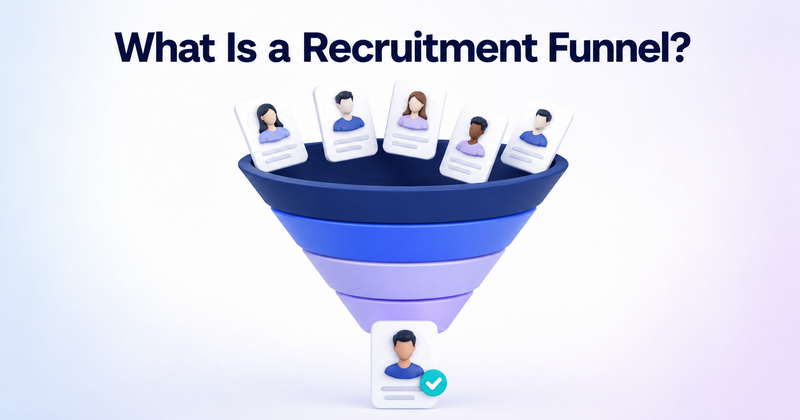
A recruitment funnel is a framework that represents how candidates move through different stages of the hiring process.
The funnel is wider at the top because many people may discover or apply for a position. It gradually becomes narrower as candidates are screened, assessed and interviewed. A smaller group eventually receives offers and joins the company.
A typical recruitment funnel includes:
- Awareness
- Attraction
- Application
- Screening
- Assessment
- Interview
- Offer
- Hire
Companies may combine or expand these stages based on their recruitment process. The purpose of the funnel is not simply to reduce candidate numbers. It helps recruiters understand how effectively suitable candidates move from one hiring stage to another.
Why Is the Recruitment Funnel Important?
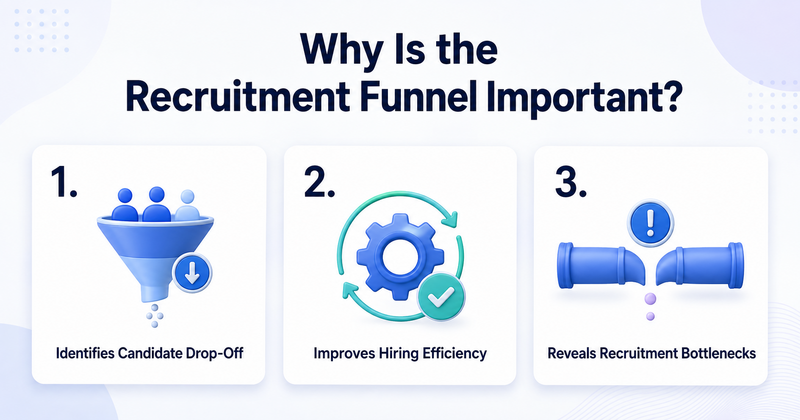
- Identifies Candidate Drop-Off
Candidates may leave during applications, assessments or interviews.
Tracking each stage shows where drop-off is highest. Recruiters can then investigate whether long forms, difficult assessments or slow communication are creating unnecessary friction.
- Improves Hiring Efficiency
A vacancy receiving 1,000 applications may appear successful. However, application volume means little when very few applicants meet the job requirements.
Recruitment funnel analysis helps teams evaluate the quality and movement of candidates instead of focusing only on volume.
- Reveals Recruitment Bottlenecks
Candidates may complete screening quickly but wait several days for an interview. This delay can become a major recruitment challenge when strong candidates are also considering other opportunities.
Funnel data makes these delays easier to identify. Recruiters can then focus on the stage responsible for slowing down the hiring process.
Make every stage of your recruitment funnel easier to track with HyreNet’s data-backed hiring platform. Monitor candidate movement, identify hiring bottlenecks, reduce drop-offs, improve screening accuracy, and build a structured recruitment workflow that helps teams hire faster with better talent decisions.
What Are the Stages of a Recruitment Funnel?
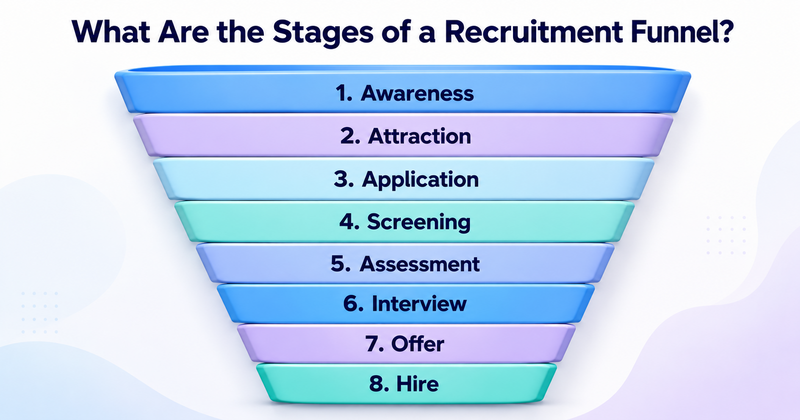
Every organization has a slightly different hiring process. However, most recruitment funnels follow several core stages.
1. Awareness
The recruitment funnel begins before candidates apply.
Potential applicants first need to discover the company or vacancy. Awareness can come through job boards, social media, employee referrals, career pages or recruitment campaigns.
A clear employer presence helps potential candidates understand what the company offers and what opportunities are available.
2. Attraction
Awareness does not automatically create applications.
Candidates need enough information to decide whether the position deserves their attention. Salary transparency, responsibilities, location and required skills can influence this decision.
Job descriptions should explain what the role actually involves. Vague descriptions may attract large numbers of unsuitable candidates or discourage qualified applicants.
3. Application
Interested candidates enter the recruitment funnel by submitting an application.
This stage should be simple and accessible. Requiring candidates to repeatedly enter information already available on their resumes can create unnecessary friction.
Recruiters should collect enough information for initial screening without making the application unnecessarily long.
4. Screening
Candidate screening determines which applicants meet the essential requirements.
Recruiters may review resumes, application responses or basic eligibility criteria. Screening calls can also verify important information before candidates move forward.
Automated AI tools may help organize high application volumes. However, recruiters should maintain oversight when technology influences candidate progression.
5. Assessment
Assessments provide evidence beyond the resume.
Depending on the role, candidates may complete:
- Technical assessments
- Coding tests
- Work samples
- Cognitive assessments
- Communication exercises
- Situational judgment tests
The assessment should measure abilities that directly relate to the position.
A software developer might complete a coding challenge. A content writer may receive an editing exercise. A sales candidate could respond to a realistic customer scenario.
6. Interview
Candidates who meet the screening and assessment criteria progress to interviews.
Structured interviews work particularly well because each candidate receives the same core questions. Recruiters can compare responses against predefined criteria instead of relying entirely on general impressions.
Some companies use multiple interview rounds. Each round should have a clear purpose to avoid making the recruitment funnel unnecessarily long.
7. Offer
The strongest candidate or candidates receive an employment offer.
Recruiters should communicate salary, benefits, joining expectations and other important terms clearly.
Offer acceptance also provides useful recruitment funnel data. Frequent offer rejections may indicate problems with compensation, hiring speed or candidate expectations.
8. Hire
The funnel ends when the selected candidate accepts the offer and joins the organization.
However, recruitment teams can continue tracking early retention and onboarding outcomes.
A candidate who accepts an offer but leaves quickly may indicate a mismatch that began earlier in the recruitment process.
Recruitment Funnel Example
Consider a company hiring software developers.
| Recruitment funnel stage | Candidates |
| Job page visitors | 2,500 |
| Applications | 600 |
| Resume screening passed | 180 |
| Assessment completed | 130 |
| Assessment passed | 55 |
| Interviewed | 25 |
| Offers made | 8 |
| Offers accepted | 6 |
The numbers alone do not show whether the funnel is performing well.
Recruiters should examine conversion between stages.
A sharp decline between assessment invitations and completions may indicate candidate drop-off. A large number of interviews with very few offers could indicate weak screening or unclear interview criteria.
Which Recruitment Funnel Metrics Should You Track?
Recruitment funnel metrics help teams understand where hiring is working and where improvement is needed.
| Metric | What it measures |
| Application completion rate | Percentage of candidates who finish an application |
| Screening pass rate | Percentage progressing beyond initial screening |
| Assessment completion rate | Percentage completing assigned assessments |
| Assessment pass rate | Percentage meeting the required assessment score |
| Interview-to-offer ratio | Number of interviews required to produce an offer |
| Offer acceptance rate | Percentage of offers accepted |
| Candidate drop-off rate | Percentage leaving before completing a stage |
| Time to hire | Time between entering the hiring process and accepting an offer |
Teams should interpret these metrics together. A single number rarely explains the entire recruitment process.
How to Calculate Recruitment Funnel Conversion Rate
Conversion rate shows how many candidates move from one stage to the next.
The basic calculation is:
Recruitment funnel conversion rate = Candidates reaching the next stage ÷ Candidates entering the current stage × 100
Suppose 200 candidates complete an assessment and 50 progress to interviews.
The assessment-to-interview conversion rate is 25%.
Recruiters can compare conversion rates across roles or hiring periods. Major changes can reveal problems that deserve closer investigation.
Where Do Candidates Drop Out of the Recruitment Funnel?
Candidate drop-off can happen at almost every stage.
Common causes include lengthy application forms, irrelevant assessments and unclear job descriptions. Slow recruiter responses can also cause strong candidates to accept opportunities elsewhere.
High drop-off should therefore trigger investigation rather than an immediate assumption that candidates lacked interest.
Recruiters can review candidate feedback and stage completion data to understand what is happening.
How Can You Optimize the Recruitment Funnel?
Recruitment funnel optimization focuses on removing unnecessary friction while maintaining hiring quality.
- Write Clear Job Descriptions
Set expectations before candidates apply.
Explain responsibilities, required skills and important employment conditions clearly. This can reduce unsuitable applications and improve the quality of the initial candidate pool.
- Simplify Applications
Ask only for information needed during the early hiring stage.
Long application forms can discourage candidates before recruiters have an opportunity to evaluate them.
- Improve Candidate Screening
Define essential requirements before applications arrive.
Structured screening criteria help recruiters identify suitable candidates consistently and prevent unnecessary interviews.
- Use Job-Relevant Assessments
Assessments should reflect real responsibilities.
Short and focused assessments can provide useful evidence without creating an excessive burden for candidates.
- Reduce Unnecessary Interview Rounds
Every interview should answer a specific hiring question.
Multiple rounds covering the same information extend time to hire and may increase candidate drop-off.
- Communicate With Candidates
Candidates should know where they are in the process.
Application confirmations, assessment instructions and interview updates can improve transparency. Automated communication can handle routine updates while recruiters remain available for important conversations.
- Analyze Funnel Data Regularly
Recruitment funnel optimization is an ongoing process.
Compare stage conversion rates and drop-off patterns over time. Look for stages where qualified candidates repeatedly leave or where processing takes unusually long.
Changes should target specific problems identified through the data.
How Can Recruitment Technology Improve the Funnel?
Recruitment technology can connect different stages of the hiring process.
An applicant tracking system can centralize candidate information. Assessment platforms can automatically send role-based tests. Scheduling software can help qualified candidates book interviews without repeated email exchanges.
Recruitment analytics can then show how candidates progress across these stages.
Automation is most valuable for repetitive tasks and process visibility. Recruiters should remain responsible for decisions that require context and human judgment.
Recruitment Funnel vs. Recruitment Pipeline
The terms recruitment funnel and recruitment pipeline are sometimes used interchangeably. However, they emphasize different aspects of hiring.
A recruitment funnel focuses on how candidate numbers narrow as applicants progress through hiring stages.
A recruitment pipeline focuses more on the movement and status of individual candidates throughout those stages.
Recruiters can use both concepts together. The funnel helps analyze overall hiring performance while the pipeline helps manage individual candidates.
Conclusion
A recruitment funnel turns hiring into a structured and measurable process. It shows how candidates move from initial awareness through applications, screening, assessments, interviews and offers before becoming hires.
The real value comes from analyzing what happens between these stages.
Recruiters should track conversion rates, candidate drop-off, assessment completion and offer acceptance. These metrics can expose unnecessary delays and weak screening stages.
A strong recruitment funnel does not simply produce more applicants. It helps qualified candidates move through a clear and efficient process while giving recruiters better evidence for hiring decisions.
FAQs
What is a recruitment funnel?
A recruitment funnel represents the stages candidates move through from discovering a job opportunity to becoming a successful hire.
What are the main recruitment funnel stages?
Common stages include awareness, attraction, application, screening, assessment, interview, offer and hire.
How do you measure a recruitment funnel?
Recruiters can track application completion, screening pass rates, assessment completion, interview-to-offer ratios, offer acceptance and candidate drop-off.
What is recruitment funnel optimization?
Recruitment funnel optimization involves identifying weak stages and improving them through clearer job descriptions, better screening, relevant assessments and faster communication.
What is the difference between a recruitment funnel and a recruitment pipeline?
A recruitment funnel shows how candidate numbers narrow across hiring stages. A recruitment pipeline focuses on tracking individual candidates as they move through those stages.