

A recruiter used to spend an entire afternoon going through 300 resumes for one role, skimming fast and hoping nothing important got missed. Today, that same batch gets sorted in minutes, with a shortlist waiting before the coffee even finishes brewing. That shift is what ai shortlisting actually looks like in practice.
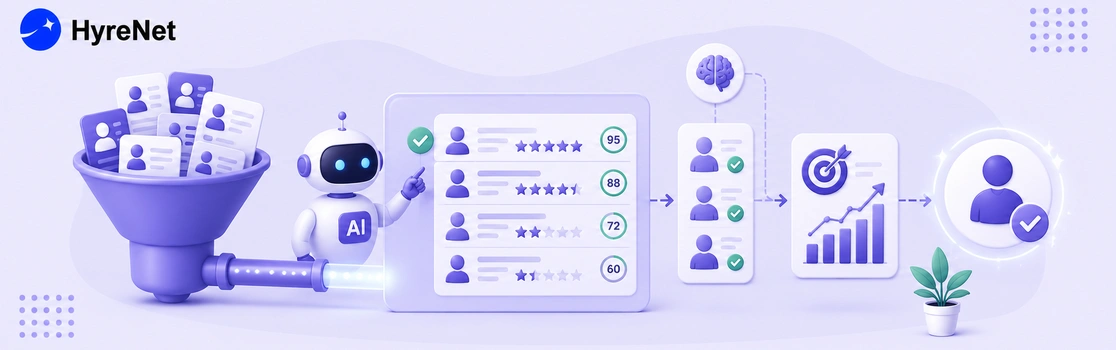
AI shortlisting is the use of algorithms to scan, score, and rank job applications based on how closely they match a role’s requirements, so recruiters spend their time on the strongest candidates instead of the full pile. It pulls from resume data, skills, and sometimes assessment results to narrow a large applicant pool down to a manageable, ranked shortlist.
This blog looks at how ai shortlisting actually improves hiring accuracy, what the current data shows, where it can go wrong, and how recruiters can use it responsibly without losing the human judgment that still matters most.
TL;DR Summary
- AI shortlisting scores and ranks applicants automatically, based on how closely they match a role
- Current data shows resume parsing accuracy around 94 percent and skill matching around 89 percent
- Companies using structured, AI-supported screening report notably higher first-year retention rates
- Bias and unfair rejections remain real risks, so human oversight still matters at every stage
- The biggest accuracy gains come from pairing ai shortlisting with real skills assessments, not resumes alone
- Candidate trust in AI evaluation remains low, which makes transparency about the process worth prioritizing
What AI Shortlisting Actually Does
At its core, ai shortlisting replaces manual resume skimming with a structured, repeatable scoring system.
- Parses resumes into structured data: Extracting skills, experience, and qualifications instead of relying on a human skim
- Scores against role requirements: Comparing each candidate’s profile to what the job actually needs
- Ranks candidates by fit: Producing an ordered shortlist instead of a flat pile of applications
- Flags edge cases for review: Surfacing unusual or borderline profiles a recruiter should look at personally
- Learns from outcomes over time: Some systems refine their scoring based on which shortlisted candidates actually got hired and performed well
How AI Shortlisting Improves Hiring Accuracy
The accuracy gains here come from consistency, not magic. A human reviewer gets tired, distracted, and inconsistent across a long stack of resumes. A scoring system applies the same criteria to candidate number one and candidate number three hundred.
Current data backs this up clearly. Resume parsing tools now reach roughly 94 percent accuracy, and skill matching tools land around 89 percent, a meaningful jump from where these tools stood just a few years ago.
Teams using structured, AI-supported screening report 24 to 30 percent higher assessment consistency compared to unstructured methods.
The retention numbers are even more telling. Companies using AI-assisted matching report 25 to 35 percent higher first-year retention, which suggests better shortlisting is not just faster, it is genuinely picking stronger long-term fits.
The Numbers Behind AI Shortlisting in 2026
| Data Point | What It Shows |
|---|---|
| Roughly 82 percent of large companies use AI for resume screening and shortlisting | This has become a mainstream, not experimental, part of hiring |
| Resume parsing accuracy sits around 94 percent | Structured data extraction has gotten genuinely reliable |
| Skill matching accuracy sits around 89 percent | Matching candidates to role requirements is nearly as strong |
| Time-to-shortlist drops by up to 75 percent for high-volume roles | Speed gains are just as significant as accuracy gains |
| Only around 26 percent of candidates trust AI to evaluate them fairly | Candidate trust still lags well behind adoption |
That last number matters more than it might seem. Strong accuracy on the recruiter’s side does not automatically translate into candidate confidence, which is exactly why transparency about how ai shortlisting works remains important.
A Simple Example of AI Shortlisting in Action
Say 250 people apply for a data analyst role. A recruiter reviewing every resume by hand might realistically give each one 30 to 60 seconds of attention, if time allows at all.
A scoring system instead checks every resume against the same criteria, like required tools, years of experience, and relevant keywords, producing a ranked list in minutes. The top 20 candidates move forward for human review, while borderline cases get flagged rather than silently dropped.
The recruiter still makes every final call. What changes is that their limited time now goes toward the strongest and most uncertain candidates, instead of being spread evenly and thinly across all 250 resumes.
Do check out this post on why HyreNet’s recruitment platform stands out for a closer look at how structured evaluation data supports this kind of accuracy.
Where AI Shortlisting Can Go Wrong
- Bias baked into training data: A system trained on historical hiring patterns can quietly repeat the same biases those patterns contained
- Overly rigid keyword matching: Some tools reject strong candidates simply for phrasing skills differently than the job posting
- Ignoring context resumes can’t capture: Career gaps, career changes, or non-traditional paths can get unfairly penalized
- Too little human review: Treating the shortlist as final, rather than a starting point, risks losing genuinely strong candidates
- Opaque scoring: When recruiters cannot explain why a candidate was ranked low, it becomes hard to catch mistakes or defend decisions
Roughly one in five organizations report AI unintentionally passing over good candidates, which is exactly why this step should narrow the pool, not make the final call alone.
How to Use AI Shortlisting Responsibly
- Pair it with skills assessments: Resume-based scoring alone misses real, demonstrated ability, so add a structured test where it makes sense
- Review flagged edge cases personally: Do not let borderline profiles get auto-rejected without a human glance
- Audit scoring criteria regularly: Check whether the system is quietly favoring certain phrasing, schools, or backgrounds over real fit
- Be transparent with candidates: Letting applicants know AI is part of the process, and roughly how it works, builds trust over time
- Keep a human in the loop for final decisions: Most hiring managers and candidates alike still expect a person to make the actual call
Platforms like HyreNet are built around this exact balance, combining AI-powered shortlisting with structured skills assessments so recruiters get a shortlist backed by real ability, not just resume keywords.
Common Mistakes Companies Make
- Relying on ai shortlisting alone: Skipping assessments or interviews entirely removes the human judgment that catches what resumes miss
- Never auditing for bias: Assuming a system is fair simply because it is automated is a costly assumption to make
- Using generic, off-the-shelf scoring criteria: A model that is not tuned to your specific role and team produces weaker, less relevant rankings
- Hiding the process from candidates: Silence about AI involvement erodes trust faster than disclosing it upfront
For more on how modern platforms are solving these exact challenges, do check out HyreNet’s post on common recruitment challenges and how assessment platforms solve them.
Conclusion
AI shortlisting genuinely improves hiring accuracy when it is used to narrow the pool, not replace human judgment entirely. The data is clear that structured, consistent scoring outperforms manual resume skimming on both speed and long-term retention outcomes.
The recruiters getting the most value from this technology are pairing it with real skills assessments, auditing it regularly for bias, and staying transparent with candidates about how it works. That combination is what turns a faster process into a genuinely more accurate one.
FAQs
1. Does AI shortlisting replace the need for interviews?
No. It narrows a large applicant pool down to a manageable, ranked group, but interviews and assessments still matter for confirming fit and ability.
2. How accurate is AI shortlisting compared to manual resume review?
Current data puts resume parsing accuracy around 94 percent and skill matching around 89 percent, generally more consistent than manual review across a large volume of applications.
3. Can AI shortlisting be biased?
Yes, if trained on biased historical hiring data or tuned poorly. Regular audits and human review of flagged cases help catch and correct this over time.
4. Why do candidates still distrust AI in hiring even as accuracy improves?
Trust often lags behind technical performance, since candidates rarely see how scoring works. Transparency about the process helps close that gap over time.
5. Is AI shortlisting only useful for high-volume hiring?
It helps most with volume, but even smaller hiring pools benefit from the consistency and reduced bias that structured ai shortlisting can bring compared to purely manual review.