
This email is already subscribed. Please use a different one.
AI Proctoring Myths: What Recruiters Need to Know
Author
Jebasta Jennifer
AI proctoring has become one of the most talked about tools in modern hiring. But with that attention comes a lot of misinformation. Recruiters who have...
Tags
Blog
AI proctoring has become one of the most talked about tools in modern hiring. But with that attention comes a lot of misinformation. Recruiters who have never used it often hold back because of things they have heard that simply are not true. Understanding the real AI proctoring myths versus the actual facts helps you make a much more informed decision about whether this technology belongs in your hiring process.
TL;DR Summary
There are many AI proctoring myths that prevent companies from adopting a tool that genuinely works.
AI proctoring does not spy on candidates, it only monitors what is directly relevant to the assessment.
It is not just for large companies, businesses of any size can use it effectively.
AI proctoring flags behaviour for human review, it does not make hiring decisions on its own.
AI proctoring keeps assessments fair, honest, and efficient without adding friction to the process.
Most AI proctoring myths fall apart the moment you look at how the technology actually works.
Clearing Up the AI Proctoring Myths
A lot of the hesitation around AI proctoring comes from assumptions people have made without actually looking into how it works. Here are the most common AI proctoring myths, and the truth behind each one.
Myth 1: AI Proctoring Is Just Spying on Candidates
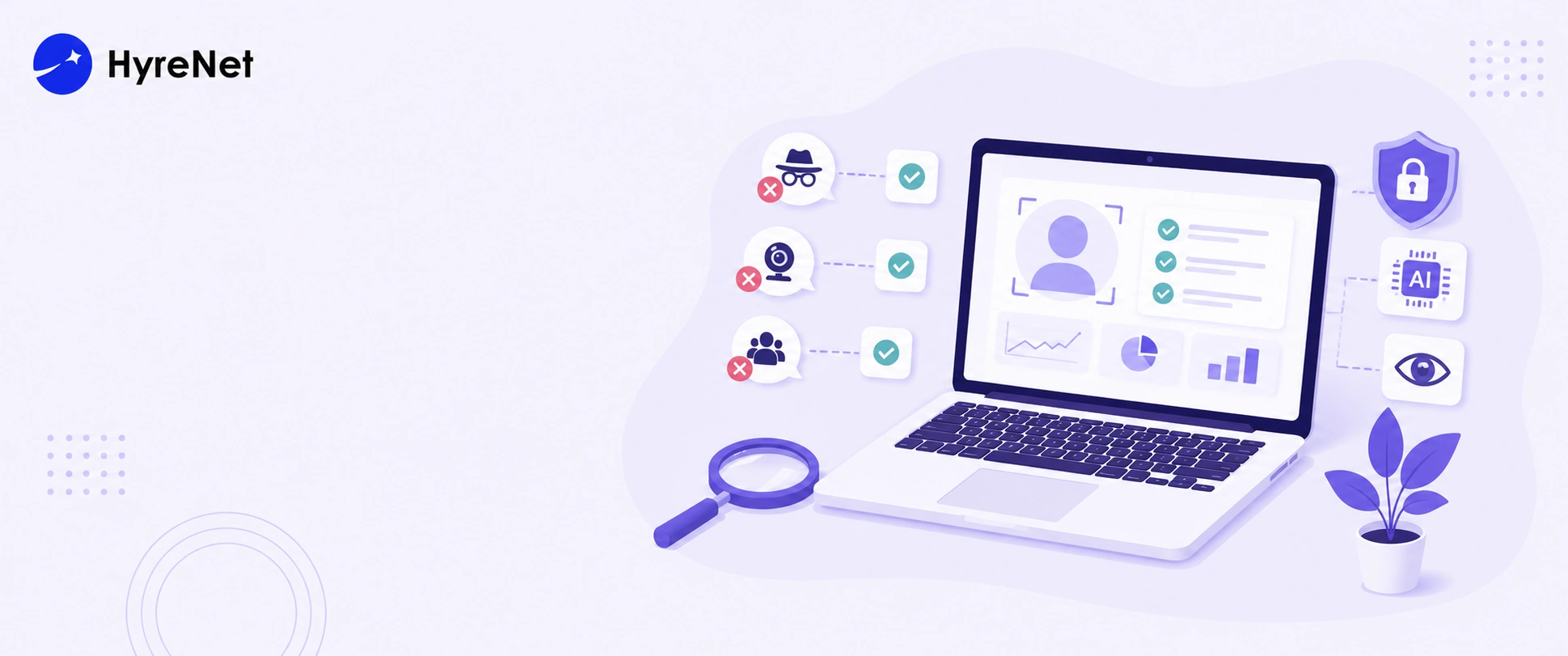
This is probably the most widespread of all the AI proctoring myths. The reality is that AI proctoring only monitors what is directly relevant to the assessment, webcam activity, screen behaviour, and browser usage. It does not access files on a candidate’s device, read personal messages, or record anything beyond the test session. Candidates are always informed before the assessment begins that monitoring is in place, so there are no surprises.
Myth 2: It Gets Things Wrong Too Often to Be Useful
AI proctoring myths around accuracy are common, but modern systems are significantly better than this assumption suggests. They are trained to distinguish between genuine suspicious behaviour and normal things like adjusting your seating position. Flags are always reviewed by a human before any decision is made.
Myth 3: Only Large Enterprises Can Afford It
This is one of the AI proctoring myths that stops smaller companies from even looking into it. In reality, AI proctoring is built into platforms like HyreNet as part of the standard assessment package. You do not need a separate contract, a dedicated IT team, or an enterprise budget. Whether you are hiring for two roles or two hundred, the cost is the same per assessment.
Myth 4: Candidates Hate It and It Hurts Your Employer Brand
The concern here is understandable, but it is based on an outdated version of the technology. Poorly designed proctoring that feels invasive or breaks down mid-session does damage perception. But a smooth, well-communicated AI proctoring experience does not. Candidates who are told upfront what will be monitored and why generally accept it as a fair part of a standardised process. Most AI proctoring myths around candidate experience come from bad implementations, not the technology itself.
Myth 5: AI Proctoring Makes the Hiring Decision for You
This is one of the most important AI proctoring myths to clear up. AI proctoring does not decide whether someone gets hired. It flags behaviour for human review. A recruiter still looks at every flagged incident and decides whether it is actually concerning. The technology supports judgment, it does not replace it.
Myth 6: It Only Works for Technical Roles
AI proctoring is often associated with coding assessments and technical tests because those were early adopters of the technology. But AI proctoring myths like this ignore how broadly it applies. Any role that involves a remote assessment, whether it is a customer service position, a finance role, or a graduate hire, benefits from the same level of monitoring and result integrity.
Myth 7: Candidates Can Easily Cheat AI Proctoring
This myth usually comes from people who have heard of workarounds. The truth is that modern AI proctoring monitors multiple signals simultaneously, webcam, microphone, screen activity, tab switches, and more. Defeating all of those at once without triggering a flag is far harder than most people assume, and the attempt itself usually shows up in the data.
Myth 8: AI Proctoring Is a Privacy Violation
This is perhaps the stickiest of the AI proctoring myths because it sounds serious. But proctoring during an assessment is no different in principle to having an invigilator present in an exam room. Candidates consent before starting, monitoring is limited to the session, and data is stored securely within the platform.
When you look past the AI proctoring myths, what you find is a tool that makes remote assessments more trustworthy, more consistent, and more defensible. The companies holding back because of things they have heard are often the ones spending the most time dealing with assessment integrity issues that could have been avoided.
The most widespread ones are that it spies on candidates, makes too many errors, is only for large companies, and that it makes hiring decisions automatically. None of these are accurate.
2. Does AI proctoring record candidates without their knowledge?
No. Candidates are always notified before the assessment begins that monitoring is active. Nothing is recorded without prior consent.
3. Can AI proctoring replace human judgment?
No, and it is not designed to. It flags behaviour for a recruiter to review. The final call always stays with a human.
4. Is AI proctoring only suitable for technical assessments?
Not at all. It works for any role that involves a remote test, whether the assessment is technical, aptitude-based, or personality-focused.
5. How does HyreNet handle AI proctoring?
HyreNet’s AI proctoring monitors webcam feeds, screen activity, and browser behaviour throughout every assessment. Anything suspicious is flagged in the candidate’s report for recruiter review, keeping the process honest without adding extra work to your team.
Recruiting fresh talent from colleges has always been competitive. But campus hiring in 2026 looks very different from what it did even a few years ago. Students expect faster processes, digital-first experiences, and feedback that actually respects their time. Companies that are still running slow, paper-heavy campus drives are losing good candidates to faster-moving competitors before the process even gets going. Getting campus hiring in 2026 right is not optional anymore, it is a competitive necessity.
If you want to win at campus hiring in 2026, the way you approach it needs to change.
TL;DR Summary
Campus hiring in 2026 demands speed, digital-first processes, and structured assessments from the very start.
Moving assessments earlier in the process saves time and filters out poor fits before interviews begin.
AI proctoring ensures remote campus tests produce honest, reliable results at any scale.
Generic tests do not work, role-specific assessments give you data you can actually act on.
Automating follow-ups and reminders keeps the pipeline moving without adding workload to your HR team.
Companies that make campus hiring in 2026 faster and more data-driven consistently attract better talent.
Why Campus Hiring in 2026 Is Different
The students entering the job market today are digital natives. They apply to ten companies at once, compare hiring experiences, and make decisions quickly. A clunky assessment process or a weeks-long silence after a test is enough to push them toward someone else. Campus hiring in 2026 demands speed, clarity, and a process that feels modern from the student's perspective.
At the same time, the volume of applicants at campus drives has grown significantly. Without the right tools, evaluating hundreds of candidates fairly and quickly becomes an operational challenge that most HR teams are not equipped to handle manually.
Start With Structured Pre-Assessment Screening
One of the most effective changes you can make to campus hiring in 2026 is moving assessment earlier in the process. Instead of waiting for interview rounds to filter candidates, send a structured skills or aptitude assessment as the very first step after registration.
This immediately separates students who meet the minimum criteria from those who do not, without your team having to review every single application manually. You end up with a focused shortlist before a single interview is scheduled, which saves enormous amounts of time on both sides.
Use Role-Specific Assessments, Not Generic Tests
A common problem in campus hiring in 2026 is that companies send the same test to every candidate regardless of the role. A student applying for a software engineering position and one applying for a business analyst role are being assessed on completely different skill sets. Generic tests produce data that is hard to act on and often misleading.
Build or use templates that are tailored to each role. Test the actual skills the position requires, whether that is coding ability, logical reasoning, communication, or problem-solving. The more specific the assessment, the more useful the output.
Automate Everything You Can
Manual follow-up at scale is one of the biggest bottlenecks in campus hiring in 2026. When you are processing applications from multiple colleges at once, sending individual emails, tracking who has completed what, and scheduling reminders takes up time that should be spent evaluating candidates, not chasing them.
A good assessment platform automates all of this. Invites go out automatically, reminders are triggered for incomplete tests, and results land in one centralised dashboard without your team having to chase anything. The whole campus drive keeps moving smoothly even when volumes are high.
Do Not Skip Proctoring
Campus assessments are often taken on personal devices, in uncontrolled environments, with plenty of opportunity to cheat. This is a real problem for campus hiring in 2026, especially when hundreds of candidates are taking the same test simultaneously across different locations.
AI proctoring removes this risk without requiring a human supervisor for every session. It monitors webcam feeds, screen activity, and browser behaviour throughout the test, flagging anything suspicious for recruiter review. The results you get are honest, which means the decisions you make based on them are more reliable.
Give Candidates a Good Experience
A significant part of successful campus hiring in 2026 is how students feel about your company after going through your process. Word travels fast on campus. If your assessment is confusing, too long, or leaves candidates in the dark for weeks, that reputation spreads.
Keep assessments focused and reasonably timed. Communicate clearly about what the test involves, how long it takes, and what happens after. Even an automated message confirming receipt and giving a rough timeline goes a long way toward building a positive impression of your brand among students who are evaluating multiple companies at the same time.
Review Your Data After Every Drive
Campus hiring in 2026 should not be a set-and-forget process. After every campus drive, look at your completion rates, your time-to-hire, and how your top performers from campus are doing once they are on the job. This data tells you whether your assessments are actually predicting performance, and where adjustments need to be made before the next season.
HyreNet's built-in analytics give you this visibility in one place. You can see how candidates performed across different colleges, which assessments are producing the best hires, and where candidates are dropping out of the process. That kind of insight makes every subsequent campus hiring in 2026 drive better than the last.
Make Speed Your Competitive Advantage
The best students get multiple offers. In campus hiring in 2026, the company that moves fastest through the process, from assessment to offer, has a genuine advantage. Every day of unnecessary delay is an opportunity for a competitor to step in first.
Structured assessments, automated workflows, and real-time reporting cut the time between application and offer significantly. Companies that have made the switch report moving from weeks-long processes to decisions made in days. In a market where speed matters as much as the role itself, that difference is significant and often decides who the best graduates choose.
Campus hiring in 2026 rewards companies that have invested in making their process faster, fairer, and more data-driven. The tools to do that exist. The question is whether your recruitment team is using them.
1. What makes campus hiring in 2026 different from previous years?
Students today are faster to compare hiring experiences and quicker to move on. Digital-first processes, faster turnaround times, and structured assessments are now expected rather than optional.
2. When should assessments be sent during campus hiring?
As early as possible, ideally as the very first step after a candidate registers. This filters out poor fits before any interview time is spent, saving significant time for both sides.
3. How does AI proctoring help with campus hiring?
Campus assessments are taken on personal devices in uncontrolled environments. AI proctoring monitors webcam feeds, screen activity, and browser behaviour automatically, making sure results are honest without needing a human supervisor for every session.
4. Do role-specific assessments really make a difference?
Yes. Generic tests produce data that is hard to act on. An assessment built around the actual skills a role needs gives you a much clearer picture of who can genuinely do the job.
5. How can HyreNet support campus hiring in 2026?
HyreNet provides role-specific assessment templates, AI proctoring, automated reminders, detailed candidate reports, and built-in analytics all in one platform, making it easier to run faster, fairer campus drives at any scale.
Hiring developers becomes difficult when the evaluation method does not match the role. Some candidates perform well in live coding rounds but struggle with real project work. Others write strong code but underperform under interview pressure. That is why technical assessments and coding interviews need to be understood clearly.
Technical assessments measure practical coding, debugging, and role-specific skills at scale. Coding interviews reveal real-time thinking, communication, and problem-solving depth. Read the full blog to compare both methods and choose the right approach for developer hiring.
TL;DR
Technical assessments measure practical coding, debugging, and role-specific skills at scale.
Coding interviews reveal real-time thinking, communication, and problem-solving depth.
Technical assessments work best for early screening and high-volume developer hiring.
Coding interviews work best for shortlisted candidates, senior roles, and deeper validation.
The strongest hiring process combines both with clear rubrics and post-hire performance tracking.
What Are Technical Assessments?
Technical assessments are structured evaluation methods used to measure a candidate’s job-specific technical skills. A well-designed technical assessment should reflect the actual responsibilities of the role. A backend developer may be tested on APIs, databases, and logic flow. A data engineer may be tested on pipelines, SQL, and data processing. This role alignment makes the assessment more useful than generic screening questions.
Common Types of Technical Assessments
Coding tests measure a candidate’s ability to solve programming problems using a specific language or logic pattern. They are often used for software developer, frontend, backend, and full-stack roles.
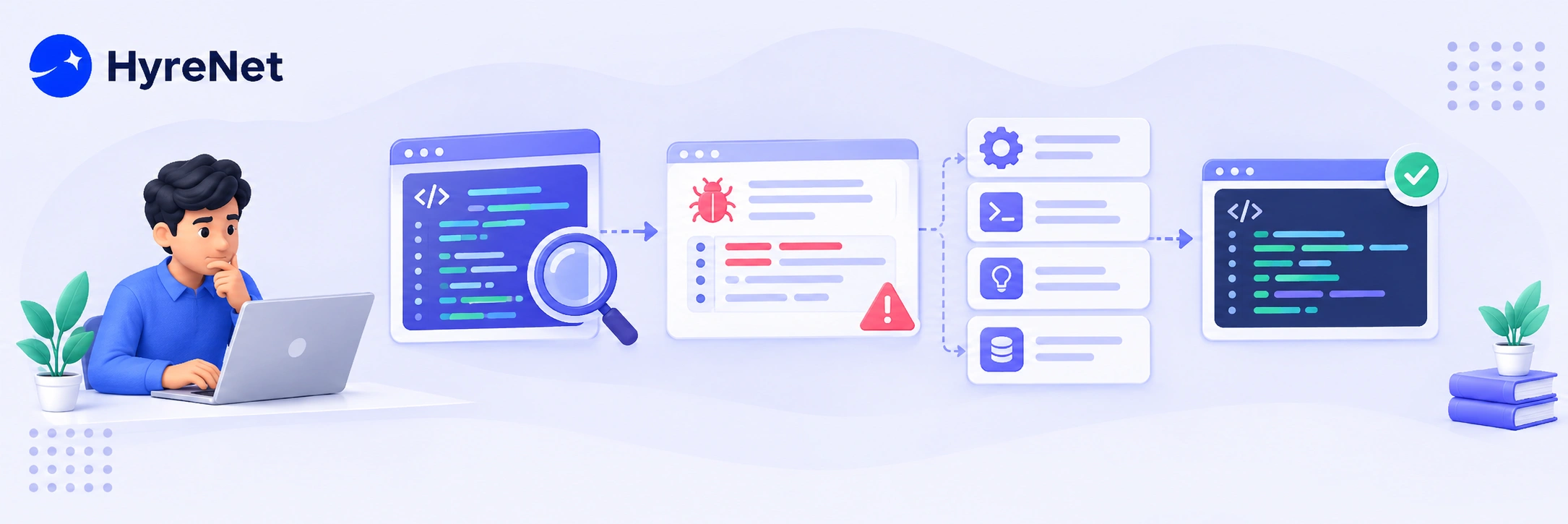
Debugging tasks ask candidates to find and fix errors in existing code. These tasks are valuable because debugging is a routine part of real engineering work.
System design exercises evaluate how candidates think about architecture, scalability, databases, APIs, and service communication. They are commonly used for mid-level and senior engineering roles.
Multiple-choice technical quizzes test conceptual knowledge across programming, databases, cloud, frameworks, or computer science basics. They work well for early screening but should not be the only evaluation method.
Take-home assignments give candidates more time to solve a practical problem. They can reveal deeper thinking, but they must be reasonable in scope to avoid candidate drop-off.
Project-based assessments ask candidates to build or improve a small real-world application. These assessments are useful when the role demands practical delivery, clean structure, and end-to-end execution.
Advantages of Technical Assessments
Better Skill-Based Screening: Technical assessments help recruiters check real technical ability before interviews. A candidate may list Python, JavaScript, SQL, or cloud tools on a resume, but a practical task shows whether that knowledge can be applied correctly.
Easier to Scale for Large Hiring Pipelines: Technical assessments work well for campus hiring, entry-level developer roles, and high-volume tech recruitment. They help teams evaluate many candidates through one structured process before moving stronger profiles to interviews.
More Consistent Candidate Evaluation: Every candidate can receive the same task, time limit, and scoring criteria. This creates a fairer comparison because candidates are judged against a shared benchmark rather than different interviewer opinions.
Stronger Role-Relevance: Technical assessments can be built around real job responsibilities. A backend developer can be tested on APIs and database logic, while a data engineer can be tested on SQL, pipelines, and workflow reliability.
Choose the right developer hiring method with HyreNet’s smarter technical assessment workflows. Compare technical assessments and coding interviews with clearer skill signals, structured evaluation, reduced interviewer workload, and data-backed insights that help recruitment teams identify job-ready developers with confidence.
Limitations of Technical Assessments
Lengthy assessments can increase candidate drop-off.
Unclear instructions can make the task feel unfair.
Written tests may not show how candidates explain technical decisions.
Online assessments can raise concerns around copied work or outside help.
Generic tests may fail to reflect actual job responsibilities.
What Are Coding Interviews?
Coding interviews are live or guided technical evaluation sessions where candidates solve coding problems in front of interviewers. They help solve common recruitment challenges by giving interviewers direct visibility into a candidate’s reasoning process, technical depth, and communication style. This makes them especially useful after initial screening, when companies need to validate how well a candidate thinks, explains, and applies coding concepts in real time.
Common Coding Interview Formats
Live coding interviews require candidates to solve a coding problem in real time. These sessions help interviewers assess speed, logic, and communication under pressure.
Pair programming interviews involve the candidate and interviewer working through a problem together. This format is useful for checking collaboration, feedback response, and team fit.
Whiteboard-style coding rounds focus on logic, algorithms, and problem structure. They are less common in practical hiring today, but some companies still use them for conceptual evaluation.
Algorithm-based problem-solving tests a candidate’s understanding of data structures, complexity, and optimized logic. This format works best when algorithmic thinking is relevant to the role.
Technical discussions with code review ask candidates to explain or critique code. This is highly practical because code review is a regular part of engineering teamwork.
Advantages of Coding Interviews
Shows Real-Time Problem-Solving: Coding interviews help interviewers see how candidates approach unfamiliar problems. The process reveals how they read requirements, ask questions, and build a solution step by step.
Evaluates Communication and Collaboration: Live coding shows how candidates explain logic, respond to feedback, and discuss trade-offs. This matters because developers need to work with engineering, product, QA, and design teams.
Useful for Senior and Critical Roles: Coding interviews are valuable when deeper technical judgment is needed. Interviewers can ask follow-up questions about scalability, maintainability, performance, and system constraints.
Limitations of Coding Interviews
Good developers may underperform because of live interview pressure.
Interviewer bias can affect how performance is judged.
Different interviewers may use different difficulty levels.
Live rounds take more time to schedule and review.
Coding interviews are difficult to scale for large hiring pipelines.
Technical Assessments vs Coding Interviews: Key Differences
Technical assessments and coding interviews both help hiring teams evaluate developer ability, but they do it in different ways. A technical assessment checks how well a candidate applies skills through a defined task. A coding interview shows how the candidate thinks, explains, and responds during a live problem-solving discussion.
A strong technical hiring process should not treat these methods as competitors. Each one answers a different question. Technical assessments ask, “Can this candidate do the work?” Coding interviews ask, “How does this candidate think through the work?”
Evaluation Format
Technical assessments are usually structured and asynchronous. Candidates receive a task, complete it within a given time, and submit their work for review. This format gives recruiters a clear way to compare candidates using the same criteria.
Coding interviews are live and interaction-based. Candidates solve problems in front of interviewers through a shared coding platform, video call, or pair programming setup. The interviewer can ask follow-up questions and observe how the candidate responds.
The main difference lies in visibility. Technical assessments show the quality of the final output. Coding interviews show the reasoning process behind the solution.
Candidate Experience
Technical assessments often feel more flexible for candidates. They get time to read the problem, plan the solution, and submit their work without constant observation. This can help candidates perform closer to their actual working style.
Coding interviews can feel more stressful because candidates must think, code, and explain in real time. A skilled developer may still struggle under pressure, especially when the task feels distant from daily engineering work.
A candidate-friendly process should respect effort and time. Assessments should be clear and reasonable. Coding interviews should test relevant thinking, not only speed under pressure.
Hiring Accuracy
Technical assessments are useful for measuring practical job skills at scale. A backend assessment can test API logic, database handling, and error management. A frontend assessment can test component structure, state handling, and interface logic.
Coding interviews add another layer of accuracy. They help interviewers understand how candidates explain decisions, handle feedback, and reason through constraints. These signals matter because developers work with teams, not only code editors.
Hiring accuracy improves when both methods work together. The assessment validates technical readiness. The coding interview validates reasoning, communication, and judgment.
Time and Scalability
Technical assessments help recruiters screen more candidates in less time. Standard tasks, rubrics, and automated review can reduce early-stage hiring workload. This makes them useful for campus hiring and high-volume technical recruitment.
Coding interviews need more time from both recruiters and engineering teams. Every live round requires scheduling, interviewer availability, and detailed feedback. This can slow hiring when the applicant pool is large.
A practical approach is to use technical assessments before live interviews. This helps teams spend interview time on candidates who already show baseline technical ability.
Bias and Consistency
Structured technical assessments can improve consistency because every candidate receives the same task and scoring criteria. A clear rubric helps reviewers judge correctness, code quality, readability, and problem-solving more fairly.
Coding interviews can vary based on interviewer style and question difficulty. Candidate nervousness can also affect performance. Two interviewers may judge the same answer differently if there is no shared scorecard.
Fair technical hiring needs process discipline. Standard questions and clear evaluation rubrics reduce inconsistency and improve trust.
Use technical assessments when hiring teams need to:
Screen many candidates quickly
Check job-specific coding skills
Compare candidates fairly
Reduce interviewer workload
Hire for junior or mid-level roles
Manage campus or high-volume hiring
Test practical skills before live interviews
When Should You Use Coding Interviews?
Use coding interviews when hiring teams need to:
Evaluate real-time thinking
Check communication skills
Understand problem-solving depth
Assess response to feedback
Hire senior developers
Review technical judgment
Validate earlier assessment results
Best Hiring Approach: Combine Both Methods
Step 1: Use Technical Assessments for Initial Screening
Start with a role-relevant technical assessment to filter candidates based on real technical ability. The task should reflect the work the candidate will actually do after hiring.
A good early-stage assessment should be clear, focused, and reasonable in length. It should help recruiters identify candidates who meet the basic technical standard without creating unnecessary drop-off.
Step 2: Use Coding Interviews for Shortlisted Candidates
After candidates pass the assessment, use coding interviews to evaluate communication, logic, and problem-solving depth. This stage should focus on how candidates think, not only whether they reach the final answer quickly.
Interviewers can ask candidates to explain their assessment solution, improve part of their code, or solve a related problem. This makes the live interview more connected to the role and less dependent on random puzzle-style questions.
Step 3: Add Scorecards for Consistency
Structured scorecards help reduce bias and improve hiring accuracy. Every interviewer should rate candidates on clear factors such as problem understanding, code quality, communication, debugging ability, and response to feedback.
Scorecards also make hiring discussions more useful. Instead of relying on vague comments like “good candidate” or “weak fit,” teams can compare evidence across specific skills.
Step 4: Track Post-Hire Performance
Hiring teams should compare assessment and interview results with employee performance after hiring. This shows whether the evaluation process is actually predicting job success.
Useful signals can include manager feedback, time to productivity, code quality, project delivery, retention, and peer collaboration. This review helps companies improve their tests, interview questions, and scoring rubrics over time.
Final Takeaway
Technical assessments and coding interviews serve different purposes in developer hiring. Technical assessments help measure practical skills at scale, while coding interviews reveal communication, reasoning, and real-time problem-solving. Recruitment teams should combine both methods to build a fairer, faster, and more accurate technical hiring process.
FAQs
What is the difference between technical assessments and coding interviews?
Technical assessments are structured tests used to measure job-specific technical skills. Coding interviews are live sessions used to evaluate real-time problem-solving and communication.
Are technical assessments better than coding interviews?
Technical assessments are better for scalable skill screening. Coding interviews are better for evaluating thinking style, collaboration, and communication.
Should companies use coding tests before interviews?
Yes. Coding tests help shortlist skilled candidates before live interviews, which saves recruiter and interviewer time.
Do coding interviews accurately measure developer skills?
Coding interviews can measure problem-solving ability, but they should be structured to reduce stress, bias, and inconsistency.
What is the best way to hire developers?
The best approach is to use technical assessments for initial screening and coding interviews for deeper evaluation.
AI proctoring has become one of the most talked about tools in modern hiring. But with that attention comes a lot of misinformation. Recruiters who have never used it often hold back because of things they have heard that simply are not true. Understanding the real AI proctoring myths versus the actual facts helps you make a much more informed decision about whether this technology belongs in your hiring process.
TL;DR Summary
There are many AI proctoring myths that prevent companies from adopting a tool that genuinely works.
AI proctoring does not spy on candidates, it only monitors what is directly relevant to the assessment.
It is not just for large companies, businesses of any size can use it effectively.
AI proctoring flags behaviour for human review, it does not make hiring decisions on its own.
AI proctoring keeps assessments fair, honest, and efficient without adding friction to the process.
Most AI proctoring myths fall apart the moment you look at how the technology actually works.
Clearing Up the AI Proctoring Myths
A lot of the hesitation around AI proctoring comes from assumptions people have made without actually looking into how it works. Here are the most common AI proctoring myths, and the truth behind each one.
Myth 1: AI Proctoring Is Just Spying on Candidates
This is probably the most widespread of all the AI proctoring myths. The reality is that AI proctoring only monitors what is directly relevant to the assessment, webcam activity, screen behaviour, and browser usage. It does not access files on a candidate's device, read personal messages, or record anything beyond the test session. Candidates are always informed before the assessment begins that monitoring is in place, so there are no surprises.
Myth 2: It Gets Things Wrong Too Often to Be Useful
AI proctoring myths around accuracy are common, but modern systems are significantly better than this assumption suggests. They are trained to distinguish between genuine suspicious behaviour and normal things like adjusting your seating position. Flags are always reviewed by a human before any decision is made.
Myth 3: Only Large Enterprises Can Afford It
This is one of the AI proctoring myths that stops smaller companies from even looking into it. In reality, AI proctoring is built into platforms like HyreNet as part of the standard assessment package. You do not need a separate contract, a dedicated IT team, or an enterprise budget. Whether you are hiring for two roles or two hundred, the cost is the same per assessment.
Myth 4: Candidates Hate It and It Hurts Your Employer Brand
The concern here is understandable, but it is based on an outdated version of the technology. Poorly designed proctoring that feels invasive or breaks down mid-session does damage perception. But a smooth, well-communicated AI proctoring experience does not. Candidates who are told upfront what will be monitored and why generally accept it as a fair part of a standardised process. Most AI proctoring myths around candidate experience come from bad implementations, not the technology itself.
Myth 5: AI Proctoring Makes the Hiring Decision for You
This is one of the most important AI proctoring myths to clear up. AI proctoring does not decide whether someone gets hired. It flags behaviour for human review. A recruiter still looks at every flagged incident and decides whether it is actually concerning. The technology supports judgment, it does not replace it.
Myth 6: It Only Works for Technical Roles
AI proctoring is often associated with coding assessments and technical tests because those were early adopters of the technology. But AI proctoring myths like this ignore how broadly it applies. Any role that involves a remote assessment, whether it is a customer service position, a finance role, or a graduate hire, benefits from the same level of monitoring and result integrity.
Myth 7: Candidates Can Easily Cheat AI Proctoring
This myth usually comes from people who have heard of workarounds. The truth is that modern AI proctoring monitors multiple signals simultaneously, webcam, microphone, screen activity, tab switches, and more. Defeating all of those at once without triggering a flag is far harder than most people assume, and the attempt itself usually shows up in the data.
Myth 8: AI Proctoring Is a Privacy Violation
This is perhaps the stickiest of the AI proctoring myths because it sounds serious. But proctoring during an assessment is no different in principle to having an invigilator present in an exam room. Candidates consent before starting, monitoring is limited to the session, and data is stored securely within the platform.
When you look past the AI proctoring myths, what you find is a tool that makes remote assessments more trustworthy, more consistent, and more defensible. The companies holding back because of things they have heard are often the ones spending the most time dealing with assessment integrity issues that could have been avoided.
The most widespread ones are that it spies on candidates, makes too many errors, is only for large companies, and that it makes hiring decisions automatically. None of these are accurate.
2. Does AI proctoring record candidates without their knowledge?
No. Candidates are always notified before the assessment begins that monitoring is active. Nothing is recorded without prior consent.
3. Can AI proctoring replace human judgment?
No, and it is not designed to. It flags behaviour for a recruiter to review. The final call always stays with a human.
4. Is AI proctoring only suitable for technical assessments?
Not at all. It works for any role that involves a remote test, whether the assessment is technical, aptitude-based, or personality-focused.
5. How does HyreNet handle AI proctoring?
HyreNet's AI proctoring monitors webcam feeds, screen activity, and browser behaviour throughout every assessment. Anything suspicious is flagged in the candidate's report for recruiter review, keeping the process honest without adding extra work to your team.
3 min read
28 Jul, 2026
Subscribe to our Blogs
We're committed to your privacy. Hyrenet uses the information you
provide to us to contact you about our relevant content, products, and services.