

A candidate answers a genuinely hard coding question in under ten seconds, with a flawless, textbook-perfect solution. No hesitation, no typos, no thinking out loud. That speed, not the answer itself, is often the first thing AI Cheating Detection systems are trained to catch.
AI Cheating Detection refers to the technology recruiters use to catch candidates who lean on tools like ChatGPT, hidden overlays, or a second person off-screen during a remote assessment. It combines behavioral analysis, screen monitoring, and identity checks to flag suspicious sessions without needing a human to watch every candidate live.
This blog explains how AI Cheating Detection actually works, what signals it looks for, how common this cheating really is in 2026, and what recruiters can do to build assessments that are harder to cheat on in the first place.
TL;DR Summary
- AI Cheating Detection uses gaze tracking, response timing, screen activity, and audio analysis to flag suspicious behavior
- Recent data shows AI-assisted cheating in technical assessments has more than doubled since 2024
- Flagged candidates often still score above the passing bar, which is exactly the problem this technology exists to solve
- No single signal proves cheating on its own, detection works by combining several signals into one risk score
- Layered defenses, better assessment design plus proctoring, work far better than relying on one detection method alone
- Human review still matters for confirming flagged sessions before making a final decision on AI Cheating Detection results
What AI Cheating Detection Actually Looks For
This is not one single tool, it is a mix of signals that, together, paint a picture of whether a candidate is doing the work themselves.
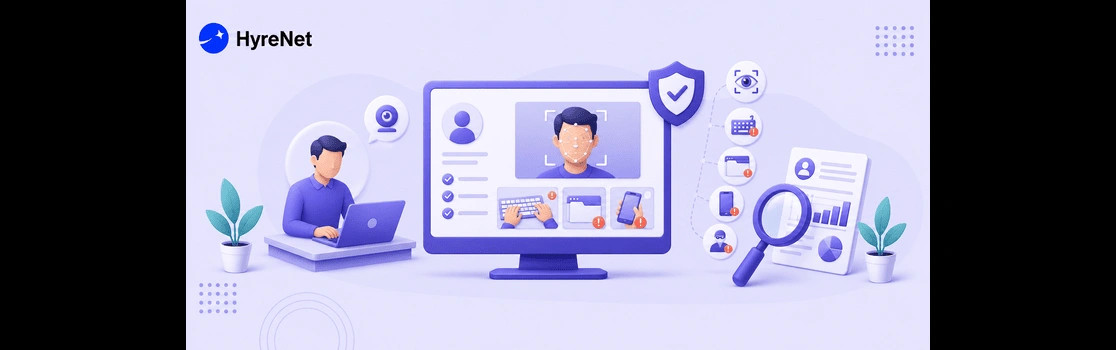
- Eye gaze tracking: Repeated glances toward a second screen or off-camera source, especially right before answering
- Response timing analysis: Complex questions answered unusually fast, often called a flatline response, since a human brain typically needs visible thinking time
- Screen and tab activity monitoring: Switching to another application or browser tab during a locked assessment session
- Audio analysis: Background voices, typing sounds that do not match what is on screen, or unnatural pauses that suggest reading from elsewhere
- Facial recognition and identity checks: A core part of AI Cheating Detection, confirming the person taking the test matches the person who applied, checked against a government ID at the start
- Behavioral biometrics: Typing rhythm, mouse movement patterns, and overall interaction style compared against what is typical for a genuine candidate
How Common Is AI-Assisted Cheating Right Now
The scale of the problem AI Cheating Detection was built to solve has grown fast, and the numbers from 2026 make that clear.
| Data Point | What It Shows |
|---|---|
| Cheating and fraud-attempt rates on proctored technical tests roughly doubled from 2024 to 2025 | AI-assisted cheating is accelerating, not slowing down |
| Entry-level assessment fraud rates nearly tripled over the same period | Newer job seekers are adopting AI cheating tools the fastest |
| One large study flagged over a third of AI-led interviews for suspected AI assistance | This is no longer a rare, edge-case problem |
| A majority of flagged candidates in that same study still scored above the passing bar | Skilled-sounding answers do not guarantee the candidate did the work |
| Software engineering roles showed far higher flag rates than sales roles | Technical assessments face the heaviest pressure from AI-assisted cheating |
These numbers point to something important. AI Cheating Detection is not solving a hypothetical problem, it is responding to a real, fast-growing gap between how candidates perform on paper and what they can actually do unaided.
Why Flatline Responses Matter So Much to AI Cheating Detection
One of the clearest signals inside these systems is what recruiters call a flatline response, an answer to a genuinely hard question that arrives almost instantly, with little to no visible hesitation.
Real problem-solving usually shows a natural rhythm. A candidate reads the question, pauses, tries something, maybe deletes it, and adjusts.
A candidate quietly copying an AI-generated answer skips almost all of that, since the model has already produced a polished response for them to read and retype.
This is exactly why response timing has become one of the most reliable individual signals feeding into modern AI Cheating Detection systems, even though it is never used entirely on its own.
Common Ways Candidates Try to Beat AI Cheating Detection
- Hidden browser overlays: Tools that quietly transcribe a question, generate an answer using AI, and display it directly on the candidate’s screen, sometimes invisible to standard screen sharing
- A second device off-camera: Using a phone or second laptop just outside the camera’s view to look up answers
- A second person assisting: Someone else feeding answers through a chat app or whispering off-screen
- Pre-written answers: Copying prepared responses for common interview questions instead of answering live
- Identity swaps: Having a more qualified person take the assessment on the candidate’s behalf, one of the harder patterns for AI Cheating Detection to catch without strong ID verification
How Recruiters Can Build Assessments That Support AI Cheating Detection
- Layer multiple defenses together: No single tool catches everything, so combine proctoring, identity verification, and smart question design
- Design questions AI struggles with: Scenario-based or context-heavy questions are harder to answer well with a generic AI prompt
- Add live follow-up questions: Asking a candidate to explain their own answer, line by line, exposes gaps that a script cannot fill
- Verify identity at the start: Matching a government ID against a webcam capture before the session begins closes an easy loophole
- Always pair flagged sessions with human review: A risk score should prompt a closer look, not an automatic rejection
Platforms like HyreNet build this layered approach directly into their assessment flow, combining AI Cheating Detection with structured, role-relevant testing so recruiters get a clearer, more reliable signal on real candidate ability.
Common Mistakes Companies Make With AI Cheating Detection
- Trusting one signal completely: A single flagged behavior, like a quick glance away from the screen, does not automatically mean someone cheated
- Skipping human review on flagged sessions: Automated systems should support a decision, not replace it entirely
- Using generic, easily searchable questions: Standard interview questions are exactly what AI tools are best at answering instantly
- Ignoring the identity verification step: Without confirming who is actually taking the test, every other detection signal becomes far less reliable
For more on how modern platforms are solving these exact integrity challenges, do check out HyreNet’s breakdown of common recruitment challenges.
Conclusion
AI Cheating Detection exists because the gap between a polished answer and genuine ability has never been easier to fake. Gaze tracking, response timing, screen monitoring, and identity checks each catch a different piece of the puzzle, and none of them work well alone.
The recruiters getting AI Cheating Detection right are not chasing a single perfect tool.
They are layering smart assessment design with proctoring technology and keeping a human in the loop for anything flagged as suspicious, which is exactly the balance that keeps hiring both fast and fair.
FAQs
1. Can AI Cheating Detection tell exactly which AI tool a candidate used?
Not usually. Most systems detect the behavioral signals that come with AI assistance, like unnatural timing or gaze patterns, rather than identifying the specific tool being used, since new tools appear faster than detection systems can catalog them.
2. Does a flagged session always mean the candidate cheated?
No. A flag means a session showed unusual signals worth a closer look, not automatic proof of cheating, which is why human review remains an important final step in any AI Cheating Detection workflow.
3. Are hidden browser overlays really invisible to screen sharing?
Some are. Certain tools are built specifically to avoid appearing in standard screen-share views, which is why behavioral and timing signals matter as a backup layer against these tools.
4. Is AI-assisted cheating more common in technical roles?
Yes, current data shows technical and software engineering assessments see notably higher flag rates than less technical roles like sales, likely because coding answers are easier for AI tools to generate convincingly.
5. What is the single best defense against AI-assisted cheating?
There is no single best defense. Combining strong assessment design, identity verification, proctoring, and live follow-up questions works far better than relying on any one AI Cheating Detection method alone.