


Recruiters spend a significant part of their day on repetitive administrative work. They review applications, schedule interviews, send follow-ups and update candidate records. These tasks are essential but they can leave less time for meaningful candidate conversations and hiring decisions.
Recruitment automation changes this process by using software to handle repetitive and rule-based hiring tasks. It can help recruiters screen applications faster and maintain consistent communication throughout the hiring journey.
However, automation works best when it supports recruiters rather than replacing their judgment. Companies need to understand where automation adds value and where human involvement remains essential.
This guide explains recruitment automation, its benefits and challenges and the best practices for implementing it effectively.
TL;DR
- Recruitment automation handles repetitive hiring tasks such as screening, scheduling and candidate communication.
- It helps reduce time to hire, improve recruiter productivity and manage high-volume recruitment.
- Poor automation can create bias, integration issues and an impersonal candidate experience.
- Human oversight should remain central to screening and final hiring decisions.
- The best approach is to automate clear bottlenecks and regularly track performance.
- LinkedIn reports that recruiters using generative AI save about 20% of their workweek.
- SHRM’s 2026 data shows median time-to-fill for nonexecutive roles is 39 calendar days.
- LinkedIn research says 93% of recruiters plan to increase AI use in 2026.
What Is Recruitment Automation?

Recruitment automation is the use of technology to automate repetitive tasks within the hiring process. These tasks can include candidate sourcing, resume screening, interview scheduling, assessment management and candidate communication.
Recruitment teams can define rules or workflows for specific hiring activities. The system then completes those activities automatically when certain conditions are met.
Consider a company that receives 2,000 applications for 20 open positions. Reviewing every resume manually can take considerable time. Recruitment automation software can organize applications and identify candidates based on predefined job requirements. Recruiters can then focus their attention on the most relevant profiles.
Automation can support different stages of recruitment without removing recruiters from the decision-making process.
How Does Recruitment Automation Work?
Recruitment automation connects different hiring activities through predefined workflows and software tools.
A typical automated recruitment process may work like this:
- Job posting: The recruitment platform publishes an opening across selected job boards and career channels.
- Application collection: Candidate applications enter a centralized applicant tracking system.
- Initial screening: The system organizes or filters applications using predefined job criteria.
- Candidate assessment: Qualified applicants receive relevant assessments automatically.
- Interview scheduling: Candidates can choose available interview slots without lengthy email exchanges.
- Candidate communication: Automated messages provide confirmations and status updates.
- Recruiter review: Hiring teams review candidate information and make decisions using the collected evidence.
Make recruitment automation more efficient and candidate-friendly with HyreNet’s smart hiring platform. Automate repetitive screening tasks, streamline candidate evaluation, reduce manual workload, improve hiring accuracy, and build a structured recruitment process that helps teams hire faster without losing quality.
Which Recruitment Tasks Can Be Automated?
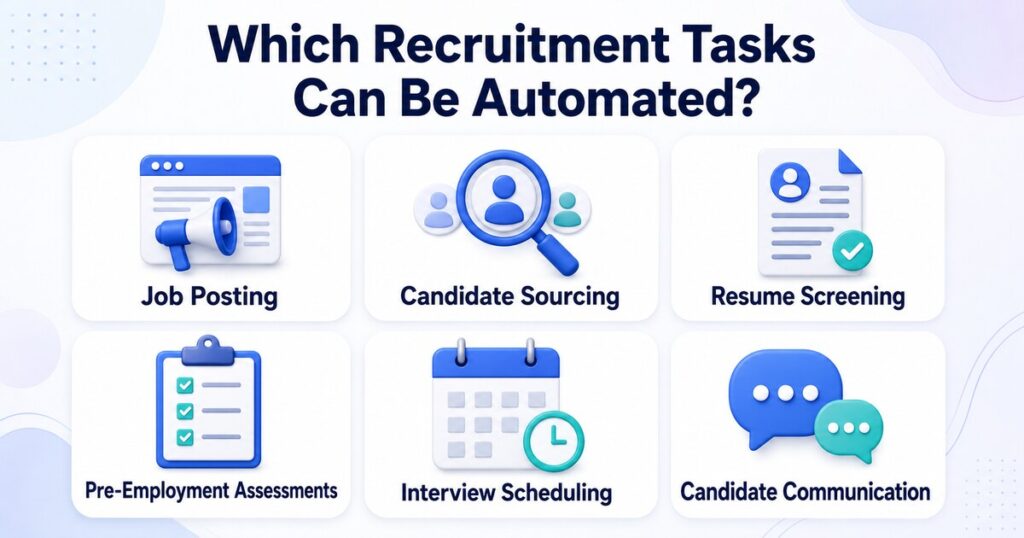
Not every recruitment activity should be automated. However, several repetitive tasks are well suited to automation.
1. Job Posting
Recruiters often advertise the same vacancy across several platforms. Recruitment automation tools can distribute job postings across selected channels from one system.
This saves time and helps teams maintain consistent job information across platforms.
2. Candidate Sourcing
Some recruitment tools can search talent databases or existing candidate pools based on predefined requirements.
Recruiters can use these recommendations as a starting point rather than searching every profile manually.
3. Resume Screening
High-volume roles can attract hundreds or thousands of applications. Automated screening tools can organize applications based on job-related criteria such as skills, qualifications or experience.
Recruiters should still review shortlisted candidates before making important decisions.
4. Pre-Employment Assessments
Automation platforms can send technical, aptitude or job-specific technical assessments after candidates reach a particular recruitment stage.
Results can be collected within the same hiring workflow. This makes it easier for recruiters to compare candidates using consistent criteria.
5. Interview Scheduling
Scheduling becomes complicated when recruiters need to coordinate multiple calendars.
Automated scheduling tools allow candidates to select available interview slots. Confirmation emails and reminders can also be triggered automatically.
6. Candidate Communication
Recruitment teams can automate application confirmations, interview reminders and basic status updates.
Candidates receive timely information while recruiters spend less time sending repetitive emails.
What Are the Benefits of Recruitment Automation?
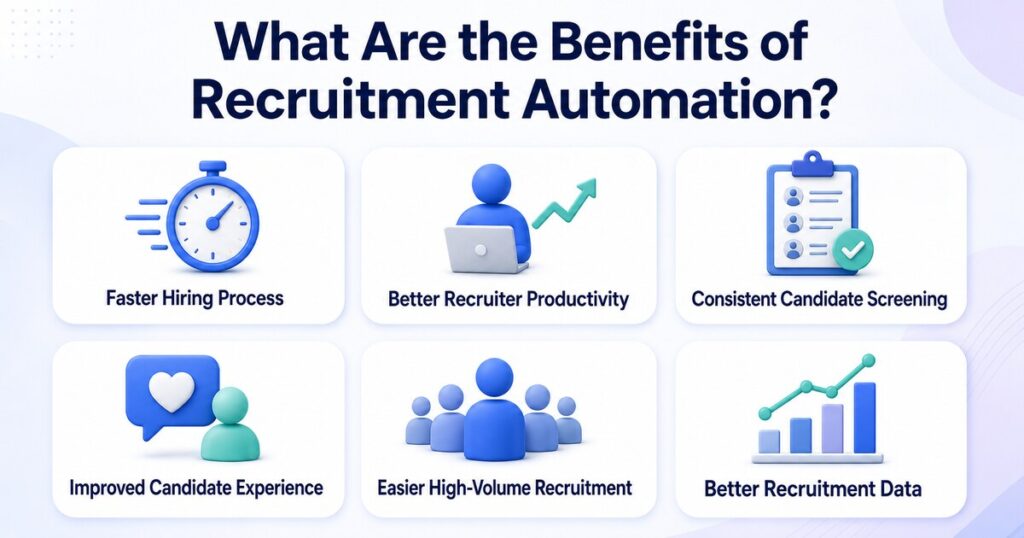
The value of recruitment automation goes beyond saving a few hours of administrative work. A well-designed system can improve several parts of the hiring process.
- Faster Hiring Process
Manual screening and scheduling can create unnecessary delays.
Automation moves qualified candidates through routine recruitment stages more quickly. Recruiters can then spend more time evaluating applicants who require closer attention.
This can help reduce time to hire without rushing important hiring decisions.
- Better Recruiter Productivity
Recruiters should spend their time understanding candidates and evaluating suitability rather than repeatedly updating spreadsheets or sending scheduling emails.
Automation handles many administrative tasks in the background. Recruiters can focus on interviews, candidate engagement and hiring strategy.
- Consistent Candidate Screening
Different recruiters may interpret applications differently.
Structured automation can apply the same predefined screening criteria across applicants. A remote hiring assessment can also help teams evaluate candidates consistently across locations. This creates a more consistent initial evaluation process.
However, companies should regularly review those criteria to ensure they remain relevant and fair.
- Improved Candidate Experience
Candidates often become frustrated when they receive no updates after applying.
Automated confirmations and reminders can keep candidates informed throughout the recruitment process. Scheduling tools also reduce unnecessary back-and-forth communication.
A smoother process can create a more professional candidate experience.
- Easier High-Volume Recruitment
Manual processes become difficult to manage when thousands of candidates apply within a short period.
Recruitment automation helps companies organize applications and assessments at scale. Recruiters can manage larger candidate pools without increasing repetitive administrative work at the same rate.
- Better Recruitment Data
Automated recruitment systems can capture information across different hiring stages.
Teams can track metrics such as application volume, assessment completion, interview progression and time to hire. These insights can reveal bottlenecks within the recruitment funnel.
What Are the Challenges of Recruitment Automation?
Recruitment automation can improve efficiency but poor implementation can create new problems.
- Automation Bias
Recruiters may assume an automated recommendation is always accurate.
A system can only work with the data and rules behind it. Poor criteria can lead to poor recommendations. Human review remains important for decisions that affect candidate progression.
- Risk of Unfair Screening
Automated hiring systems may produce unfair outcomes when their underlying data or screening criteria contain bias.
Employers should regularly review screening rules and test automated systems for unintended patterns. Job-related criteria should guide candidate evaluation.
- Poor Candidate Experience
Automation can improve communication but excessive automation can make recruitment feel impersonal.
Candidates may become frustrated when every interaction is handled by templates or chatbots. Recruiters should remain available for questions and meaningful conversations.
- Integration Problems
Recruitment teams often use multiple platforms for sourcing, assessments, interviews and applicant tracking.
Poor integrations can create duplicate records or fragmented candidate information. Companies should evaluate compatibility before introducing another recruitment tool.
- Data Privacy Concerns
Recruitment systems process personal candidate information.
Companies need appropriate access controls and data retention policies. They should also understand how recruitment vendors collect, process and store candidate data.
Recruitment Automation vs. Traditional Recruitment
The main difference lies in how repetitive work is managed.
| Area | Traditional Recruitment | Recruitment Automation |
| Resume screening | Primarily manual | Automated support with recruiter review |
| Interview scheduling | Emails and calls | Automated scheduling workflows |
| Candidate updates | Manually sent | Trigger-based communication |
| Assessments | Manually assigned | Automatically assigned |
| Data tracking | Spreadsheets or separate tools | Centralized workflow data |
| Scalability | Requires more manual effort | Handles higher volumes efficiently |
| Human involvement | Required across most tasks | Focused on higher-value decisions |
Automation does not remove the need for recruiters. It changes where recruiters spend their time.
What Are the Best Practices for Recruitment Automation?
Recruitment automation delivers better results when companies introduce it with a clear purpose.
1. Identify Recruitment Bottlenecks First
Do not automate a process simply because automation is available.
Review the existing hiring workflow and identify where recruiters lose the most time. Common bottlenecks include resume screening, scheduling and repeated candidate follow-ups.
Start with the processes where automation can solve a measurable problem.
2. Keep Humans in Important Decisions
Technology can organize information and automate repetitive steps. It should not become the only decision-maker for hiring.
Recruiters should review candidate evidence before rejection or selection decisions. Human oversight becomes particularly important when automated systems influence candidate rankings.
3. Use Job-Relevant Screening Criteria
Automated screening should focus on requirements that actually matter for the role.
A software developer may need specific programming knowledge. A customer support role may require communication and problem-solving skills.
Clear criteria make automated screening more meaningful.
4. Maintain Human Candidate Communication
Automated messages are useful for confirmations and reminders.
Sensitive conversations deserve direct human communication. Recruiters should personally handle complex questions, interview feedback and important hiring updates whenever appropriate.
5. Protect Candidate Data
Recruitment automation involves significant amounts of personal information.
Review vendor security standards before implementation. Define who can access candidate data and how long information should remain within the system.
6. Track Recruitment Metrics
Automation should produce measurable improvements.
Recruitment teams can monitor:
- Time to hire: How long does the overall recruitment process take?
- Time to screen: How quickly are applications reviewed?
- Assessment completion rate: How many candidates finish assigned assessments?
- Candidate drop-off: Where do candidates leave the hiring process?
- Interview-to-offer ratio: How many interviews result in offers?
- Candidate satisfaction: How do applicants rate their hiring experience?
These metrics can show whether automation is solving the intended problem.
7. Review Automated Workflows Regularly
Hiring requirements change over time.
A screening rule that worked six months ago may no longer match the role. Teams should regularly review automated workflows and update criteria when job requirements change.
How to Choose Recruitment Automation Software
The best recruitment automation software depends on the company’s hiring volume and existing recruitment process.
Start by identifying the tasks that need improvement. A small company may primarily need automated scheduling and candidate communication. A large employer may require sourcing, screening, assessments and analytics within one workflow.
Evaluate each platform based on:
- Integration with your existing ATS and HR tools
- Customizable recruitment workflows
- Candidate screening capabilities
- Assessment integrations
- Interview scheduling
- Candidate communication features
- Reporting and recruitment analytics
- Data privacy and security controls
- Ease of use for recruiters and candidates
A long feature list does not automatically make a platform suitable. The right solution should reduce friction within the existing recruitment process.
What Is the Future of Recruitment Automation?
Recruitment automation is becoming more intelligent as artificial intelligence becomes part of hiring technology.
AI tools can help recruitment teams organize candidate information and identify relevant skills. It can also support candidate matching and recruitment analytics.
The biggest opportunity is not removing recruiters from hiring. It is reducing administrative work so recruiters can spend more time on areas that require context and human judgment.
Organizations that combine structured automation with meaningful human involvement are more likely to create an efficient and candidate-friendly recruitment process.
Conclusion
Recruitment automation helps companies reduce repetitive hiring work and manage larger candidate pools more efficiently. It can support resume screening, assessments, interview scheduling, candidate communication and recruitment analytics.
However, automation should have clear boundaries. Poor screening rules or excessive reliance on automated recommendations can affect both hiring quality and candidate experience.
Start with genuine recruitment bottlenecks. Automate repetitive processes and measure the results. Keep recruiters involved wherever context, fairness and judgment matter.
The goal is not to automate recruitment completely. It is to give recruiters better tools so they can spend more time making better hiring decisions.
FAQs
What is recruitment automation?
Recruitment automation uses software to automate repetitive hiring tasks such as resume screening, interview scheduling, assessment delivery and candidate communication.
What are the main benefits of recruitment automation?
The main benefits include faster hiring, improved recruiter productivity, consistent workflows, better candidate communication and easier management of high-volume recruitment.
Which recruitment processes can be automated?
Companies can automate job posting, candidate sourcing, initial resume screening, assessment delivery, interview scheduling, reminders and routine candidate updates.
Can recruitment automation replace recruiters?
No. Automation is most useful for repetitive and administrative tasks. Recruiters are still needed for candidate evaluation, interviews, relationship building and final hiring decisions.
How can companies implement recruitment automation effectively?
Companies should identify existing hiring bottlenecks first. They should choose job-relevant automation rules and maintain human oversight. Regular performance reviews and candidate data protection are also essential.