

Remote hiring is now the default for most companies, and the way you run assessments has a direct impact on the quality of candidates you bring in. Done well, remote assessments save time, reduce costs, and give you more reliable data. Done poorly, they frustrate candidates, produce unreliable results, and slow down a process that should be moving faster. Understanding the best practices for conducting remote hiring assessments is what separates companies that hire well from those that keep repeating the same mistakes.
TL;DR Summary
- The best practices for conducting remote hiring assessments start with role-specific tests, not generic ones.
- Assessments should happen early in the process, not as a final stage afterthought.
- AI proctoring is essential for maintaining result integrity in remote settings.
- Candidate communication before and after the assessment directly affects completion rates and perception of your brand.
- Automated reminders, centralised reporting, and scalable platforms are no longer optional.
- Companies that follow the best practices for conducting remote hiring assessments consistently hire faster and better.
Why Remote Assessments Need a Structured Approach
Remote assessments come with a unique set of challenges. Candidates are taking tests on personal devices in their own environments without supervision. Without the right setup, the data you collect is inconsistent at best and unreliable at worst.
Following the best practices for conducting remote hiring assessments means building a process that is fair, efficient, and trustworthy from the candidate’s first interaction to the recruiter’s final review.
1. Match the Assessment to the Role
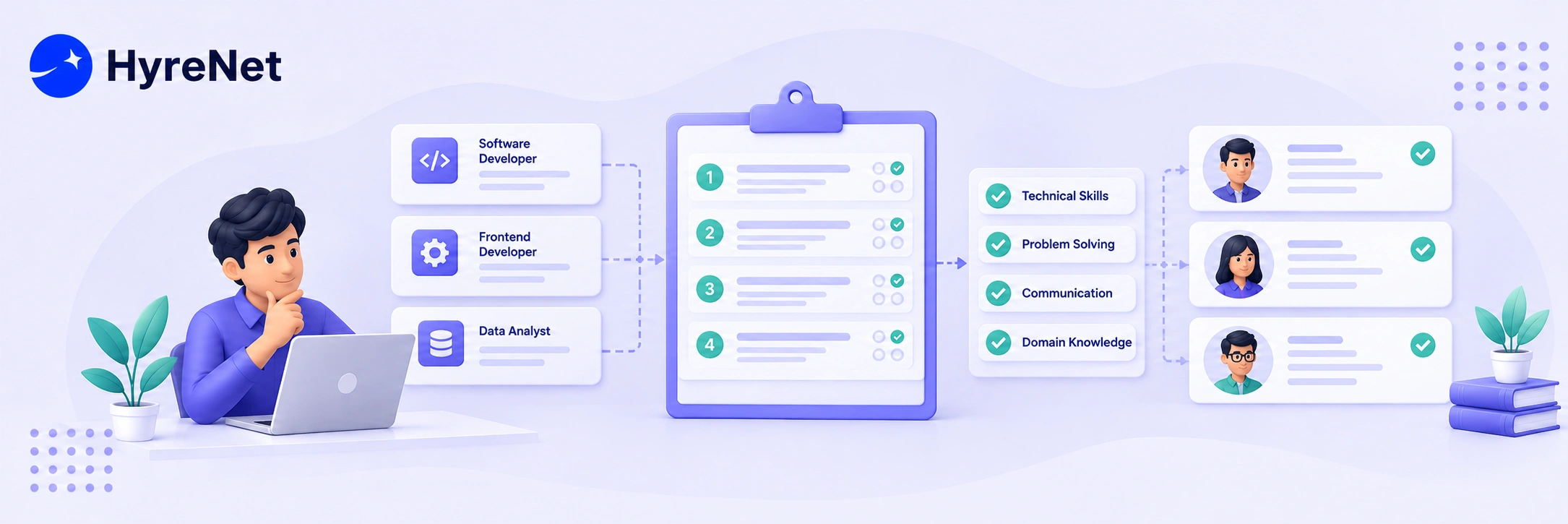
This is the most fundamental of all the best practices for conducting remote hiring assessments, and the one most often ignored. Sending a generic aptitude test to every candidate regardless of what they are applying for tells you very little about whether someone can do the job.
Every assessment should reflect the real skills the role demands. A developer role needs a coding test. A data analyst role needs problem-solving and SQL. A customer success role needs communication and scenario-based questions. The more the test mirrors the actual work, the more useful the results.
2. Send the Assessment Early
One of the most impactful best practices for conducting remote hiring assessments is using them as a filter at the start, not the end. Most companies run multiple interview rounds first and only then send an assessment. By that point, significant time has been wasted on candidates who might not make it through.
Move the assessment to the very first step after initial registration. This creates a data-backed shortlist before a single interview is scheduled.
3. Keep It Focused and Reasonably Timed
Candidates apply to multiple companies at once. If your assessment takes two hours for an entry-level role, your drop-off rate will be high. One of the clearest best practices for conducting remote hiring assessments is to test only what is genuinely necessary. Aim for 30 to 45 minutes for most roles.
4. Use AI Proctoring to Protect Result Integrity
A remote assessment without proctoring is a test anyone can cheat. Among the best practices for conducting remote hiring assessments, AI proctoring is one of the most important to get right.
HyreNet’s AI proctoring monitors webcam feeds, screen activity, tab switching, and browser behaviour throughout every session. Suspicious behaviour is flagged automatically and included in the candidate report, keeping result integrity intact across thousands of assessments.
5. Communicate Clearly With Candidates
Candidates who receive a test invite with no context are more likely to ignore it or abandon it halfway. Before the assessment, tell candidates how long it takes, what it covers, and what happens after. This is one of the best practices for conducting remote hiring assessments that directly improves completion rates without any extra cost.
6. Automate Follow-Ups and Reminders
Manual follow-up at scale is slow and inconsistent. Automated reminders are a non-negotiable part of the best practices for conducting remote hiring assessments. HyreNet sends automated reminders to incomplete candidates, keeping the pipeline moving without adding to your team’s workload.
7. Use Detailed Reports, Not Just Scores
A raw score is the least useful output a remote assessment can produce. The best practices for conducting remote hiring assessments include reviewing full candidate reports that cover how someone approached problems, where they struggled, and how they compare against others in the pipeline. This makes shortlisting faster and interviews more focused.
8. Track Completion Rates and Refine
If candidates are dropping off before finishing your assessment, something needs to change. Monitoring completion rates and drop-off data is one of the best practices for conducting remote hiring assessments that most companies skip. Review this after every hiring cycle and adjust the length, instructions, or timing accordingly.
Conclusion
The best practices for conducting remote hiring assessments are not complicated, but they require intention. Getting the role match right, moving assessments earlier, protecting result integrity with proctoring, and communicating clearly with candidates are things any company can do with the right platform. The ones that do these things well hire faster, make fewer mistakes, and build a stronger reputation with candidates. Remote hiring is not going away, and neither is the need to run it properly.
Also read – 5 Reasons Why HyreNet’s Recruitment Platform Easily Stands Out in Talent Acquisition
FAQs
1. What are the most important best practices for conducting remote hiring assessments?
Matching the assessment to the role, using AI proctoring, sending assessments early, and communicating clearly with candidates are the most impactful things to get right.
2. How long should a remote hiring assessment be?
For most roles, 30 to 45 minutes is the sweet spot. Anything longer risks significant candidate drop-off without producing meaningfully better data.
3. Why is AI proctoring important for remote assessments?
Without proctoring there is no way to verify results are honest. AI proctoring monitors multiple signals simultaneously and flags suspicious behaviour automatically, keeping every assessment fair and consistent.
4. How does candidate communication affect remote assessment outcomes?
Candidates who know what to expect are far more likely to complete the test. A short, clear pre-assessment message directly improves completion rates and leaves a better impression of your company.
5. How does HyreNet support the best practices for conducting remote hiring assessments?
HyreNet brings role-specific templates, AI proctoring, automated reminders, detailed candidate reports, and built-in analytics together in one platform, making it straightforward to run remote assessments that are fast, fair, and reliable.