

AI proctoring has become one of the most talked about tools in modern hiring. But with that attention comes a lot of misinformation. Recruiters who have never used it often hold back because of things they have heard that simply are not true. Understanding the real AI proctoring myths versus the actual facts helps you make a much more informed decision about whether this technology belongs in your hiring process.
TL;DR Summary
- There are many AI proctoring myths that prevent companies from adopting a tool that genuinely works.
- AI proctoring does not spy on candidates, it only monitors what is directly relevant to the assessment.
- It is not just for large companies, businesses of any size can use it effectively.
- AI proctoring flags behaviour for human review, it does not make hiring decisions on its own.
- AI proctoring keeps assessments fair, honest, and efficient without adding friction to the process.
- Most AI proctoring myths fall apart the moment you look at how the technology actually works.
Clearing Up the AI Proctoring Myths
A lot of the hesitation around AI proctoring comes from assumptions people have made without actually looking into how it works. Here are the most common AI proctoring myths, and the truth behind each one.
Myth 1: AI Proctoring Is Just Spying on Candidates
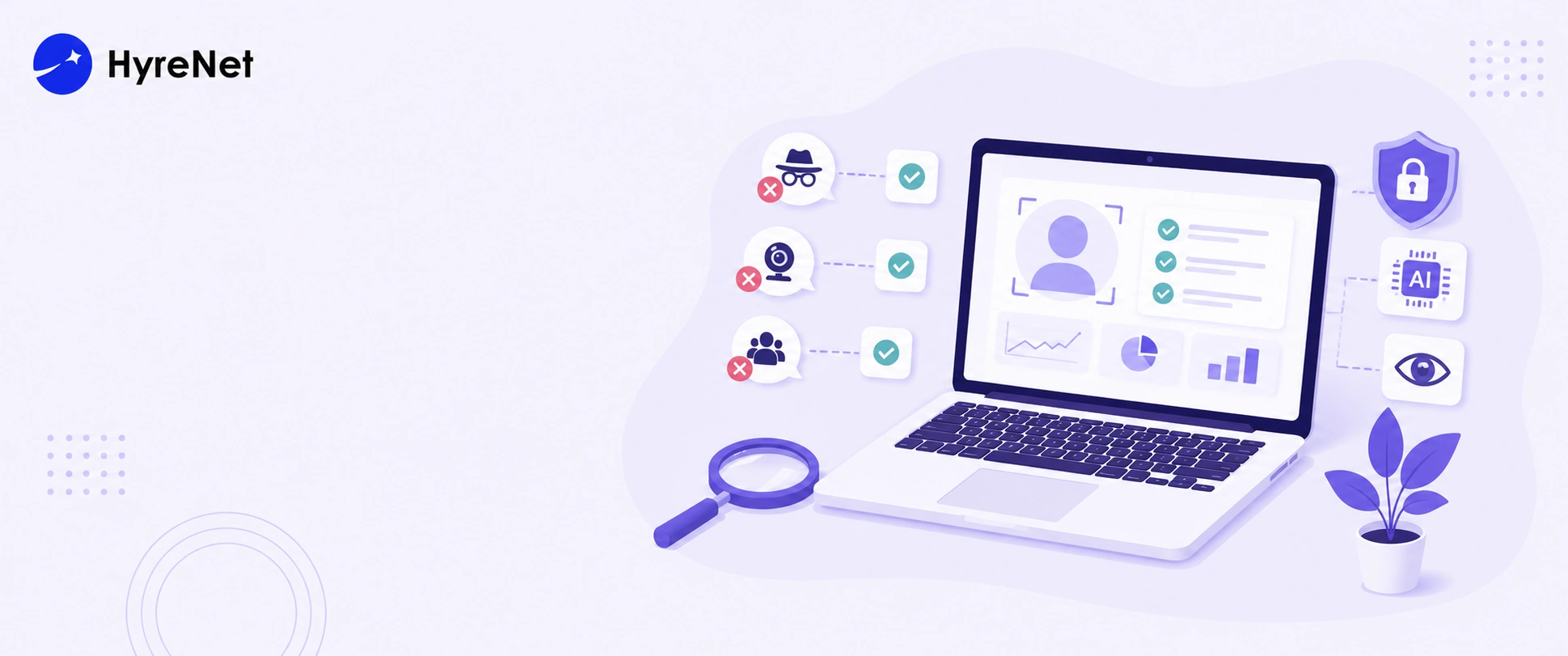
This is probably the most widespread of all the AI proctoring myths. The reality is that AI proctoring only monitors what is directly relevant to the assessment, webcam activity, screen behaviour, and browser usage. It does not access files on a candidate’s device, read personal messages, or record anything beyond the test session. Candidates are always informed before the assessment begins that monitoring is in place, so there are no surprises.
Myth 2: It Gets Things Wrong Too Often to Be Useful
AI proctoring myths around accuracy are common, but modern systems are significantly better than this assumption suggests. They are trained to distinguish between genuine suspicious behaviour and normal things like adjusting your seating position. Flags are always reviewed by a human before any decision is made.
Myth 3: Only Large Enterprises Can Afford It
This is one of the AI proctoring myths that stops smaller companies from even looking into it. In reality, AI proctoring is built into platforms like HyreNet as part of the standard assessment package. You do not need a separate contract, a dedicated IT team, or an enterprise budget. Whether you are hiring for two roles or two hundred, the cost is the same per assessment.
Myth 4: Candidates Hate It and It Hurts Your Employer Brand
The concern here is understandable, but it is based on an outdated version of the technology. Poorly designed proctoring that feels invasive or breaks down mid-session does damage perception. But a smooth, well-communicated AI proctoring experience does not. Candidates who are told upfront what will be monitored and why generally accept it as a fair part of a standardised process. Most AI proctoring myths around candidate experience come from bad implementations, not the technology itself.
Myth 5: AI Proctoring Makes the Hiring Decision for You
This is one of the most important AI proctoring myths to clear up. AI proctoring does not decide whether someone gets hired. It flags behaviour for human review. A recruiter still looks at every flagged incident and decides whether it is actually concerning. The technology supports judgment, it does not replace it.
Myth 6: It Only Works for Technical Roles
AI proctoring is often associated with coding assessments and technical tests because those were early adopters of the technology. But AI proctoring myths like this ignore how broadly it applies. Any role that involves a remote assessment, whether it is a customer service position, a finance role, or a graduate hire, benefits from the same level of monitoring and result integrity.
Myth 7: Candidates Can Easily Cheat AI Proctoring
This myth usually comes from people who have heard of workarounds. The truth is that modern AI proctoring monitors multiple signals simultaneously, webcam, microphone, screen activity, tab switches, and more. Defeating all of those at once without triggering a flag is far harder than most people assume, and the attempt itself usually shows up in the data.
Myth 8: AI Proctoring Is a Privacy Violation
This is perhaps the stickiest of the AI proctoring myths because it sounds serious. But proctoring during an assessment is no different in principle to having an invigilator present in an exam room. Candidates consent before starting, monitoring is limited to the session, and data is stored securely within the platform.
When you look past the AI proctoring myths, what you find is a tool that makes remote assessments more trustworthy, more consistent, and more defensible. The companies holding back because of things they have heard are often the ones spending the most time dealing with assessment integrity issues that could have been avoided.
Also read – 5 Reasons Why HyreNet’s Recruitment Platform Easily Stands Out in Talent Acquisition
FAQs
1. What are the most common AI proctoring myths?
The most widespread ones are that it spies on candidates, makes too many errors, is only for large companies, and that it makes hiring decisions automatically. None of these are accurate.
2. Does AI proctoring record candidates without their knowledge?
No. Candidates are always notified before the assessment begins that monitoring is active. Nothing is recorded without prior consent.
3. Can AI proctoring replace human judgment?
No, and it is not designed to. It flags behaviour for a recruiter to review. The final call always stays with a human.
4. Is AI proctoring only suitable for technical assessments?
Not at all. It works for any role that involves a remote test, whether the assessment is technical, aptitude-based, or personality-focused.
5. How does HyreNet handle AI proctoring?
HyreNet’s AI proctoring monitors webcam feeds, screen activity, and browser behaviour throughout every assessment. Anything suspicious is flagged in the candidate’s report for recruiter review, keeping the process honest without adding extra work to your team.