

Out of every 100 people who apply for a role, fewer than one actually gets hired. That sounds harsh, but it is the honest math behind hiring in 2026, and understanding why requires understanding your recruitment funnel.
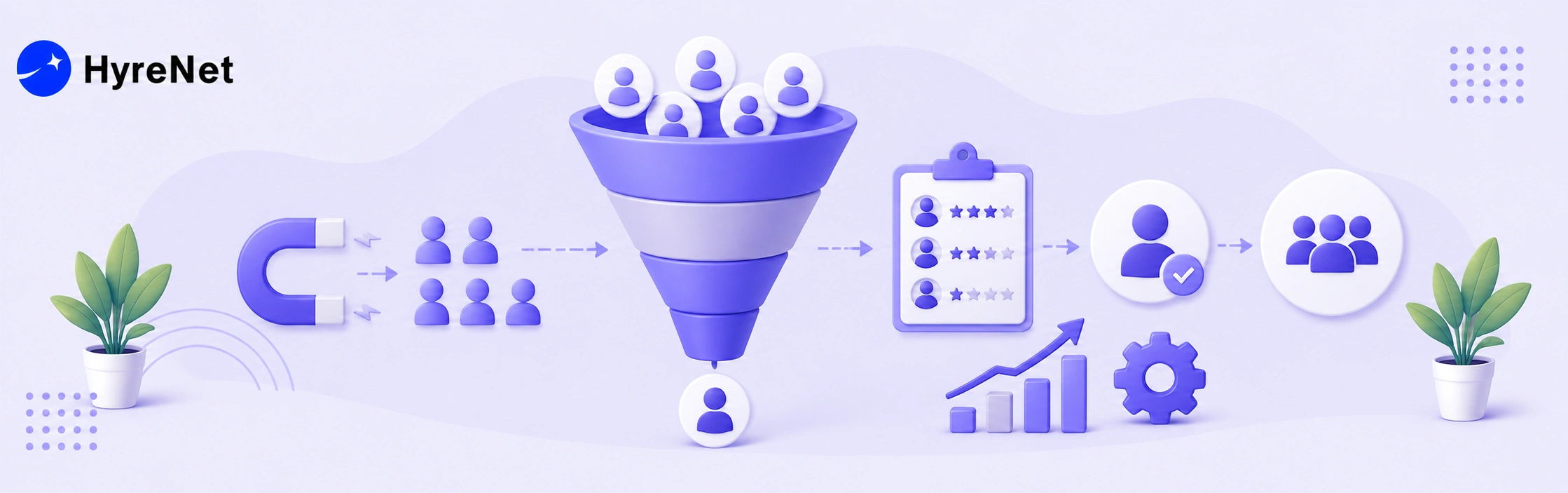
A recruitment funnel is simply the journey a candidate takes from seeing your job posting to accepting an offer, broken into stages, with a percentage of people dropping off at each one. Think of it the same way a sales team thinks about their pipeline.
This blog walks through the stages of a recruitment funnel, the benchmark numbers you should actually expect, and practical ways to fix the stages where you are quietly losing good candidates.
TL;DR Summary
- A recruitment funnel tracks candidates from job view through to accepted offer, stage by stage
- Most funnels lose the majority of candidates between application and interview, not at the offer stage
- Typical conversion rates range widely by stage, but application to screen usually sits around 12 to 20 percent
- Sourced and referred candidates convert at far higher rates than job board applicants
- Tracking conversion rate at each stage, not just the final hire count, is how you find real bottlenecks
- Small, targeted fixes at your weakest stage beat trying to overhaul the whole process at once
The Stages of a Recruitment Funnel
Every funnel follows roughly the same shape, even though the exact steps vary by company.
- Job view: Someone sees your job posting, on a job board, LinkedIn, or your careers page
- Application: A smaller group actually applies, often after reading the description and deciding it fits
- Screening: Recruiters review applications and shortlist candidates who meet the basic requirements
- Interview: Shortlisted candidates go through one or more rounds of interviews or assessments
- Offer: A smaller group makes it to the offer stage after interviews are complete
- Acceptance: The candidate accepts, and the funnel officially ends in a hire
Each stage naturally loses people, and that is expected. The real question is not whether people drop off, it is whether they are dropping off for the right reasons or because of a broken process.
Typical Recruitment Funnel Conversion Rates
These numbers vary by role, industry, and company size, but they give a useful starting benchmark for most recruitment funnel stages in 2026.
| Stage | Typical Conversion Rate | What It Means |
|---|---|---|
| Job view to application | Roughly 5 to 10 percent | Most viewers do not apply, which is normal |
| Application to screen | Roughly 12 to 20 percent | Many applicants do not meet basic requirements |
| Screen to interview | Roughly 30 to 50 percent | This stage often has the most room for improvement |
| Interview to offer | Roughly 15 to 36 percent | Wide range depending on role and interview rigor |
| Offer to acceptance | Roughly 70 to 85 percent | Most candidates accept if the process went smoothly |
Multiplying every stage together gives you the full recruitment funnel conversion rate, from first application to accepted offer, which often lands well under 2 percent across most industries.
How to Calculate Your Own Recruitment Funnel Numbers
The formula behind every recruitment funnel stage is the same, and it is simpler than it sounds.
Conversion rate equals the number of candidates who advanced to the next stage, divided by the number who entered that stage, multiplied by 100.
For example, if 300 people apply and 45 make it to screening, that stage converts at 15 percent.
Do this for every stage, and you get a clear, numbers-based picture of exactly where your recruitment funnel is strongest and weakest, instead of relying on gut feeling.
A Full Funnel Example
Let’s walk through one complete example to make this concrete. Say 500 people view your job posting.
- 500 view the job, 40 apply: An 8 percent view-to-application rate, which is fairly typical
- 40 apply, 7 reach screening: A 17.5 percent application-to-screen rate, right in the healthy range
- 7 reach screening, 3 get interviewed: A screen-to-interview rate of about 43 percent
- 3 are interviewed, 1 gets an offer: Roughly a 33 percent interview-to-offer rate
- 1 offer, 1 acceptance: An 100 percent acceptance rate for this small example
Multiplying these stages together shows that out of 500 initial viewers, exactly one hire results, an end-to-end conversion rate of 0.2 percent. Seeing the math laid out this way makes it much easier to spot which single stage would have the biggest impact if improved.
Where Recruitment Funnels Usually Leak the Most
- Application to screen: This is often the biggest drop-off point, since unqualified or mismatched applicants apply anyway
- Screen to interview: A weak or inconsistent screening process either lets too many unqualified people through or filters out strong candidates by mistake
- Interview to offer: Long, disorganized interview processes cause strong candidates to lose interest or accept another offer first
- Offer to acceptance: Slow offer delivery or a poor overall experience can cause candidates to decline even a strong offer
Most recruiting teams focus heavily on sourcing more applicants, but the bigger win is usually fixing whichever stage of the recruitment funnel is leaking the most qualified people.
Tips to Optimize Your Recruitment Funnel
- Track conversion rate by stage, not just total hires: This is the only way to spot where the real bottleneck lives
- Prioritize sourced and referred candidates: These channels consistently convert at higher rates than open job board applications
- Add a skills assessment early: Screening for real ability before the interview stage improves the quality of who reaches later rounds
- Keep interview rounds proportional to the role: Extra rounds without added value slow the funnel without improving decisions
- Move fast at the offer stage: A delayed offer is one of the easiest ways to lose a strong candidate to a competitor
Platforms like HyreNet help directly at the screening stage, using structured, role-relevant assessments to filter candidates by real ability before they reach the interview stage, which tightens the middle of the recruitment funnel considerably.
Common Mistakes When Managing a Recruitment Funnel
These mistakes show up again and again, even on teams that genuinely care about hiring well.
- Only measuring the end result: Looking only at total hires hides exactly which stage is actually underperforming
- Comparing your funnel to the wrong benchmark: A tech role and a retail role have very different expected conversion rates
- Ignoring source quality: Treating every applicant the same, regardless of channel, hides where your best candidates are actually coming from
- Adding steps without removing others: Every extra stage added to the recruitment funnel needs a clear reason, or it just adds friction
For more on how modern platforms address these exact funnel problems, do check out HyreNet’s breakdown of common recruitment challenges.
Conclusion
A recruitment funnel is not just a diagram, it is a practical tool for finding out exactly where your hiring process is losing good candidates. Once you start tracking conversion rate stage by stage, the fixes usually become obvious.
Start small. Pick your weakest stage, apply one focused fix, and measure the change before moving to the next one. That steady, stage-by-stage approach beats trying to rebuild your entire recruitment funnel all at once.
FAQs
What is considered a healthy recruitment funnel conversion rate overall?
There is no single universal number, since it varies heavily by industry and role, but tracking your own stage-by-stage trend over time matters more than chasing an external benchmark.
Which stage usually has the most room for improvement?
The screening stage often has the widest benchmark range, meaning there is usually the most opportunity to tighten it up with a clearer, more consistent process and better initial filtering criteria.
Do referrals really convert better than job board applicants?
Yes, referred and sourced candidates typically convert at noticeably higher rates than open applications, since they usually arrive with a stronger existing fit.
How often should I review my recruitment funnel numbers?
Monthly or quarterly reviews work well for most teams, though high-volume hiring may benefit from checking conversion rates weekly to catch problems faster.
Can adding more job postings fix a weak recruitment funnel?
Not usually. More applicants without fixing a leaky stage just means more people dropping off at the same broken point, not more hires.