


How do you know a remote developer can actually solve the problems your role requires before you hire them? Resumes show experience. Interviews reveal communication. Neither always proves how well a developer can code under realistic conditions.
Coding assessments give hiring teams a more practical way to evaluate technical ability before moving candidates to final interviews. They can help recruiters compare developers using the same criteria while supporting remote hiring across different locations and time zones.
This guide explains how to hire remote developers using coding assessments and build a more structured technical hiring process.
TL;DR
- Coding assessments help recruiters evaluate practical programming skills before interviews.
- Remote assessments make it easier to compare developers across locations.
- Tests should reflect the actual role rather than use generic coding questions.
- Clear scoring criteria improve consistency across candidates.
- The strongest process combines coding assessments with structured technical interviews.
Why Is Hiring Remote Developers Different?
Remote developer hiring creates a wider talent pool but it also makes evaluation more complex. Recruiters may receive applications from candidates with very different educational backgrounds and work histories. A resume alone may not show:
- Actual coding ability
- Debugging skills
- Problem-solving approach
- Code quality
- Familiarity with relevant technologies
- Ability to work independently
Technical interviews can provide more context but they require significant engineering time. Coding assessments help recruiters screen candidates earlier so technical teams can focus on stronger applicants.
What Is a Coding Assessment?
A coding assessment is a structured test that measures a candidate’s programming ability. The goal of this test is not simply to check whether a candidate knows syntax. A useful coding assessment should show how the developer approaches problems that resemble the work they would perform after joining.
Candidates may be asked to:
- Solve coding problems
- Debug existing code
- Build a small feature
- Write algorithms
- Work with APIs
- Complete database queries
- Review code
- Solve role-specific technical tasks
Why Use Coding Assessments to Hire Remote Developers?
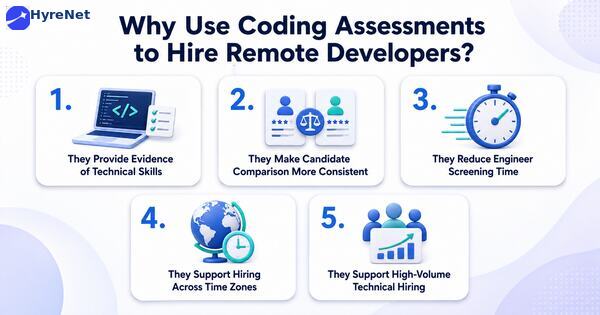
1. They Provide Evidence of Technical Skills
Remote candidates may come from different companies or education systems.
A coding assessment gives recruiters a common way to evaluate practical ability.
Instead of relying only on resume claims such as “proficient in Python” or “experienced in React,” recruiters can see how the candidate performs on relevant tasks.
2. They Make Candidate Comparison More Consistent
Unstructured technical interviews may vary significantly between interviewers.
One interviewer may ask algorithm questions while another focuses on architecture.
A structured assessment gives candidates comparable tasks and scoring criteria.
This helps teams make more consistent shortlisting decisions.
3. They Reduce Engineer Screening Time
Senior developers often spend hours interviewing candidates who do not meet basic technical requirements.
A coding assessment can identify stronger candidates before live interviews.
Engineering teams can then focus their time on candidates who have already demonstrated essential skills.
4. They Support Hiring Across Time Zones
Live technical screening can be difficult when candidates and interviewers work in different regions.
Asynchronous coding assessments allow candidates to complete tasks within a defined window.
This makes remote hiring easier without requiring every early-stage evaluation to happen live.
5. They Support High-Volume Technical Hiring
Companies hiring several remote developers may receive hundreds of applications.
A structured remote hiring assessment can help organize this volume and identify candidates who meet predefined technical benchmarks.
This is especially useful for:
- Graduate developer hiring
- Large engineering teams
- Remote-first companies
- Startup hiring campaigns
- Offshore development teams
How Can HyreNet Help Hire Remote Developers?
HyreNet can support remote technical hiring through structured candidate screening and coding assessments.
Recruitment teams can use a more organized workflow to:
- Evaluate programming skills
- Compare candidates using structured criteria
- Deliver remote assessments
- Track assessment completion
- Shortlist stronger developers
- Reduce repetitive manual screening
- Manage technical hiring at scale
Recruiters can then use assessment results to guide technical interviews rather than relying only on resumes. This creates a clearer connection between early screening and final hiring decisions.
Hire remote developers with more confidence using HyreNet’s smarter coding assessment workflows. Evaluate practical coding skills, compare candidates across locations, reduce interview workload, and build a structured remote hiring process that helps teams identify job-ready developers faster.
How to Hire Remote Developers Using Coding Assessments
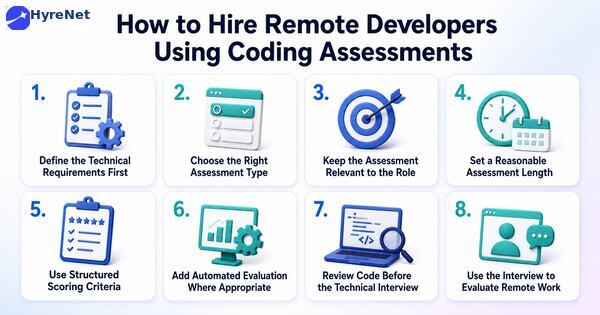
1. Define the Technical Requirements First
Recruiters and engineering managers should agree on what the developer must actually do in the role.
For example, a backend developer may need:
- Python or Java proficiency
- API development skills
- SQL knowledge
- Debugging ability
- Basic system design knowledge
A frontend developer may require:
- JavaScript or TypeScript
- React
- HTML and CSS
- API integration
- Browser debugging
Clear requirements make it easier to design relevant assessments.
2. Choose the Right Assessment Type
Different roles require different coding tasks. The assessment format should match the job.
- Algorithm-Based Assessments
These test logical reasoning and programming fundamentals.
They may be useful for:
- Entry-level developers
- Graduate hiring
- Roles requiring strong computer science fundamentals
They are less useful when the role depends heavily on frameworks or practical application development.
- Role-Based Coding Tasks
These simulate actual development work.
Examples include:
- Building an API endpoint
- Fixing a broken React component
- Writing a database query
- Debugging an existing function
- Implementing authentication logic
These assessments often provide stronger evidence of job readiness.
- Take-Home Projects
Candidates complete a larger task over several hours or days.
These can show:
- Code organization
- Documentation
- Testing habits
- Architecture decisions
Take-home projects should remain reasonably scoped. Excessive unpaid work can negatively affect candidate experience.
- Live Coding Assessments
Candidates solve a problem while speaking with an interviewer.
These allow interviewers to observe:
- Problem-solving approach
- Communication
- Debugging process
- Response to feedback
Live coding works best later in the recruitment process after initial screening.
3. Keep the Assessment Relevant to the Role
A strong online assessment should resemble actual work.
A developer being hired for API development should not be evaluated only through abstract puzzles.
Likewise, a frontend developer should not spend the entire assessment solving unrelated algorithm questions.
Recruiters should ask:
- Does this task measure a skill required in the job?
- Would a strong employee reasonably perform similar work?
- Does the assessment produce evidence that helps make a hiring decision?
Tasks that do not answer these questions may add unnecessary friction.
4. Set a Reasonable Assessment Length
Assessment length affects completion rates.
Early-stage assessments should usually focus on essential skills rather than testing everything at once.
A shorter screening assessment can identify baseline ability.
More detailed technical evaluation can happen later.
Recruiters should clearly communicate:
- Expected duration
- Submission deadline
- Allowed programming languages
- Whether external resources are permitted
- How the assessment will be evaluated
Clear instructions reduce confusion and candidate drop-off.
5. Use Structured Scoring Criteria
Coding assessments should use predefined evaluation criteria so every candidate is reviewed consistently. Passing test cases is important but it should not be the only factor. Recruiters should also consider how the candidate approaches the problem and whether the code is clear, efficient and maintainable.
A scoring framework may include:
| Evaluation Area | What to Review |
| Correctness | Does the solution work as expected? |
| Code quality | Is the code readable and organized? |
| Problem solving | Does the approach make technical sense? |
| Efficiency | Is the solution reasonably efficient? |
| Testing | Has the candidate considered edge cases? |
| Maintainability | Could another developer understand and modify the code? |
6. Add Automated Evaluation Where Appropriate
Automated test cases can quickly verify whether candidate code produces the expected results. AI in recruitment can also support this stage by helping teams process assessment results and identify candidates who meet predefined technical criteria.
Automation can help evaluate:
- Correct outputs
- Failed test cases
- Execution errors
- Performance limits
- Code completion
However, automated scoring should not replace all human review. Two candidates may produce working solutions with very different code quality and reasoning.
7. Review Code Before the Technical Interview
The assessment should inform the next interview. Technical interviewers can review the submission and ask candidates about:
- Why they chose a particular approach
- What they would improve
- How they handled edge cases
- Alternative solutions
- Tradeoffs in their implementation
This creates a more meaningful technical discussion than asking unrelated questions from scratch.
8. Use the Interview to Evaluate Remote Work Skills
Technical ability is only one part of remote developer hiring. Remote developers also need to communicate clearly and work with limited direct supervision. The interview should therefore explore:
- Written communication
- Collaboration habits
- Documentation skills
- Time management
- Ownership
- Experience working asynchronously
These skills should complement coding results rather than be mixed into the assessment score without clear criteria.
What Skills Should Coding Assessments Measure?
- Frontend Developers
Assessments may evaluate:
- JavaScript or TypeScript
- React or another relevant framework
- State management
- API integration
- Responsive interfaces
- Debugging
- Backend Developers
Useful areas include:
- Server-side programming
- API design
- Database queries
- Authentication
- Error handling
- Performance considerations
- Full-Stack Developers
A full-stack assessment may combine:
- Frontend logic
- Backend APIs
- Database interaction
- Basic architecture decisions
The scope should remain manageable.
- Mobile Developers
Tasks may measure:
- Platform-specific programming
- UI implementation
- API integration
- State management
- Error handling
- DevOps or Cloud Engineers
A traditional coding challenge may not be enough.
Assessments may instead involve:
- Writing scripts
- Infrastructure configuration
- CI/CD troubleshooting
- Containerization tasks
- Cloud deployment scenarios
Common Mistakes When Hiring Remote Developers
- Using Generic Coding Tests
A generic test may measure algorithm knowledge without reflecting actual job responsibilities.
This can produce high scores from candidates who are good at coding puzzles but weaker in practical development.
- Making Assessments Too Long
Large unpaid projects can discourage experienced candidates.
Recruiters should request only enough work to make a meaningful screening decision.
- Testing Too Early
Sending a complex assessment immediately after someone applies can reduce participation.
Basic eligibility screening can happen first.
- Relying Only on Assessment Scores
A high coding score does not automatically mean a candidate will perform well in the role.
Hiring decisions should also consider:
- Technical discussion
- Relevant experience
- Communication
- Collaboration
- Role fit
- Ignoring Candidate Experience
Candidates should understand why the assessment is required and what happens after completion.
Silence after a lengthy assessment can damage trust.
How Can You Prevent Cheating in Remote Coding Assessments?
- Use Role-Specific Questions
Custom tasks are harder to answer through memorized solutions.
- Randomize Question Sets
Candidates can receive different problems from the same difficulty level.
- Review the Code During Interviews
Ask candidates to explain their solution.
Developers who completed the work themselves should usually be able to discuss their decisions clearly.
- Use Similar Follow-Up Questions
Interviewers can ask candidates to modify their solution or explain how it would change under different requirements.
This provides additional evidence of actual understanding.
- Set Clear Assessment Rules
Candidates should know whether documentation, search engines or AI tools are permitted.
Modern developers commonly use external tools at work. The assessment should test skills under realistic conditions rather than rely on unclear restrictions.
How Should AI Be Used in Coding Assessments?
AI tools are now part of many developers’ normal workflows. Hiring teams should therefore decide what they actually want to measure. A company may choose to:
- Restrict AI use when testing fundamental coding ability.
- Allow AI but require candidates to explain and modify generated code.
- Create separate tasks that measure debugging and code review skills.
- Evaluate whether candidates can verify AI-generated output.
The rules should be stated before the assessment begins. The objective should be to measure relevant development capability rather than surprise candidates with hidden expectations.
Coding Assessment Workflow for Remote Hiring
Stage 1: Application Screening
Review essential experience and technical requirements.
Stage 2: Short Coding Assessment
Measure core programming skills.
Stage 3: Assessment Review
Evaluate code quality and technical approach.
Stage 4: Technical Interview
Discuss the candidate’s solution and explore deeper technical knowledge.
Stage 5: Remote Work Interview
Evaluate communication and collaboration habits.
Stage 6: Final Decision
Combine assessment evidence with interview feedback.
This structure gives each recruitment stage a clear purpose.
Metrics to Track When Hiring Remote Developers
Recruiters should measure whether coding assessments actually improve hiring.
| Metric | Why It Matters |
| Assessment completion rate | Shows whether candidates are completing the test |
| Assessment pass rate | Shows how many meet the technical benchmark |
| Candidate drop-off | Identifies friction in the hiring process |
| Time to technical interview | Measures screening efficiency |
| Interview-to-offer ratio | Shows shortlist quality |
| Offer acceptance rate | Indicates candidate interest |
| Time to hire | Measures total hiring speed |
| New-hire performance | Helps validate assessment quality |
Note: A very low assessment completion rate may indicate that the test is too long or introduced too early. A high assessment pass rate followed by poor interview performance may indicate that the test is not sufficiently relevant.
Best Practices for Remote Developer Coding Assessments
Before the Assessment
- Define the exact technical skills required.
- Choose tasks that reflect the role.
- Decide whether AI and external resources are allowed.
- Set a reasonable completion time.
During the Assessment
- Provide clear instructions.
- Use consistent scoring criteria.
- Track completion and technical issues.
- Avoid unnecessary surveillance.
After the Assessment
- Review both output and code quality.
- Discuss the submission during the interview.
- Combine assessment results with human evaluation.
- Track whether assessment performance predicts job performance.
Conclusion
The challenge in remote technical hiring is not finding more applicants. It is identifying which developers can actually perform the work. Coding assessments provide practical evidence before recruiters invest time in several interview rounds.
The strongest assessments are short enough to respect candidate time and specific enough to reflect real job requirements. Structured scoring also makes candidate comparison more consistent.
Companies looking to hire remote developers should use assessments as one part of a broader process. Coding tasks can measure technical ability. Interviews can then evaluate deeper knowledge, communication and remote collaboration skills. This combination creates a more efficient and evidence-based remote hiring process.
FAQs
1. How do you hire remote developers effectively?
Define the role clearly and use structured screening followed by job-relevant coding assessments and technical interviews.
2. Are coding assessments useful for remote hiring?
Yes. Coding assessments help employers evaluate practical technical skills before committing engineering time to live interviews.
3. What should a remote developer coding assessment include?
It should include tasks related to the actual role such as debugging, API development, frontend implementation or database work.
4. How long should a coding assessment be?
The assessment should be long enough to measure essential skills but short enough to respect candidate time. Early-stage tests should usually be more focused than final technical exercises.
5. Can AI be used during coding assessments?
Employers can allow or restrict AI depending on what they want to measure. The rules should be explained clearly before candidates begin.