

A recruiter opens a blank document every single time a new role needs a skills test, spending an hour writing questions from scratch before candidates can even start applying. Multiply that across dozens of open roles a year, and it becomes hours of repeated, avoidable work. Assessment question banks exist to remove exactly that bottleneck.
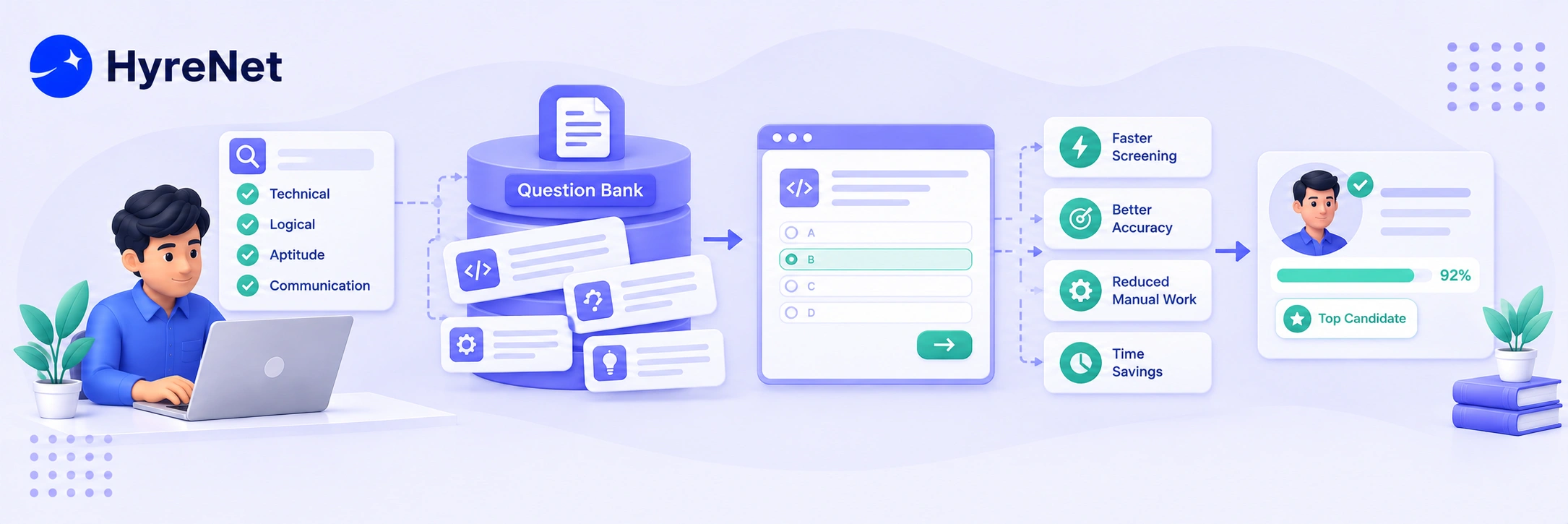
An assessment question bank is a curated, reusable library of test questions organized by role, skill, or difficulty level, ready to pull from whenever a new assessment needs to be built. Instead of writing every question from scratch, recruiters assemble a relevant test in minutes using questions that have already been reviewed and validated.
This blog looks at what makes a strong assessment question bank, how it actually speeds up hiring, and practical steps for building or maintaining one that keeps improving over time.
TL;DR Summary
- Assessment question banks are reusable libraries of pre-written, organized test questions
- They cut the time needed to build a new assessment from hours down to minutes
- Well organized banks improve consistency across roles and reduce recruiter workload
- Updating a question bank once or twice a year keeps it relevant as roles evolve
- Reusing the exact same generic test for every role weakens the signal it provides
- The strongest banks mix question formats and stay tied to real, validated job tasks
What an Assessment Question Bank Actually Is
At its core, assessment question banks are structured libraries, not just a folder of old test questions.
- Organized by role and skill: Questions are tagged so recruiters can quickly find what fits a specific opening
- Reviewed and validated: Strong banks only include questions checked against real job performance, not just written once and forgotten
- Mixed in format: A good bank includes scenario-based, task-based, and multiple choice questions, not just one type
- Continuously updated: Questions get retired or revised as roles, tools, and industry standards change over time
How Assessment Question Banks Improve Recruitment Efficiency
The biggest efficiency gain assessment question banks deliver is obvious but still worth stating clearly. Building a new assessment from an existing bank takes minutes instead of the hour or more it takes to write one from scratch every time.
That time savings compounds fast across a busy hiring season. A recruiting team filling a dozen roles a month saves a meaningful chunk of a working week just by not rewriting the same kinds of questions repeatedly.
Consistency is the second major benefit. When every recruiter pulls from the same validated assessment question banks, candidates for similar roles get evaluated against comparable standards, instead of the quality of a test depending on which recruiter happened to write it that week.
A Simple Example of the Time Savings
Imagine a recruiting team fills 15 roles a month, and writing a fresh assessment from scratch takes roughly 90 minutes each time. That adds up to over 22 hours a month spent just writing test questions.
With a well organized assessment question bank, assembling a role-specific test from existing, validated content might take 10 to 15 minutes instead. Across the same 15 roles, that drops total time spent to around three hours a month.
That difference, close to 19 hours freed up monthly, can go toward interviewing, candidate communication, or sourcing instead of rewriting similar questions over and over.
Types of Content Every Assessment Question Bank Should Include
A well rounded library covers more than one kind of question, matched to different hiring needs.
| Content Type | What It Covers | Why It Belongs in the Bank |
|---|---|---|
| Role-specific technical questions | Skills tied directly to a specific job function | Keeps assessments relevant instead of generic |
| Scenario-based questions | Realistic situations pulled from actual work | Tests judgment and real decision-making |
| General aptitude questions | Broader reasoning and problem-solving items | Useful across multiple roles with shared baseline needs |
| Difficulty-tagged variants | The same skill tested at junior, mid, and senior levels | Lets recruiters match difficulty to seniority quickly |
Do check out HyreNet’s guide to choosing the best online assessment platform for more on what a strong question library should include.
How to Build an Assessment Question Bank Step by Step
These five steps cover the practical process for building a library that actually gets used.
1. Start With Your Highest-Volume Roles
Build out the bank for roles you hire for most often first, since that is where the time savings will show up fastest.
2. Pull Questions From Real Job Tasks
Base new entries on actual work your current team handles, rather than generic, borrowed test content that may not reflect your specific tools or process.
3. Tag Everything by Role, Skill, and Difficulty
Good organization is what makes large assessment question banks actually usable. A pile of a thousand untagged questions is barely better than starting from scratch.
4. Validate New Questions Before Adding Them
Run new questions past a few current high performers before adding them permanently, so you know they actually measure what you intend.
5. Retire and Refresh Content Regularly
Review your assessment question banks once or twice a year, retiring outdated items and adding new ones as roles and tools evolve. Banks that never get refreshed slowly lose relevance.
Platforms like HyreNet support this process directly, since HyreNet’s remote assessment best practices emphasize keeping question content current and closely tied to real job scenarios.
A Step-by-Step Walkthrough: Building a Bank for a Customer Support Role
Seeing these five steps applied to one real role makes the process much easier to picture.
Step 1, pick the role. A recruiting team notices they hire customer support representatives more than any other position, roughly six times a year. This becomes the first entry in their assessment question banks.
Step 2, pull from real work. Instead of writing generic questions about “customer service skills,” the team gathers three anonymized support tickets their team actually handled last quarter, including one tricky refund dispute and one confused first-time user.
Step 3, tag by role and difficulty. Each question gets labeled “Customer Support,” “Entry Level” or “Senior,” and tagged by the specific skill it tests, like written communication or de-escalation.
Step 4, validate with top performers. The team asks their two strongest current support reps to answer the draft questions. Both handle the refund dispute question smoothly, confirming it is fair and well calibrated rather than a trick question.
Step 5, schedule a refresh. The team sets a reminder to revisit this section of their assessment question banks in six months, since support tools and common ticket types tend to shift as the product changes.
Within a single afternoon, this team has a validated, reusable set of questions ready for the next six support hires, instead of writing a new test from scratch each time a role opens.
Common Mistakes When Managing a Question Bank
These mistakes quietly undermine even well built assessment question banks over time.
- Reusing the exact same test for every role: A single generic bank applied everywhere weakens the signal for any specific position
- Never retiring outdated questions: A stale bank quietly keeps testing for skills or tools your team no longer actually uses
- Skipping validation on new additions: Adding untested questions risks filling the bank with items that do not actually predict performance
- Poor tagging and organization: A large, disorganized bank slows recruiters down instead of speeding them up
For more on building a consistent, well documented hiring process around this kind of structured content, do check out HyreNet’s breakdown of common recruitment challenges.
Conclusion
Assessment question banks turn a repeated, time-consuming task into a fast, consistent process recruiters can rely on across every open role.
The efficiency gains come from not rebuilding the wheel every time, while the accuracy gains come from using questions that have actually been validated against real job performance.
Start with your highest-volume roles, build from real tasks rather than generic content, and commit to reviewing the bank regularly. That ongoing maintenance is what keeps a question bank genuinely useful instead of slowly becoming outdated.
Frequently Asked Questions
1. How often should an assessment question bank be updated? Once or twice a year is a reasonable baseline for most assessment question banks, though a major shift in tools or role requirements is a good trigger to review it sooner.
2. Can a small recruiting team benefit from a question bank? Yes. Even modest assessment question banks covering your two or three most common roles save meaningful time compared to writing every assessment from scratch.
3. Should every role use the exact same set of questions? No. Reusing identical content across very different roles weakens the signal, so assessment question banks should be tagged and matched to specific role requirements.
4. What is the fastest way to start building a question bank? Begin with your highest-volume role, pull questions from real tasks your current team handles, and expand to other roles once that first set is validated.
5. Do question banks reduce hiring bias? They can help, since every candidate for a given role is evaluated against the same validated, consistent set of questions rather than one written on the fly.