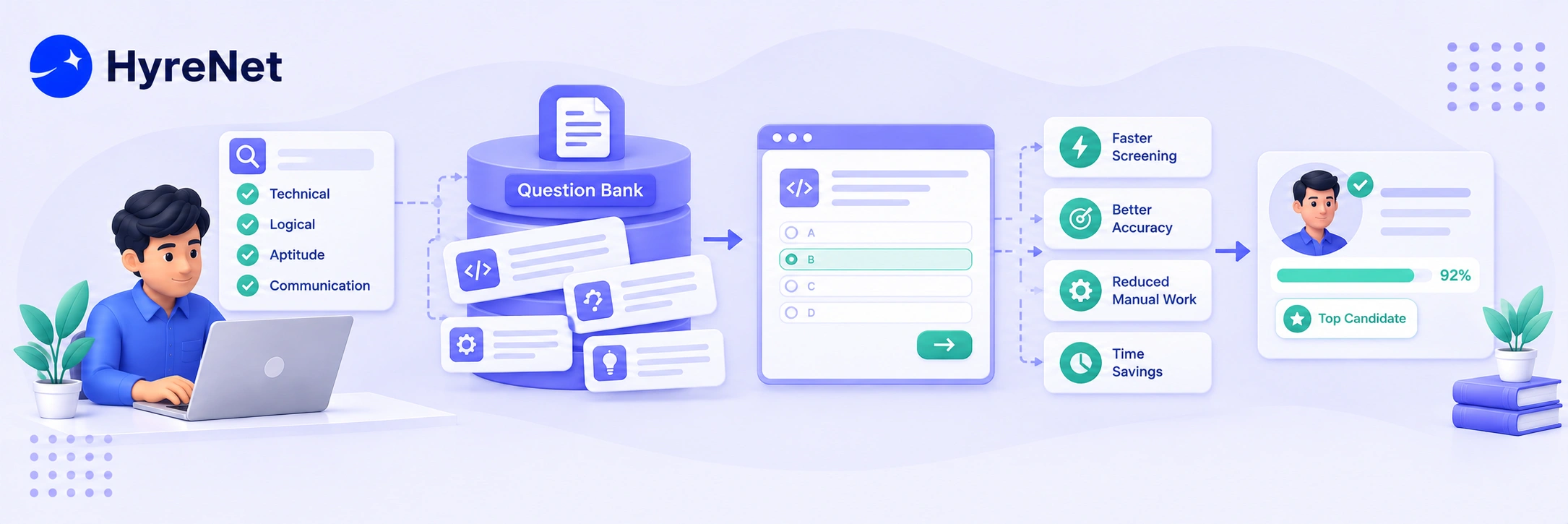



A candidate aces a trivia-style question about a programming language’s release history, then completely freezes when asked to debug a simple piece of real code. That mismatch happens constantly, and it usually comes down to one thing: the assessment was testing memory instead of ability. Writing genuinely job-relevant questions is how you avoid that gap.
Job-relevant questions are assessment items built directly from the actual tasks, decisions, and challenges someone will face in the role, rather than generic trivia or textbook theory. They exist to predict real performance, not just measure who studied the right material beforehand.
This blog walks through what makes a question genuinely job-relevant, the research behind why this matters so much, and a practical process for writing questions that actually predict who will succeed on the job.
TL;DR Summary
- Job-relevant questions are built from real job tasks, not generic trivia or textbook theory
- Research shows behavior-based, job-related questions predict performance far better than casual, unstructured ones
- Real-world scenario tasks consistently outperform hypothetical or abstract questions
- Mixing question formats gives candidates several ways to demonstrate genuine ability
- Validating questions against current high performers confirms they measure what actually matters
- Reviewing and updating questions regularly keeps them relevant as the role itself evolves
What Makes a Question Genuinely Job-Relevant
Not every technically correct question belongs in a hiring assessment. The difference between filler and genuinely job-relevant questions comes down to what the question is actually measuring.
- Tied to real tasks: A strong question mirrors something the person will actually do in the role, not just something related to the topic
- Focused on ability, not memory: Job-relevant questions test whether someone can do the work, not whether they memorized a fact
- Grounded in your own environment: The best questions often come from real situations your current team has actually faced
- Free of unnecessary jargon or trick elements: A question should test the skill itself, not how well someone decodes a confusing prompt
Why Job-Relevant Questions Predict Performance So Well
The research on why job-relevant questions work is fairly clear. Behavior-based, job-related interview questions have shown notably stronger validity in predicting job performance compared to unstructured, casual interview questions in large scale studies.
Real-world, task-based scenarios follow the same pattern. Asking a candidate to actually solve a problem, write an email, or handle a customer scenario consistently outperforms asking them to describe, in the abstract, how they might handle something similar.
This makes intuitive sense once you think about it. Watching someone do the actual work tells you far more than watching them talk about doing the work.
A Simple Example of the Difference
Imagine hiring a customer support representative. A generic question might ask the candidate to define what “active listening” means in a support context.
A job-relevant version instead gives the candidate an actual, anonymized customer complaint and asks them to write a real response. The first question tests vocabulary. The second tests whether the candidate can actually do the job on day one.
This same shift applies across almost every role. Trading a definition-based question for a task pulled from real work usually reveals far more about genuine ability.
Types of Job-Relevant Questions to Use
Different formats work best for different situations, and most strong assessments mix more than one.
| Question Type | What It Looks Like | Best Used For |
|---|---|---|
| Scenario-based | A realistic situation pulled from actual work, asking how the candidate would respond | Roles involving judgment, customer interaction, or problem solving |
| Task-based | A real, hands-on task, like writing code, drafting a document, or building a spreadsheet | Roles with clearly demonstrable technical output |
| Behavioral | Asking about a specific past experience, often using a structure like situation, task, action, result | Assessing how someone has actually handled similar challenges before |
| Multiple choice | A focused question with defined correct and incorrect answers | Quickly checking foundational knowledge at scale |
Do check out HyreNet’s guide to choosing the best online assessment platform for more on matching question formats to the right kind of role.
How to Write Job-Relevant Questions Step by Step
These six steps cover the practical process for building questions grounded in real work.
1. Start With the Actual Job, Not the Job Title
List the specific tasks, decisions, and challenges someone in this role handles weekly. This becomes your raw material for every question you write.
2. Pull From Real Situations Your Team Has Faced
Base scenario questions on real, anonymized situations, not invented ones. Real incidents naturally carry the texture and complexity a made-up scenario often misses.
3. Mix Your Question Formats
Combine a few scenario or task-based questions with a smaller number of multiple choice items. This keeps the assessment efficient while still testing real ability.
4. Remove Unnecessary Jargon and Trick Elements
A confusing question tests reading comprehension under stress, not the actual skill you care about. Keep the wording clear and direct so your job-relevant questions measure ability, not test-taking savvy.
5. Validate With Current High Performers
Run your draft questions past a few people already succeeding in the role. If your strongest performers struggle with a question, it may be poorly worded rather than genuinely hard.
6. Review and Update Regularly
Roles change as tools, processes, and priorities shift. A question that was job-relevant two years ago may already be outdated today.
Platforms like HyreNet make this process easier, since HyreNet’s remote assessment best practices emphasize building questions around real work scenarios instead of generic, one-size-fits-all test banks.
Common Mistakes When Writing Assessment Questions
These mistakes quietly undermine even well intentioned attempts at writing job-relevant questions.
- Testing trivia instead of ability: Obscure facts rarely predict whether someone can actually perform the job well
- Copying generic question banks: A question written for a completely different company rarely reflects your specific role or tools
- Relying only on one question format: Using nothing but multiple choice misses candidates who demonstrate skill better through actual work samples
- Skipping validation entirely: Assuming a question is fair and relevant without ever testing it against real performers is a risky shortcut
- Never revisiting old questions: An outdated question can quietly keep filtering for skills the role no longer actually needs
For more on building a consistent, well documented assessment process, do check out HyreNet’s breakdown of common recruitment challenges.
Conclusion
Writing genuinely job-relevant questions is less about clever test design and more about staying grounded in what the role actually demands. The research is consistent: questions built from real tasks and real behavior predict performance far better than generic or abstract ones.
Start by mapping out the actual work, pull scenarios from real situations, and validate your questions against people already doing the job well. That process is what turns an assessment from a formality into a genuine predictor of who will actually succeed.
FAQs
1. How many job-relevant questions should a typical assessment include?
Around three to five well designed scenario or task-based job-relevant questions is often enough, paired with a smaller set of multiple choice items to check foundational knowledge.
2. Are behavioral questions as effective as task-based ones?
Both work well, though task-based questions tend to reveal actual ability more directly, while behavioral questions reveal how someone has handled similar situations before.
3. Can generic, purchased question banks ever work well?
They can serve as a starting point, but they rarely reflect your specific tools, workflows, or team context as closely as questions built from your own real situations.
4. How do I know if a question is actually job-relevant?
Ask whether the skill being tested is something the person will genuinely use in the role. Job-relevant questions always trace back clearly to a real task, and if the connection feels indirect, the question likely needs revising.
5. How often should assessment questions be updated?
Reviewing them every year or two is a reasonable baseline, though a major change in tools, responsibilities, or team structure is a good trigger to revisit them sooner.