


A company may receive hundreds of applications and still struggle to fill the right position. High application numbers can look impressive but they reveal little about hiring speed, candidate quality or recruitment costs.
Recruitment KPIs give hiring teams a clearer picture. These measurable indicators show how effectively candidates move from sourcing and screening to interviews and eventual hiring.
The right KPIs can reveal slow recruitment stages and expensive sourcing channels. They can also show where qualified candidates leave the process. Hiring teams can then improve specific problems instead of relying on assumptions.
This guide explains the most important recruitment KPIs and how to use them to measure hiring performance.
TL;DR Summary
- Recruitment KPIs help hiring teams measure speed, cost, candidate movement and hiring outcomes.
- Key KPIs include time to hire, cost per hire, source of hire and offer acceptance rate.
- Candidate conversion and drop-off rates show where applicants move forward or leave the funnel.
- Quality of hire connects recruitment performance with post-hire results.
- Track only the KPIs that support real hiring decisions and process improvements.
What Are Recruitment KPIs?

Recruitment key performance indicators or recruitment KPIs are measurable values used to evaluate the effectiveness of a hiring process.
They can measure recruitment speed, cost, candidate progression and hiring outcomes. Companies can track them across individual positions or their complete recruitment process.
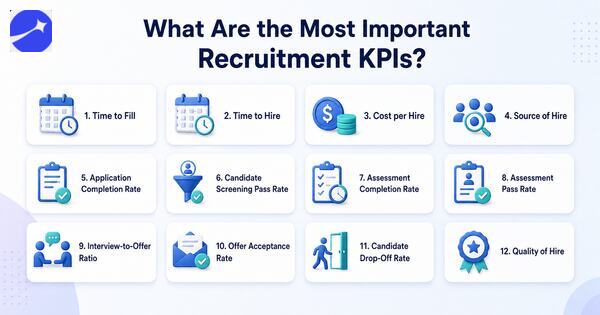
Common recruitment KPIs include:
- Time to hire
- Time to fill
- Cost per hire
- Source of hire
- Candidate conversion rate
- Assessment completion rate
- Interview-to-offer ratio
- Offer acceptance rate
- Candidate drop-off rate
- Quality of hire
Each KPI answers a different hiring question. The right combination provides a broader picture of recruitment performance.
Why Are Recruitment KPIs Important?
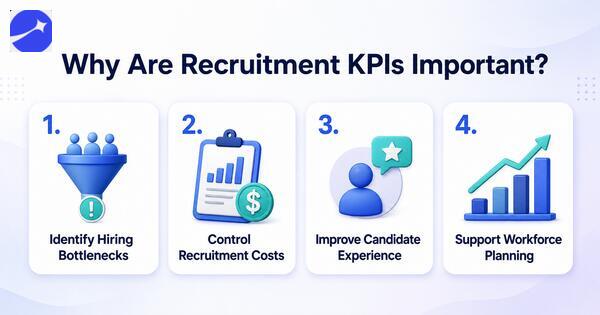
- Identify Hiring Bottlenecks
Recruiters can track how candidates move between different hiring stages.
A long delay between assessment and interview may show a scheduling problem. High candidate drop-off during assessments could indicate an unnecessarily lengthy test.
- Control Recruitment Costs
Job advertising, recruitment agencies and hiring technology all cost money. Managing these expenses can become a major recruitment challenge for growing teams.
Recruitment KPIs help companies compare spending with actual hiring outcomes. Teams can redirect resources when a channel repeatedly produces poor results.
- Improve Candidate Experience
Candidates notice slow communication and unnecessarily complicated hiring processes.
Metrics such as candidate drop-off and application completion can reveal where applicants encounter friction.
- Support Workforce Planning
Historical recruitment data can help teams estimate how long certain positions usually take to fill.
Hiring managers can use this information when planning future recruitment needs.
What Are the Most Important Recruitment KPIs?
1. Time to Fill
Time to fill measures the number of days between opening a position and successfully filling it.
Time to fill = Date offer is accepted − Date position is opened
This KPI provides insight into the overall efficiency of the recruitment process.
A consistently high time to fill may indicate sourcing difficulties or slow internal approvals. Specialized roles may naturally require longer hiring periods so teams should compare similar positions.
2. Time to Hire
Time to hire focuses specifically on the candidate journey.
It measures the period between a candidate entering the recruitment process and accepting an employment offer.
Time to hire = Offer acceptance date − Candidate entry date
A long time to hire can increase the risk of losing strong candidates to other employers.
Recruiters can break this KPI down by stage to identify where candidates spend the most time.
3. Cost per Hire
Cost per hire measures the average recruitment spending required to make one successful hire.
A basic calculation is:
Cost per hire = Total recruitment costs ÷ Total number of hires
Costs may include job advertisements, recruitment agency fees, assessment platforms and other hiring expenses.
Tracking this KPI over time can help companies identify expensive recruitment processes and evaluate whether spending produces suitable hires.
4. Source of Hire
Source of hire shows which recruitment channels produce successful candidates.
Common sources include employee referrals, job boards, career pages, recruitment agencies and professional networks.
Application volume alone should not determine source performance.
One platform may generate 1,000 applications but only two hires. Another may produce 100 applications and 10 hires. Comparing eventual outcomes gives recruiters a more meaningful view of source effectiveness.
5. Application Completion Rate
Application completion rate measures how many candidates finish an application after starting it.
Application completion rate = Completed applications ÷ Started applications × 100
A low completion rate may indicate that the application is too lengthy or difficult to use.
Recruiters can review unnecessary questions and technical issues when candidates repeatedly abandon the process at this stage.
6. Candidate Screening Pass Rate
Candidate screening pass rate shows the percentage of applicants who progress beyond initial screening.
Screening pass rate = Candidates passing screening ÷ Candidates screened × 100
A very low pass rate may suggest that sourcing channels attract poorly matched candidates.
An unusually high rate may indicate that screening criteria are too broad to create a useful shortlist.
7. Assessment Completion Rate
Many organizations use technical or job-specific assessments during candidate screening.
Assessment completion rate shows how many invited candidates finish the test.
Assessment completion rate = Completed assessments ÷ Assessment invitations × 100
Low completion deserves investigation. The assessment may be too long or instructions may be unclear. Delayed invitations and technical problems can also contribute to candidate drop-off.
8. Assessment Pass Rate
Assessment pass rate measures how many candidates meet the predefined assessment criteria.
A very low pass rate may indicate a mismatch between sourcing criteria and actual job requirements. This can be especially important during a remote hiring assessment, where the test must closely reflect the role.
Recruiters should also review whether the assessment accurately reflects the job before changing candidate screening requirements.
9. Interview-to-Offer Ratio
Interview-to-offer ratio shows how efficiently screening produces candidates suitable for an employment offer.
Suppose recruiters interview 30 candidates and make five offers. The ratio is six interviews for every offer.
A consistently high ratio may indicate weak initial screening or unclear interview criteria.
Teams can examine earlier recruitment stages before simply adding more interviews.
10. Offer Acceptance Rate
Offer acceptance rate measures the percentage of employment offers candidates accept.
Offer acceptance rate = Accepted offers ÷ Total offers made × 100
Frequent offer rejection can indicate several problems.
Compensation may not match candidate expectations. The recruitment process may also take too long or fail to communicate important employment conditions early enough.
Tracking rejection reasons provides additional context.
11. Candidate Drop-Off Rate
Candidate drop-off rate shows where applicants voluntarily leave the recruitment process.
Drop-off can happen during applications, assessments or interview stages.
Candidate drop-off rate = Candidates leaving a stage ÷ Candidates entering that stage × 100
Recruiters should measure drop-off by stage rather than only across the entire recruitment funnel.
A sudden increase at one point can reveal a specific problem that needs attention.
12. Quality of Hire
Quality of hire attempts to measure how successfully new employees perform after recruitment.
Companies may combine several indicators such as early performance results, hiring manager feedback and retention.
There is no single quality-of-hire formula that works for every organization. Companies should define the metric based on measurable outcomes relevant to their positions.
Recruitment teams can then compare these outcomes with sourcing and screening data to understand which processes produce successful hires.
Recruitment KPIs at a Glance
| Recruitment KPI | What it measures | Why it matters |
| Time to fill | Time required to fill a vacancy | Shows overall hiring efficiency |
| Time to hire | Candidate hiring journey | Identifies process delays |
| Cost per hire | Recruitment spending per hire | Measures cost efficiency |
| Source of hire | Channels producing hires | Improves sourcing decisions |
| Application completion | Completed applications | Reveals application friction |
| Screening pass rate | Candidates passing screening | Evaluates screening effectiveness |
| Assessment completion | Candidates completing tests | Identifies assessment drop-off |
| Interview-to-offer ratio | Interviews needed per offer | Evaluates shortlist quality |
| Offer acceptance | Accepted employment offers | Shows offer effectiveness |
| Candidate drop-off | Candidates leaving the process | Identifies funnel friction |
| Quality of hire | Post-hire outcomes | Connects recruitment with hiring results |
How Do Recruitment KPIs Work Across the Hiring Funnel?
Recruitment KPIs become particularly valuable when mapped to different stages of the recruitment funnel.
At the sourcing stage, recruiters can measure source of hire and application volume. Application completion shows whether candidates successfully enter the process.
Screening pass rates reveal how well the initial candidate pool matches job requirements. Assessment completion and pass rates provide information about candidate engagement and skills.
Interview-to-offer ratios show whether earlier screening stages are producing suitable candidates. Offer acceptance then measures the final conversion before hiring.
Connecting these KPIs creates a complete picture of candidate movement rather than a collection of isolated numbers.
Make recruitment KPI tracking more accurate and actionable with HyreNet’s data-backed hiring platform. Measure hiring efficiency, candidate quality, funnel performance, assessment outcomes, and recruiter productivity through smarter workflows that help hiring teams make faster and better talent decisions.
How to Choose the Right Recruitment KPIs
- Define the Hiring Problem
Identify the question before selecting a KPI.
A team struggling with recruitment speed should examine time to hire and stage duration. A company receiving many unsuitable applications should focus on source quality and screening pass rates.
- Set Consistent Definitions
Teams should agree on when each metric starts and ends.
Time to hire becomes difficult to compare when different recruiters use different starting points.
Consistent definitions create more reliable recruitment reporting.
- Compare Similar Roles
Hiring conditions differ significantly between positions.
A specialized technical role should not automatically be compared with an entry-level position. Benchmarking similar roles provides more meaningful information.
- Track Trends Over Time
One recruitment cycle can produce unusual results.
Monitor KPIs over several hiring periods to identify patterns. A consistent decline in assessment completion deserves more attention than a temporary change during one recruitment campaign.
- Connect Metrics With Actions
Every KPI should help answer a question or guide an improvement.
Collecting data without acting on it adds reporting work without improving hiring.
Recruitment KPIs vs. Recruitment Metrics
Recruitment metrics and recruitment KPIs are closely related but they are not always the same.
A recruitment metric measures an aspect of hiring. Application volume is one example.
A recruitment KPI is a metric connected to an important recruitment objective.
For example, application volume becomes particularly meaningful when the company’s goal is expanding its qualified candidate pool.
Teams may collect many recruitment metrics but should prioritize a smaller group of KPIs that reflect their main hiring goals.
Common Recruitment KPI Mistakes to Avoid
- Tracking every available metric: Focus on KPIs linked to actual recruitment goals.
- Looking only at averages: Averages can hide major differences between roles or departments.
- Focusing on speed alone: Faster recruitment is not automatically better recruitment.
- Ignoring candidate drop-off: Lost candidates can reveal important problems within the hiring experience.
- Comparing unrelated roles: Recruitment expectations should reflect job complexity and talent availability.
- Treating KPIs as final answers: Metrics identify patterns. Recruiters still need to investigate why those patterns exist.
Conclusion
Recruitment KPIs show what is working and where hiring needs improvement. Time to hire measures speed while cost per hire tracks efficiency. Candidate conversion and drop-off reveal movement through the funnel, and quality of hire connects recruitment with post-hire results.
The goal is simple: track the right KPIs, compare trends and use the findings to improve hiring decisions.
FAQs
What are recruitment KPIs?
Recruitment KPIs are measurable indicators used to evaluate the efficiency and effectiveness of a company’s hiring process.
What are the most important recruitment KPIs?
Important recruitment KPIs include time to hire, time to fill, cost per hire, source of hire, candidate conversion, offer acceptance and quality of hire.
How do you measure recruitment performance?
Recruiters can measure performance by tracking KPIs across sourcing, screening, assessments, interviews, offers and eventual hiring outcomes.
What is the difference between recruitment KPIs and metrics?
Recruitment metrics measure hiring activities. Recruitment KPIs are priority metrics directly connected to important recruitment objectives.
How often should recruitment KPIs be reviewed?
Hiring teams should monitor key metrics regularly and review longer-term trends across comparable hiring periods. The appropriate frequency depends on recruitment volume and organizational goals.