


Recruiters spend an average of 23 hours screening resumes for a single hire, and most of that time goes into applications that were never a real match to begin with. That’s the gap AI recruitment platforms are built to close. They read resumes the way a recruiter would, but without the fatigue, the backlog, or the missed candidate whose skills just weren’t phrased in the “right” keywords. From resume parsing to bias-checked job descriptions to interview scheduling that runs itself, these platforms are quietly rewiring how companies find and hire talent.
If you’re wondering how they actually work, what features matter, and where they fit into your hiring stack, this guide breaks it all down. Keep reading to see exactly how AI is changing recruitment from the inside out.
TL;DR Summary
- AI recruitment platforms use ML and NLP to screen resumes and rank candidates against job requirements in seconds.
- Core features: resume parsing, semantic candidate matching, automated scheduling, bias detection, and predictive analytics.
- Workflow: collect candidate data, parse resumes, match against job descriptions, score applicants, and track hiring performance.
- Top platforms: Workable, Eightfold AI, HireVue, Greenhouse, and HyreNet.
- Future direction: agentic AI, skills-based matching, and stronger bias/compliance auditing.
What Is an AI Recruitment Platform?
An AI recruitment platform is software that uses machine learning and natural language processing to handle the heavy lifting of hiring, from parsing resumes to ranking candidates against a job description in seconds. Instead of a recruiter manually scanning hundreds of applications, the platform reads each resume, matches skills and experience to role requirements, and surfaces a shortlist based on fit, not just keywords.
Most AI recruitment platforms can also schedule interviews, send personalized candidate messages, and check job descriptions for biased language to attract a wider talent pool. Their main value is simple: faster hiring with more consistent screening. A recruiter may feel tired after reviewing hundreds of resumes, but an algorithm can apply the same criteria to resume 2 and resume 2,000. These tools are now built into applicant tracking systems like Greenhouse and Lever, or used as standalone platforms like HireVue and Eightfold.
87% of companies now use AI somewhere in their hiring process, yet only 26% of applicants say they trust AI to evaluate them fairly.
Key Features of an AI Recruitment Platform
- AI Resume Screening
- Reviews resumes automatically and shortlists candidates based on skills, experience, education, certifications, and job requirements.
- Saves recruiters from spending hours on repetitive resume checks, especially during bulk hiring.
- Resume Parsing
- Reads resumes and pulls out important details like name, contact information, skills, job titles, work history, and qualifications.
- Turns scattered resume information into clean, searchable candidate profiles.
- Candidate Matching
- Matches candidates with open roles based on skills, experience, role fit, and job description requirements.
- Helps recruiters find strong candidates even when they have not used the exact same keywords in their resumes.
- Job Description Optimization
- Checks job descriptions for unclear wording, missing skills, biased language, and important role-specific keywords.
- Helps companies write better job posts that attract more relevant and diverse candidates.
- Automated Candidate Sourcing
- Finds suitable candidates from job boards, career pages, internal databases, and existing talent pools.
- Makes it easier to discover both active job seekers and passive candidates.
- Interview Scheduling Automation
- Connects with calendars and schedules interviews based on recruiter and candidate availability.
- Reduces back-and-forth emails and keeps the hiring process moving faster.
- Recruitment Chatbots
- Answers common candidate questions, collects basic details, shares hiring updates, and guides applicants through the process.
- Keeps candidates engaged even outside regular working hours.
- Bias Detection
- Spots biased words or screening patterns that may limit fair hiring.
- Supports more inclusive job descriptions and more balanced candidate evaluation.
- Predictive Hiring Analytics
- Uses hiring data to estimate candidate fit, hiring success, drop-off risk, and time-to-fill.
- Gives HR teams better insights before making recruitment decisions.
- Talent Pipeline Management
- Stores candidate profiles for current and future hiring needs.
- Helps recruiters reconnect with good candidates instead of starting every search from scratch.
- Automated Candidate Communication
- Sends personalized emails, application updates, interview reminders, and follow-up messages.
- Improves response time and gives candidates a smoother hiring experience.
- ATS and HRMS Integration
- Connects with applicant tracking systems, HRMS tools, job boards, calendars, and assessment platforms.
- Keeps hiring data organized across the full recruitment workflow.
- Recruitment Analytics Dashboard
- Tracks hiring metrics like time-to-hire, cost-per-hire, source quality, offer acceptance rate, and recruiter performance.
- Helps teams understand what is working and where the hiring process needs improvement.
How Does an AI Recruitment Platform Work?
1. It Collects Candidate Data from Multiple Sources
An AI recruitment platform first gathers candidate information from different hiring channels. These may include job boards, career pages, LinkedIn profiles, employee referrals, internal talent pools, and applicant tracking systems.
Example: A company hiring a software developer may receive resumes from LinkedIn, Naukri, Indeed, its website, and referral forms. The AI recruitment platform brings all these applications into one system so recruiters can manage them from a single dashboard.
2. It Reads and Organizes Resumes
The platform uses AI resume parsing to read resumes and pull out important details such as skills, education, work experience, certifications, job titles, location, and contact information.
Example: A resume may say, “Worked on Python, Django, REST APIs, PostgreSQL, and AWS.” The system extracts these as technical skills and adds them to the candidate profile. This makes the resume easier to search, filter, and compare.
3. It Understands the Job Description
The platform analyzes the job description to understand what the company needs. It checks the required skills, experience level, job location, role responsibilities, qualifications, and preferred background.
Example: A job post for a data analyst may ask for SQL, Excel, Power BI, Python, dashboard creation, and two years of experience. The AI recruitment platform reads these requirements and uses them as matching criteria.
4. It Matches Candidates with the Right Role
AI candidate matching compares each resume with the job description. It does not only look for exact keywords. It also understands related skills and similar experience using natural language processing and semantic search.
Example: A candidate may write “business intelligence reporting” instead of “Power BI dashboards.” A basic keyword search may miss this profile, but an AI recruitment platform can understand that both are related to data reporting.
5. It Scores and Ranks Applicants
The platform gives candidates a match score based on skills, experience, location, role fit, and job requirements. Recruiters can then focus on the most relevant profiles first.
Example: A recruiter receives 800 applications for a sales executive role. The AI recruitment software ranks 50 strong-fit candidates at the top based on sales experience, CRM knowledge, industry background, and location match.
6. It Automates Screening Questions
Many AI recruitment platforms use chatbots or screening forms to ask candidates basic questions before a recruiter steps in. These questions may cover notice period, salary expectations, location preference, work authorization, or shift availability.
Example: A company hiring for a customer support role may ask candidates if they are comfortable with night shifts, voice support, and weekend work. The platform filters candidates based on their responses.
7. It Schedules Interviews Automatically
AI recruitment software can connect with recruiter and candidate calendars. It suggests available slots, sends meeting invites, and shares reminders.
Example: A recruiter no longer needs five emails to confirm one interview. The candidate can choose a time slot from available options, and the platform automatically books the interview.
AI recruitment tools can cut time-to-hire by roughly a third and lower cost-per-hire by 20 to 40%. That’s the efficiency case driving nearly universal adoption among Fortune 500 firms.
8. It Sends Personalized Candidate Updates
The platform can send application updates, interview reminders, assessment links, and follow-up messages. This keeps candidates informed throughout the hiring process.
Example: A candidate who clears the first round may receive an automated message saying, “Your technical interview is scheduled for Thursday at 11 AM.” Another candidate may receive a polite rejection email with future application options.
9. It Supports Skill Assessments
Some AI recruitment platforms include coding tests, aptitude tests, video interviews, language assessments, or job-specific assignments. This helps recruiters evaluate candidates beyond resume claims.
Example: A company hiring a React developer may send a short coding test. The platform checks code quality, logic, completion time, and test performance before moving the candidate to the interview stage.
10. It Checks Job Descriptions for Bias
AI recruitment platforms can review job descriptions for biased or limiting language. This helps companies write clearer and more inclusive job posts.
Example: A job post may use phrases like “young and energetic male candidate.” The platform can flag this wording and suggest a more neutral version like “motivated candidate with strong field sales skills.”
11. It Tracks Hiring Performance
The platform tracks key recruitment metrics such as time-to-hire, cost-per-hire, offer acceptance rate, candidate drop-off, source quality, and recruiter performance.
Example: A company may find that LinkedIn brings fewer candidates but better-quality profiles, while one job board brings many applications with poor fit. This helps HR teams spend their hiring budget more wisely.
12. It Helps Build a Future Talent Pipeline
AI recruitment platforms store candidate profiles for future openings. Recruiters can search past applicants instead of starting every hiring process from zero.
Example: A candidate rejected for a senior marketing role today may be a strong fit for a mid-level marketing role after six months. The platform can surface that profile when a matching job opens.
Important Technologies Behind AI Recruitment Platforms
1. Artificial Intelligence
- Powers resume screening, candidate ranking, interview automation, and recruitment analytics.
- Helps recruiters identify relevant candidates faster by analyzing large volumes of hiring data.
2. Machine Learning
- Learns from past hiring patterns, shortlisted profiles, rejected applications, and successful hires.
- Improves candidate matching, profile recommendations, and hiring accuracy over time.
3. Semantic Search
- Understands meaning instead of depending only on exact keywords.
- Finds candidates with related skills, similar responsibilities, and relevant experience, even when resumes use different wording.
4. Generative AI
- Creates job descriptions, outreach emails, interview questions, candidate summaries, and follow-up messages.
- Helps recruiters save time while keeping candidate communication more personalized.
5. Conversational AI
- Powers recruitment chatbots that answer candidate questions and collect basic details.
- Supports screening, interview scheduling, application updates, and candidate engagement.
Top 5 AI Recruitment Platforms
1. HyreNet
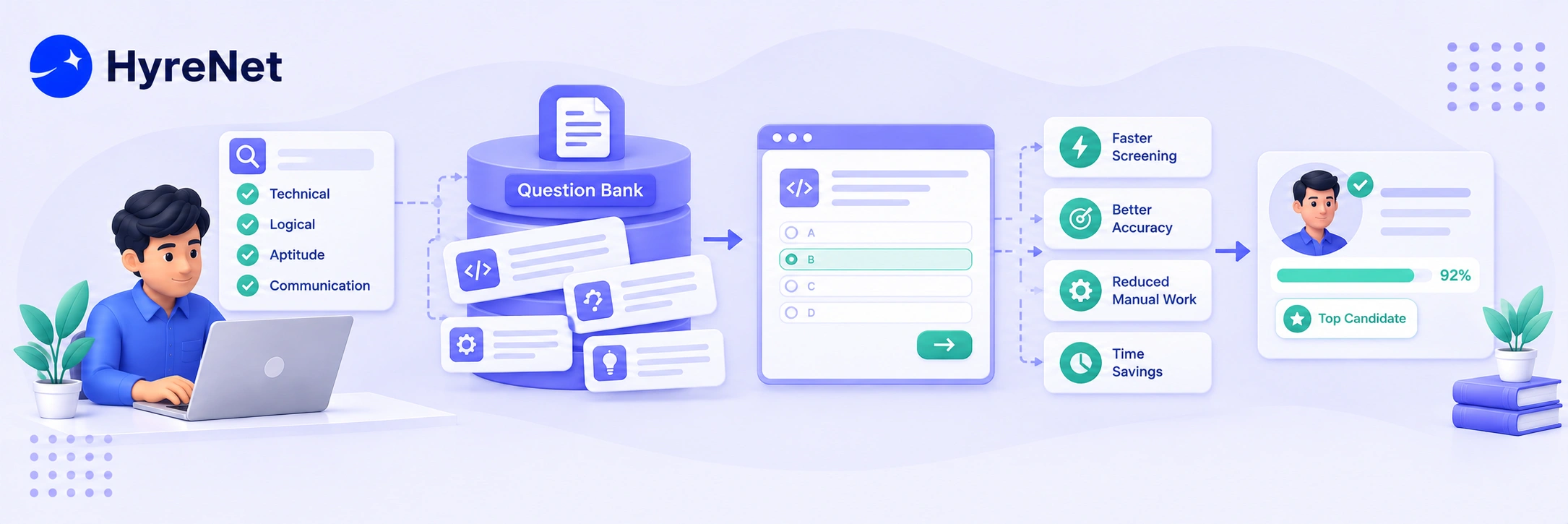
HyreNet is an AI-driven skill assessment and hiring platform designed for technical hiring, campus recruitment, and remote candidate evaluation. It supports coding tests, AI-proctored exams, aptitude assessments, automated reminders, analytics reports, and structured candidate evaluation. For companies hiring developers or entry-level technical talent, HyreNet helps test real skills before moving candidates to interviews.
2. Workable
Workable is an AI recruitment platform and ATS built for companies that want candidate sourcing, resume screening, interview scheduling, workflow automation, and hiring analytics in one place. Its AI agent helps source, screen, and engage candidates inside the Workable ATS, which makes it extremely useful for teams that want to reduce manual hiring work without managing too many separate recruitment tools.
3. Eightfold AI
Eightfold AI is a strong choice for enterprises that need AI-powered talent intelligence, workforce planning, internal mobility, and skills-based hiring. Its platform uses deep learning and agentic AI to understand candidate potential, adjacent skills, career paths, and talent gaps. This makes it pretty useful for companies that want recruitment software beyond resume screening and simple applicant tracking.
4. HireVue
HireVue focuses on AI-powered interviewing, skill validation, candidate engagement, and interview scheduling. It is useful for companies that conduct high-volume hiring, campus recruitment, customer-facing role hiring, or structured video interviews. The platform helps hiring teams screen candidates faster while using assessments and interview workflows to evaluate role-specific competencies.
5. Greenhouse
Greenhouse is a popular hiring platform with built-in AI recruiting tools for structured hiring, candidate filtering, scorecard generation, resume anonymization, reporting, and hiring workflow automation. It works well for growing teams and enterprises that want AI features inside an ATS while keeping recruiters involved in final decision-making.
Future of AI Recruitment Platforms
The future of AI recruitment platforms will go beyond resume screening and keyword matching. The next shift will be toward skills intelligence, where AI understands what a candidate can actually do through projects, certifications, assessments, work history, and career growth patterns.
A major advancement will be agentic AI in recruitment. These tools will work like smart hiring assistants that can source candidates, write outreach messages, answer candidate questions, schedule interviews, update hiring managers, and suggest next steps. Recruiters will still make the final decision, but AI will take care of more repetitive hiring tasks.
Future platforms will also become more transparent and compliance-focused. Companies will need AI hiring software that can explain why a candidate was shortlisted, which skills matched the role, and whether any screening rule created bias. This will make explainable AI, audit trails, bias checks, consent management, and data privacy much more important.
Another big shift will be AI-powered internal mobility. Instead of always hiring from outside, companies will use AI to find employees who can move into new roles, learn adjacent skills, or fill urgent talent gaps.
Conclusion
An AI recruitment platform helps companies make hiring faster, smarter, and more consistent. It reduces manual resume screening, improves candidate matching, automates interview scheduling, supports fairer job descriptions, and gives recruiters useful hiring insights. The real value is not in replacing recruiters, but in helping them focus on better conversations, stronger evaluation, and faster hiring decisions. As recruitment becomes more skills-based and data-driven, AI hiring software will become an important part of every modern talent acquisition strategy.
FAQs
What is an AI recruitment platform?
An AI recruitment platform is hiring software that uses artificial intelligence to screen resumes, match candidates, automate tasks, and improve recruitment decisions.
How does an AI recruitment platform work?
It collects candidate data, parses resumes, understands job requirements, ranks applicants, schedules interviews, and tracks hiring performance.
What are the benefits of AI in recruitment?
AI in recruitment saves time, improves candidate matching, reduces repetitive work, supports fairer screening, and improves the candidate experience.
Is an AI recruitment platform better than an ATS?
An ATS stores and manages applications, while an AI recruitment platform adds resume screening, candidate matching, automation, and recruitment analytics.
Can AI recruitment software reduce hiring bias?
AI recruitment software can support bias detection in job descriptions and screening rules, but human review is still important for fair hiring.